


Mountainhead writer-director Jesse Armstrong won’t admit to hating the rich and powerful. But it wouldn’t be hard to think why he would.
Between his work in political comedies like the brilliant British sitcom The Thick of It and HBO’s Veep, to his capitalist masterpiece in Succession, he portrays those in power and those who work in its axis as less-than-noble and very much ill-equipped to hold said power. And yet, it continues to captivate him, and us, almost to the point of obsession. In a roundtable interview last May 21, he talks about his new film and what draws him to these kinds of people.
“Sometimes a writer doesn’t always know why they choose the subjects they do, or why they’re drawn to certain areas,” says Armstrong. “Maybe I’m more angry than I know, but I think I’m writing about power. In Succession, it was the power of Logan Roy’s family and [how] that company took over media. And in this story, it’s not that they’re rich guys, although it’s important that they are, and rich guys [who] are constantly ranking themselves and thinking about their wealth, but it’s their power that is the center of the story… That’s what really interests me.”
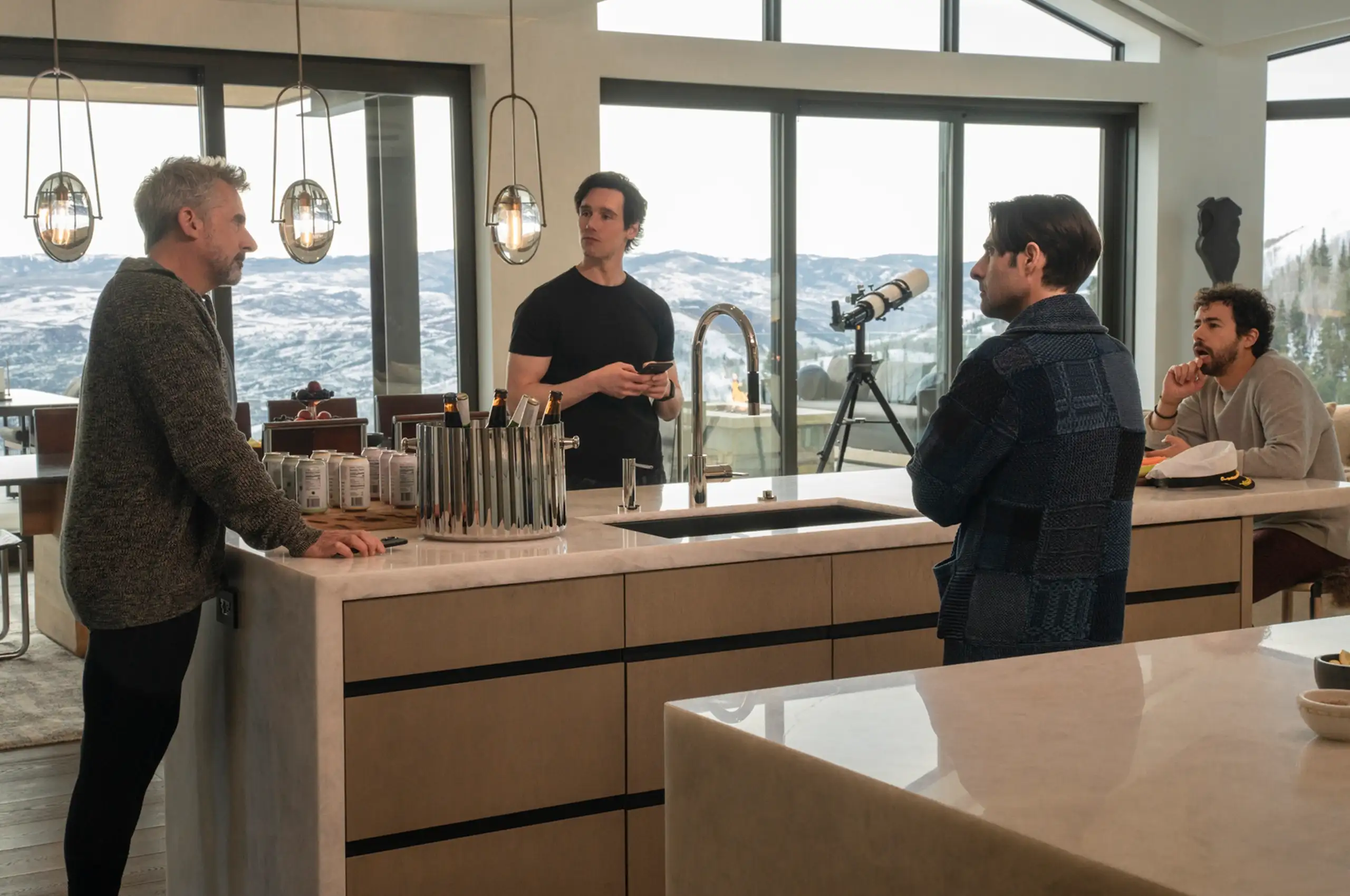
Mountainhead stars Steve Carell, Jason Schwartzman, Ramy Youssef, and Cory Michael Smith, as four tech billionaires at their own ultra private weekend retreat. Typical alphamale dick-measuiring ensues until an international crisis shifts the balance of power between the four billionaires.
For his post-Succession follow-up, it seems like a pretty natural step forward, not just for Armstrong but for the state of power as it stands today. With a terrifying new world order run by tech billionaires disrupting every facet of society, from the government to artificial intelligence, what’s happening in our world today is the perfect target for Armstrong’s critical eye.
“This was the bubble of time that I was trying to write about… that interconnectedness between political power and tech power. At the moment, I did feel that the film is still writing about this world [that’s] happening in front of our face,” he says. “After I’d started reading a little bit about this world, and especially listening to podcasts of the some of these tech world figures talking to each other, their tone of voice, which goes on a spectrum between confidence — which is maybe a good quality, and one you need in business and life — but the far end of confidence is arrogance, right? Sometimes you could feel the level of confidence tipping into a certain haughty arrogance. And that is a very rich scene, very rich vein for a comedy writer to hit. So I think it was that tone of voice which was what I was attracted to.”
A New World ORder

When asked to describe the power dynamics at play in Mountainhead, Armstrong balances it between the power these billionaires have in intervening “to ameliorate or to make worse” what happens to the world with the much more relatable story of “power interdynamics in a group.” He says, “[Perhaps] the biggest shift in the film is when one of them gets richer than the other, and that upsets in this quite pathetic male way, their hierarchy. [It’s] thrown out of order, and whether it’s international affairs or a group of four guys having a poker weekend, if the hierarchy is thrown up in the air, it’s a dangerous moment, right?”
For as much as Succession portrayed its core cast of characters as bumbling nepo babies ill-fitted to take over the family business, the depiction of the four billionaires in Mountainhead is a lot more damning. Carrell’s character Randall Garrett thinks of himself as some kind of supreme intelligence quoting Plato and Kant to justify his amoral opinions. Schwartman, who plays Hugo “Souper” Van Yalk, is the sad beta male sucking up his way up the food chain by acquiescing to whatever the other three say to get in their good graces. Meanwhile, Venis (Yes, “Venis”), played by Smith, and Jeff (Youssef) one up each other to see who’s truly the once and future king of tech. As insufferable as these characters are, it’s through Armstrong’s deft hand both as the writer and director of this movie that he’s able to lure the audience into something irredeemable.
“People were a bit resistant to Succession in terms of like, oh, do I have to watch these horrible people? [But] as you understand more about where they came from, people did find that they were interested [in them], even if they carried on finding them morally dubious,” says Armstrong. “In [Mountainhead], I haven’t got time to persuade you that there might be reasons that these guys have ended up the way they are. I guess the hope is that there’s something of a ‘thriller’ feeling of what’s going on in the world, and what are these people going to do to affect it? That’s the lever I’ve got that hopefully draws the audience in.”
Stream Mountainhead exclusively on Max.
Recommended Video