Many workers around the world now deal with the “infinite workday,” according to a Microsoft report. In an infinite work day, tasks begin hours before the worker clocks in and ends late at night, even spilling over into the weekend. The new data only complicates the boundaries between work and home, which may be a struggle for those who seek a work-life balance.
The report looks at the daily and hourly activities of people who use Microsoft 365, a suite of office applications that businesses use, particularly knowledge or desk workers in global markets, including the Philippines. Research was conducted from early February through late March this year.
During the COVID-19 pandemic, where remote work arrangements became the norm, workers saw triple peak days, workdays with three distinct periods of high productivity: morning, afternoon, and evening. Microsoft found that the triple peak days were sustained after the pandemic.
According to the tech company, an infinite workday typically starts at 6 a.m., with Microsoft 365 users opening their inboxes to check emails. At 8 a.m., workers log into the communication platform Microsoft Teams. Meetings also typically happen from 9 a.m. to 11 a.m. and 1 p.m. to 3 p.m. During this time, “many people have a natural productivity spike in their day due to their circadian rhythms,” but Microsoft also said that meetings and messages tend to interrupt this productivity “prime time.”
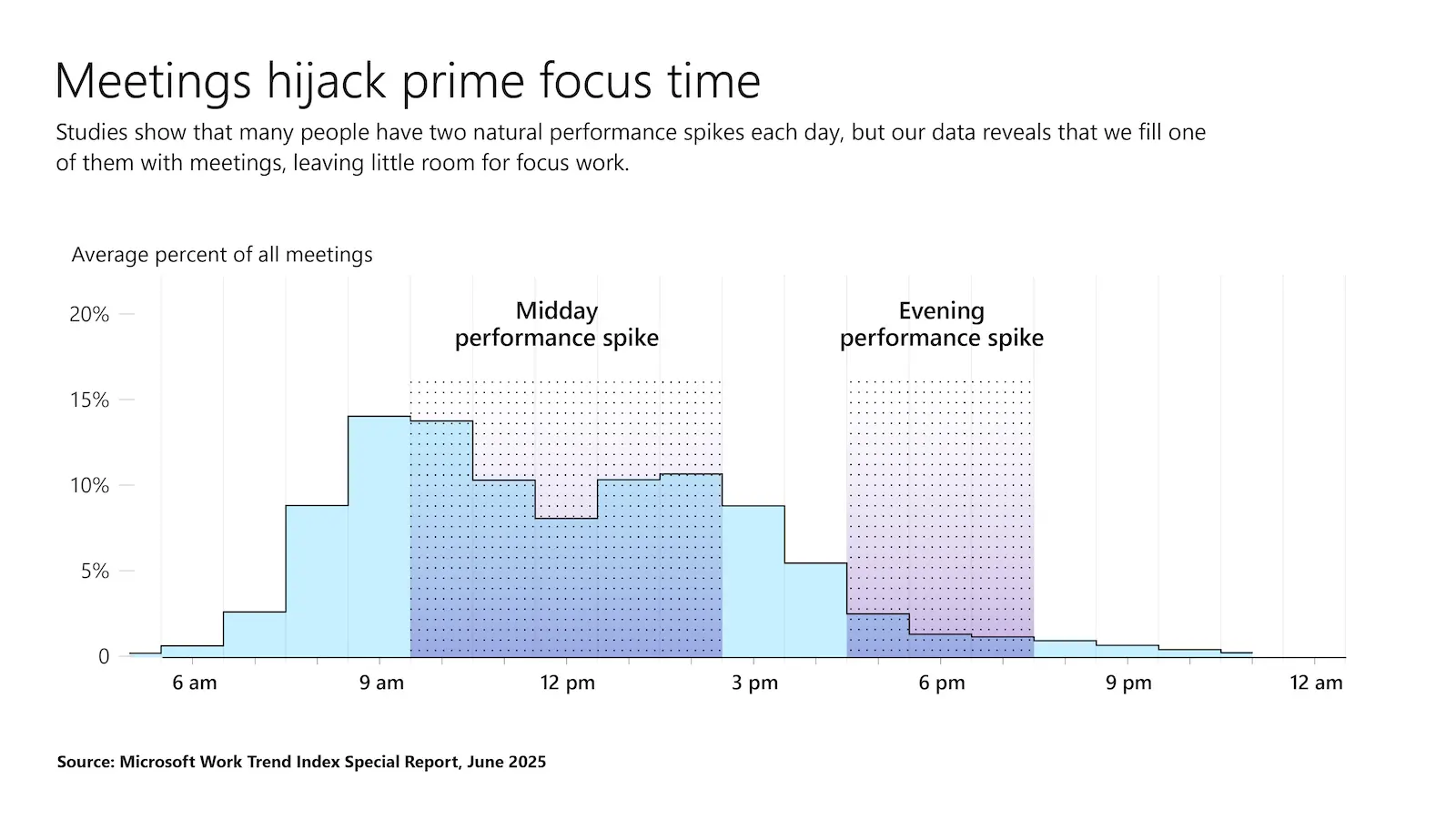
“According to our telemetry data, [11 a.m.] is the most overloaded hour of the day, as real-time messages, scheduled meetings, and constant app switching converge, making focus on any one task nearly impossible,” the report said. It added that employees using Microsoft 365 are interrupted every two minutes by a meeting, email, or notification.
Microsoft also found that employees use lunch breaks, evenings, and weekends to catch up with unfinished work. “Our data shows that meetings after 8 p.m. are up 16 percent year over year, with global and flexible teams accounting for much of the increase,” it said. Workers also maintain work-related communication through Teams and email at around 10 p.m.
According to Microsoft, the trend of the infinite workday points to a larger truth: that “the modern workday for many has no clear start or finish.”
“As business demands grow more complex and expectations continue to rise, time once reserved for focus or recovery may now be spent catching up, prepping, and chasing clarity,” the report said.
Recommended Video