

Judy Freya Sibayan, through the Museum of Mental Objects (MoMO), merges the roles of an artist, a curator, an institution, and a work of art. In MoMO, introduced in 2002, Sibayan carries nothing but herself, echoing immateriality from ideas, performative resonances, critical conversations, and archives of ephemeral interactions, which she would never write down, intentionally relying on her mental memory. Sibayan explicates critiques of conventional institutions, rejecting object-based and commodified structures of museums, and reclaiming authority, agency, and authorship in the male-dominated, often elitist, field of art history.
In the show Early Philippine Contemporary Art (1969-1985): Works and Documents from the Collection of Judy Freya Sibayan, her collection and self-archive can be transposed as a living history, rather than a scenography of a repository alone. Here, the exhibition is presented both as a potent archive and a critique of institutional memory. The Philippine sociopolitical and art historical contexts, during this time, were characterized by dictatorship and disruption during the Marcos regime. But besides this, the shift from modernism to conceptual practices flourished through varied artist experimentations and resonances: not just in form alone, but something that extended to approaches that challenged the very definition of authorship, enabled performance art as protest, and stimulated archival materials as equipment of memory, among others.
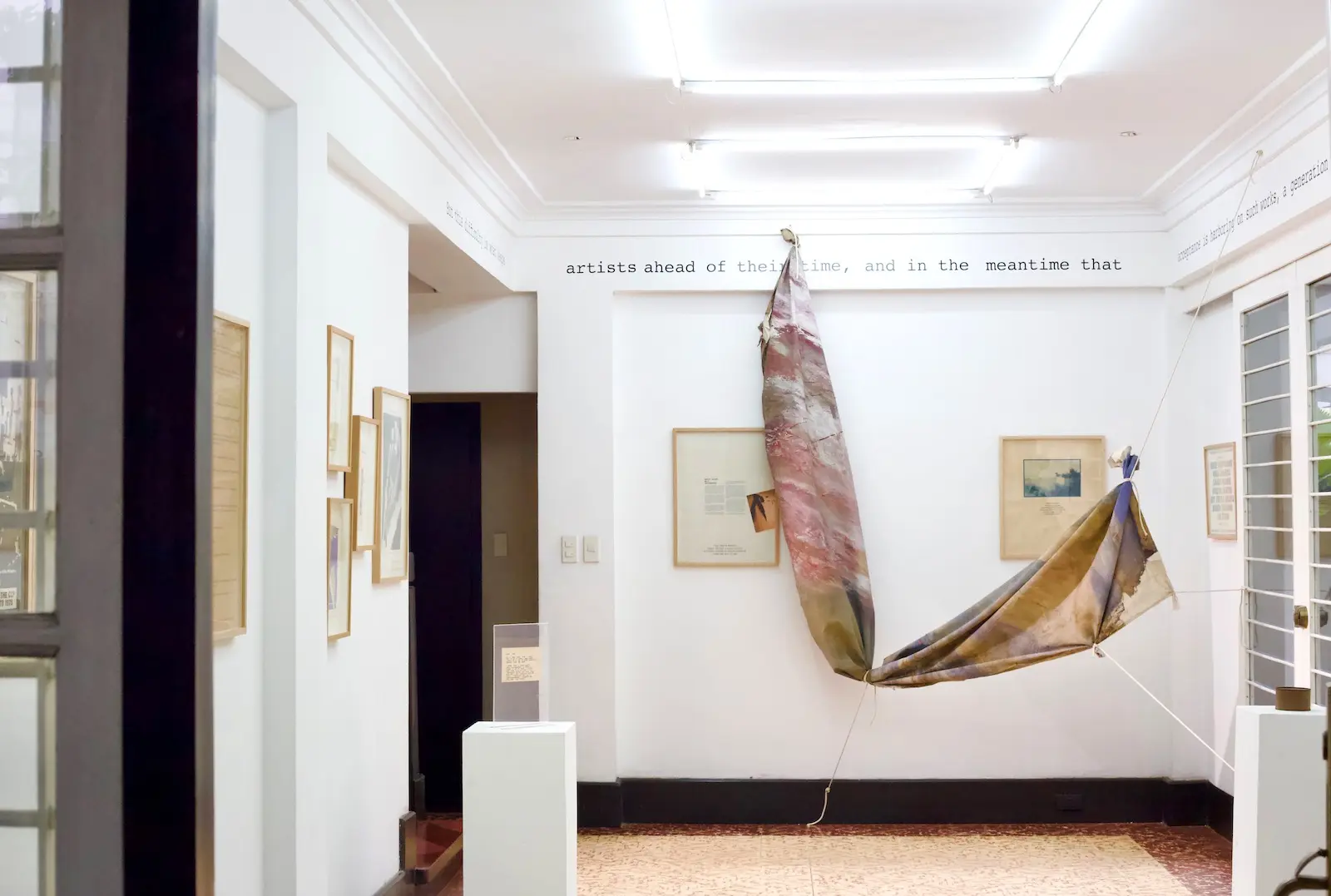
The exhibition is presented within a historical atmosphere in a restored 1950s structure. There’s a familiar feeling entering what used to be a residential space, situated on an old Manila street, lined up with places of worship and redemption: a convent, a church, and a temple. Such familiarity with a dwelling triggers a conscious, voluntary inquiry into the space and how the exhibition is presented purposefully, but still maintains a free and light experience. Sibayan collected with intention. She was a witness, observing how the art landscape is being shaped by various ecologies, and as a participant, navigating her career as an artist and curator, among many others. Materials presented in this exhibition are suggestive of such counter-counter-institution, something that urges fragmentation, fluidity, and doubt. There’s a certain amount of visceral presented as it speaks much about, beyond works of art, marginalia, paraphernalia, and other all-too-familiar in-betweens, such as often overlooked, discarded notes and exchanges, seen throughout the exhibition.
Sibayan teaches us that stepping into her collection and self-archive is stepping into a spirited conversation.
For instance, on the ground floor, a rusted, round tin, no bigger than a regular tuna can, sits on a pristine white pedestal. This is a gift from a fellow artist and known collaborator, Huge Bartolome. Its surface is mottled with oxidation, bearing an inscription of Sibayan’s name, without the artist’s signature. Perhaps this was something that was once both personal and performative — engaging in an unassuming yet deliberate citation, a counter-archive. It was a way for Bartolome to recognize his relationship with Sibayan, triggering the object’s function much less as a vestige but more as an intimate conversation.
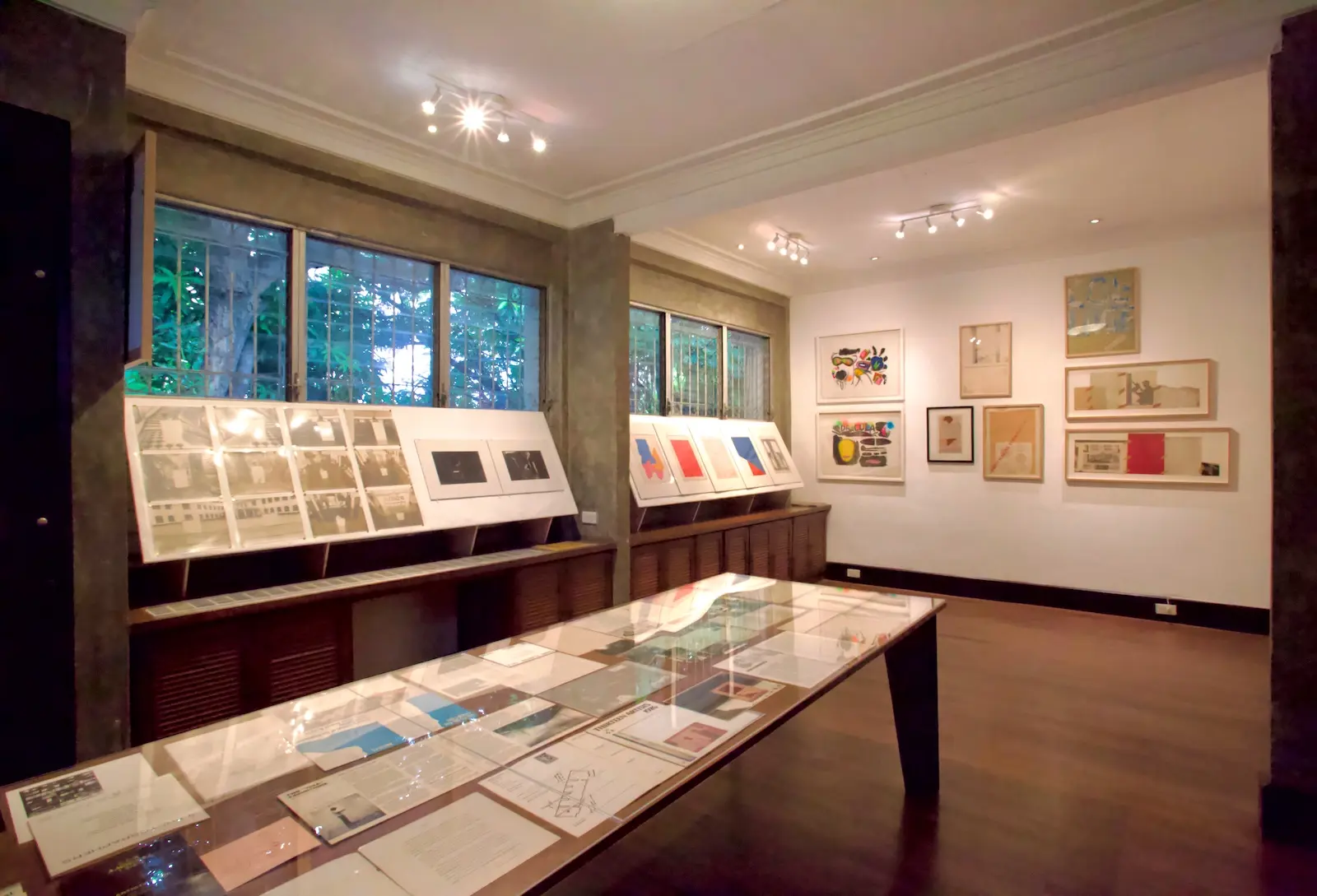
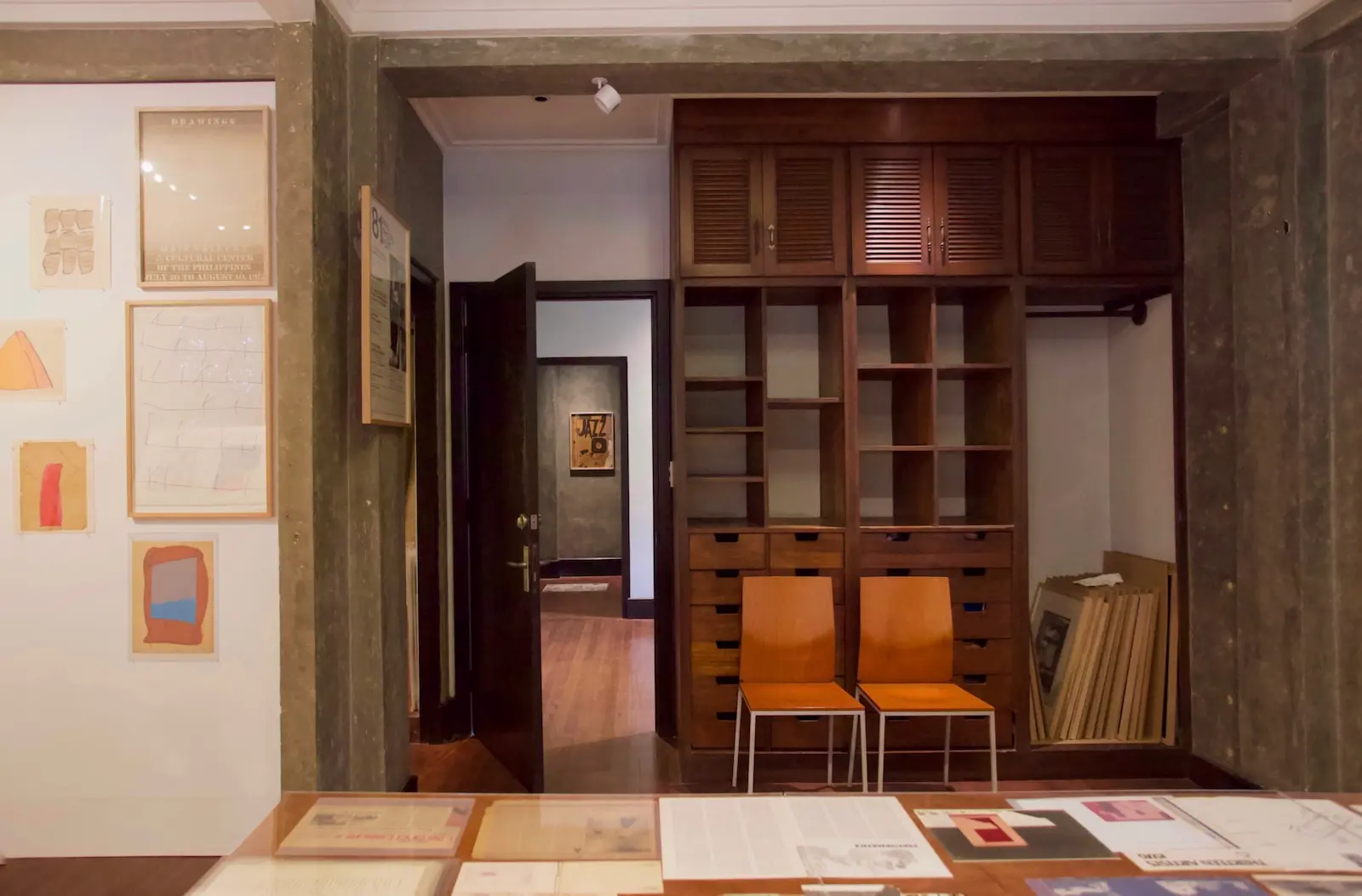
At best, the exhibition may look utterly compressed at first, but it is never monotonous. One consistently walks through a tableau of connective tissues, like networks of discourses, not as mere centerpieces, that shaped conceptual practices in the country, through Sibayan’s early artistic interventions and experimentations. What follows on the second floor, in the room, turning from the right of the staircase, are various collages and prints, adjacent to a long table, positioned almost in the center of the room, containing various archival materials which Sibayan worked on and has collected through her years as a prolific practitioner across Philippine art ecosystem. What arises strongly from these is not particularly nostalgiaNostalgiaA sentimental longing for the past, often triggered by music, films, toys, or fashion from childhood and youth. Nostalgia is a powerful force in culture and marketing, driving reunions, remakes,Go to Nostalgia Glossary but stimuli reflecting on the act of remembering, a radical memory, challenging ideas on interconnections between art, culture, and society.
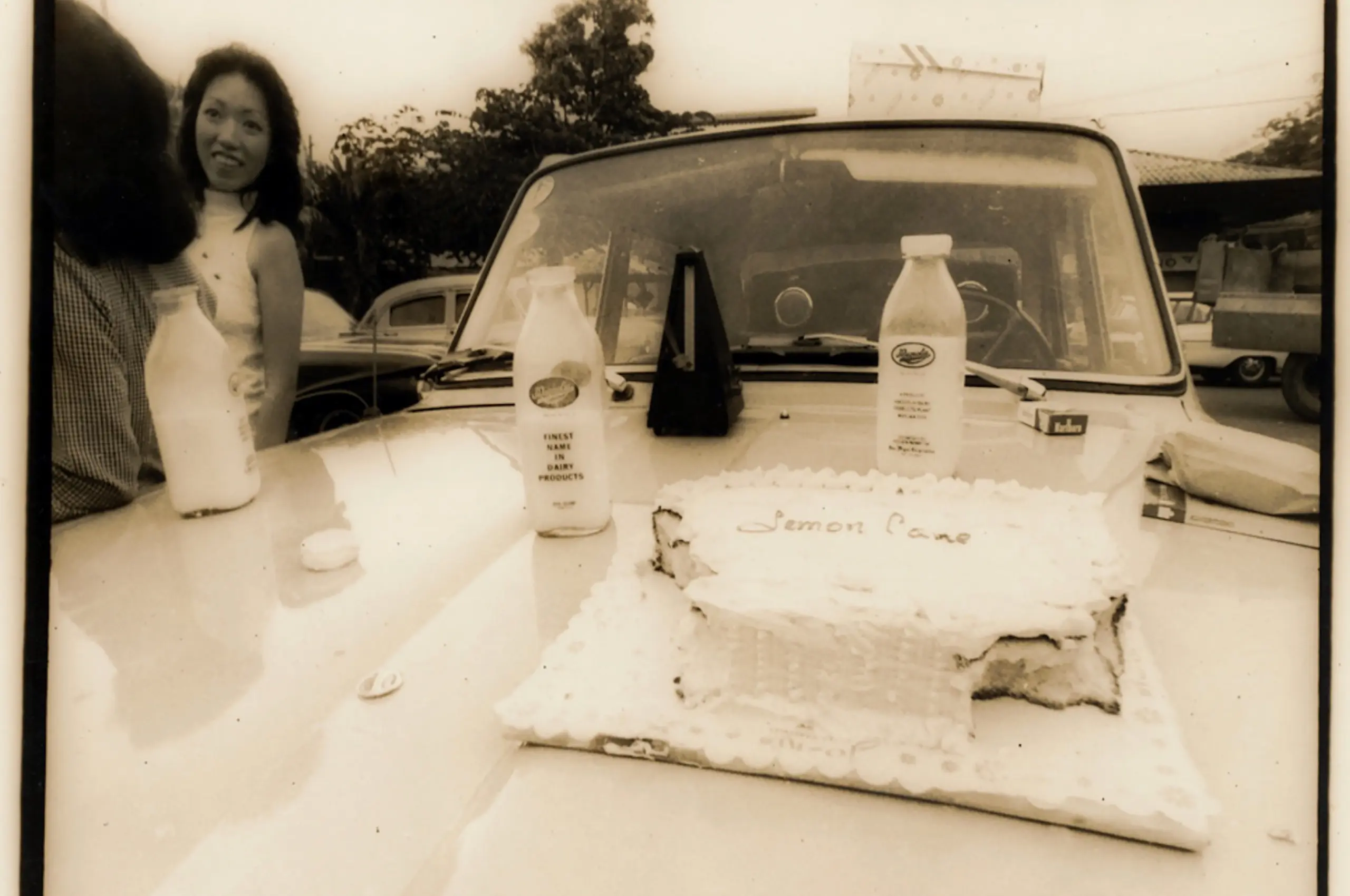
In the parallel room, mounted on the wall, are two archival photographs documenting Sibayan’s 1974 guer- rilla performance, “Lemon Cake,” that resulted from her and her classmates’ gatecrashing at the opening of 101 Artists in Shop 6, an artist-run space founded by Roberto Chabet in the 1970s, which he established as an alternative to the institution. It is through this performance that Sibayan attributes her first entry into art history, being cited by Ray Albano in Marks, the first art journal he founded.
On the whole, materials in this exhibition are confluences of spirited conversations, generously offering junctures to further understand contemporary art in the Philippines. Perhaps a dynamic point to bookend the exhibition is a look into “Collaborators, Co-con- spirators, Colleagues, Friends: A Constellation,” a thoughtful yet promising mapping, by Sibayan as part of her exhibition notes, of common denominators and shared engagements between herself and artists Albano, Johnny Manahan, Bartolome, and Chabet, having common engagements in notable projects, publications such as Marks and Philippine Art Supplement, and awards such as Thirteen Artists Exhibition Grant Award by the CCP which all aid in under- standing how early Philippine contemporary art flourished despite many things.
In Early Philippine Contemporary Art (1969-1985), Sibayan refuses to let the past stay at rest; the exhibition does not present history as something fixed but rather something that is always being written, and often, at the margins. Her collection and self-archive are not presented as a repository. It is a pulse, perhaps a contemplative reminder that Philippine contemporary art was also a way of surviving, resisting, and remembering, beyond the form. From here, Sibayan teaches us that stepping into her collection and self-archive is stepping into a spirited conversation.
This story first appeared in The State of Affairs issue of Rolling Stone Philippines. Pre-order a copy on Sari-Sari Shopping, or read the e-magazine now here.