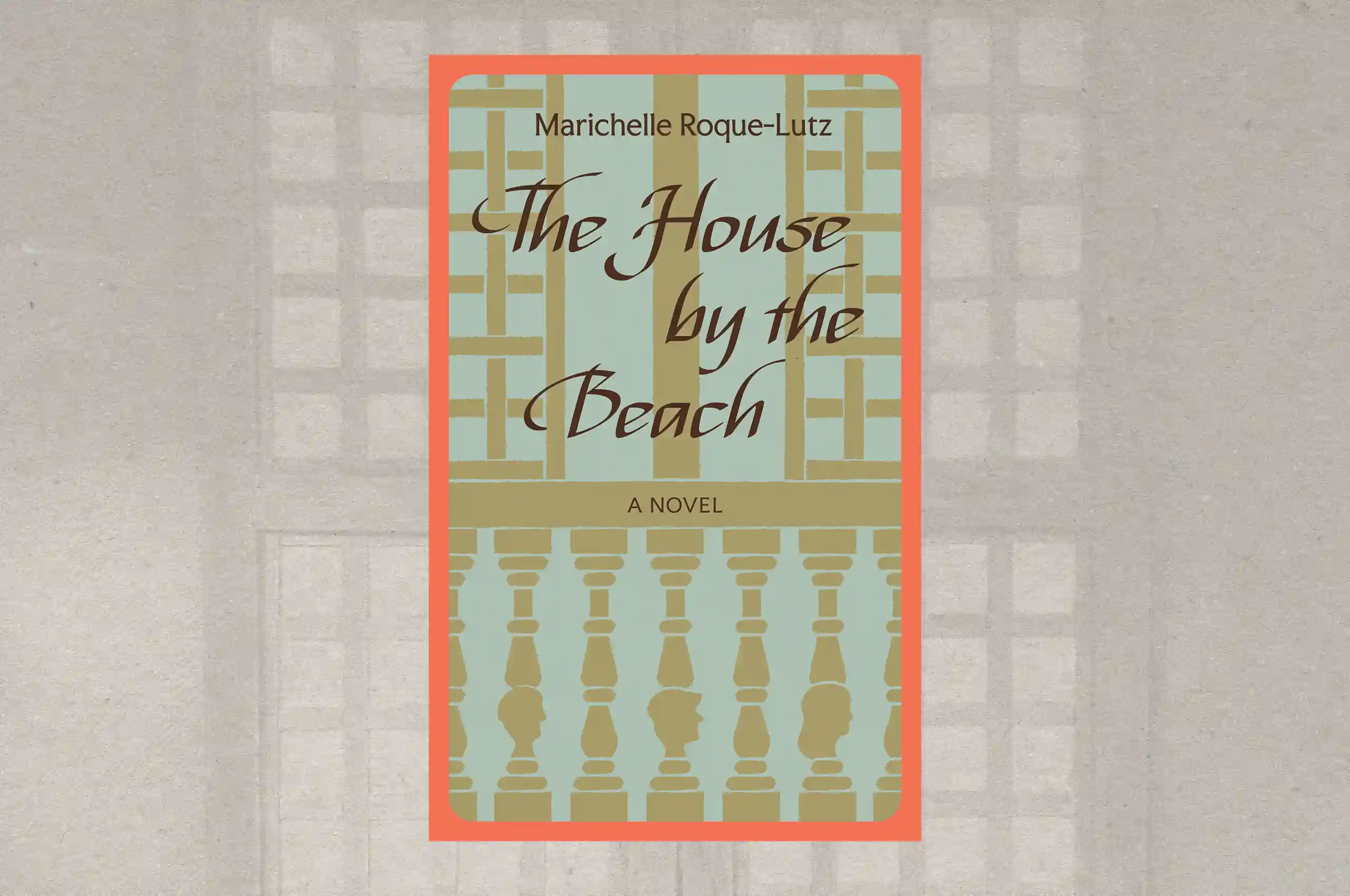
To write a multigenerational family saga is no easy feat. The most famous pieces of literature that fall under this genre, from Gabriel García Marquez’s One Hundred Years of Solitude, to Isabel Allende’s The House of the Spirits, to Min Jin Lee’s Pachinko, tend to stretch languidly across time, providing complicated stories of family members cursed to repeat their ancestors’ histories over and over again. When done well, these stories force us to reckon with our own bloodlines: Are we merely the result of our forefathers’ mistakes? Or do we have the ability to break free from the narratives that have haunted our family tree?
Marichelle Roque-Lutz, a veteran editor of Woman’s Home Companion and a seasoned writer, reckons with her own family history in her latest work, The House by the Beach. “This novel is based on the life of my grandparents,” wrote Roque-Lutz. “It is true until it isn’t.” Published by the Ateneo Press, The House by the Beach begins with Eduardo “Edong” Aragon de Aguirre, a member of the upper-class on Cuyo Island, Palawan who rises to power during the final years of Spanish rule. The novel then shifts its focus onto Edong’s descendants, from his hypersexual son Carling to his writerly granddaughter Lupe.
This is not the first time Roque-Lutz has dipped into the world of memoir writing and historical fiction. She co-wrote radio broadcaster and activist Roger “Bomba” Arienda’s 1982 memoir, Free Within Prison Walls. Her 2018 memoir, Keeping It Together: A Memoir of Familial Love and Acceptance, sees the writer picking apart her coming-of-age in the Philippines and her eventual immigration to the United States.
A Cautionary Tale
Each member of the Aragon de Aguirre clan brings with them their own idiosyncrasies, and the beauty of The House by the Beach is that you are given time to linger with each one. Roque-Lutz takes great care in fleshing out each character, especially Carling. As the eldest of Edong’s children, Carling carries with him the heavy responsibility of protecting his family’s legacy.
However, unlike his father, who dedicated his life to becoming Cuyo’s gobernadorcillo, Carling is easily swayed by breasts, swaying hips, and his strong sexual desire. His first sexual experience, which ironically was shared reluctantly at first with the town’s Catholic priest, saw Carling being transported to “a realm of irresistible excitement and pleasure and euphoria.” Roque-Lutz delights in writing these moments of forbidden bliss, but always ties them to the painful reality that they eventually corrode the Aragon de Aguirre family line.
Carling’s wandering eye slowly begins to harm his relationship with his wife, Pilang, and leads to him starting a new branch of the family tree with his mistress, Cory. As former journalist Linda Villamor wrote when describing Roque-Lutz’s novel, “The House by the Beach is, above all, a cautionary tale about the Filipino manhood and the culture of machismo.”
However, like all the family sagas that came before hers, Roque-Lutz’s attempt at providing readers with a grand, detailed character study sometimes comes at the expense of skimming through the historical events that take place in the background of her chosen narrative. We are aware of the fall of Spanish rule at the start of the novel, and we understand that the Americans have occupied the Philippines and left their mark on its education system, values, and culture. But rather than deeply analyze the fraught interactions between our country’s colonizers and citizens, these details appear subtly in the background of the Aragon de Aguirre clan’s epic.
Omniscient Narrators
Readers looking for a consistently immersive narrative may be deterred by Roque-Lutz’s style of storytelling, where the prose may come off as a factual recounting of events. In what should be a novel that focuses more on the inner workings of its characters, The House by the Beach relies more on its omniscient narrator to describe what’s going on.
For instance, when Pilang discovers that she is pregnant, readers are simply told from the narrator’s omniscient point of view what the young woman goes through during her pregnancy. “Pilang was not having an easy time of it,” wrote Roque-Lutz. “Her nausea prevented her from carrying out her usual activities… but she was happy. She was going to give her husband an heir.” Readers are told, not shown, the difficulties that Pilang endures to give her husband a child. The result is a somewhat distanced perspective of the trials the Aragon de Aguirre clan goes through. Even when Pilang undergoes a painful childbirth, the narrator’s voice remains descriptive, saying, “It took the gynecologist more than an hour to sew up the severe damage.”
There is nothing wrong with a novel relying heavily on its omniscient narrator. Many family sagas, including One Hundred Years of Solitude, need a narrator to help cover more ground in a story that spans across decades, people, and events. However, if we are to use One Hundred Years of Solitude as an example, the narrator doesn’t detract from the novel’s more fantastical events, like that of an insomnia plague or ghosts haunting the main characters. But with The House by the Beach, because it is such a character-heavy narrative and because it is so grounded in the real details of Filipino history, the narrator’s distance from the novel does not do it justice.
Overall, The House by the Beach is an ambitious work that captures the contradictions of a family bound by both love and legacy. While it occasionally stumbles under the weight of its history, both familial and national, Roque-Lutz makes up for it with characters so vividly written they feel like lolos and lolas whispering their stories right into your ear.
Recommended Video