

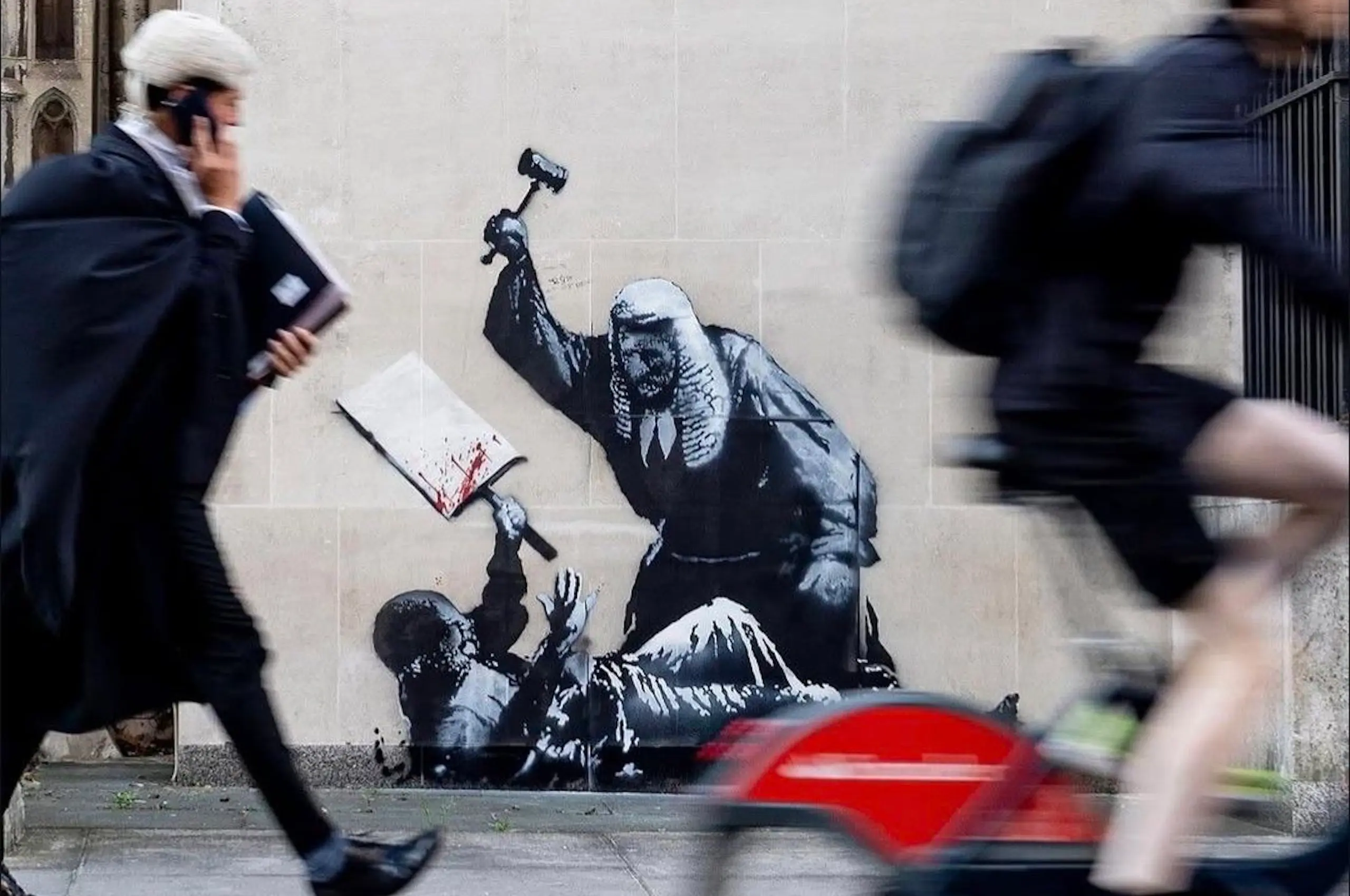
Banksy, the iconic yet controversial artist has returned, with his latest mural finding a home, albeit temporarily, on the side of London’s High Court.
The mural was discovered on September 8 on a wall of the Royal Courts of Justice building. Just hours later, it was covered up with “large sheets of plastic and metal barriers,” as reported by the BBC. An official spokesperson for HM Courts and Tribunals announced that the 143-year-old building must be “obliged to maintain its original character.”
The black-and-white mural, like many of the anonymous street artist’s pieces, is pointedly critical of the powers that be. It depicts a protester thrown on the ground, bloody protest sign in hand, as a judge beats him with a raised gavel. Two days before the mural caused a stir on the normally quiet Carey Street, nearly 900 protesters were arrested at a Palestine Action rally in London. Earlier this July, the British government formally declared the Palestine Action group a terrorist organization.
The message behind Banksy’s political mural, however, transcends geographic borders. In the Philippines, protesters have recently taken to the streets in response to the Senate Blue Ribbon Committee’s hearings on corruption and the ghost flood control projects of the Department of Public Works and Highways (DPWH). On September 4, protesters vandalized the gate of a Pasig property owned by contractors Sarah and Curlee Discaya, while on September 5, student activists staged a demonstration outside the House of Representatives in Quezon City as lawmakers held a budget hearing for the DPWH inside.
Within Asia, protests have also surged in Indonesia, with thousands demonstrating against the lavish housing allowances offered to the country’s members of parliament. Protests grew significantly on August 28, after an armoured police car reportedly sped through a crowd of demonstrators, killing 21-year-old motorcycle delivery driver Affan Kurniawan.
Tying to Banksy’s original statement on the treatment of pro-Palestine activists, similar sentiments have emerged across the Philippines, with groups of Filipino writers, organizations, and creatives boycotting the upcoming Frankfurt Book Fair for its alleged platforming of anti-Palestine rhetoric.
Regardless of location, the global discontent for unchecked authority is clearly palpable. The recent wave of protests and public dissent reflect a shared urgency among citizens to hold the people in power accountable. While Parliament may have erased Banksy’s mural, the conservations it has started and will continue to spark in the coming days remain very much in the open.
Recommended Video