

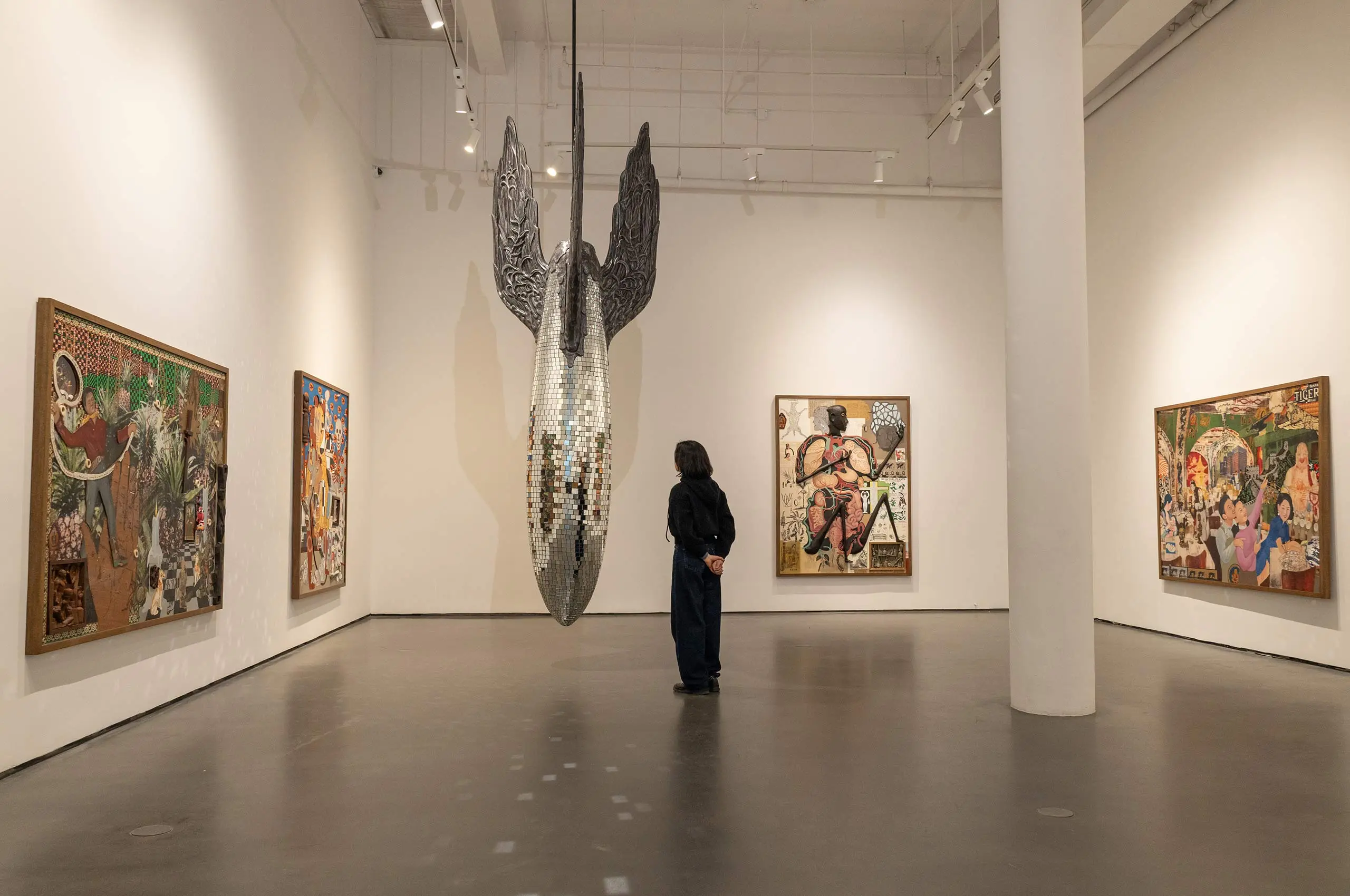
Kawayan de Guia’s America is not really America. It is the Baguio Country Club breakfast. It is Teacher’s Camp English. It is banana ketchup pretending to be tomato ketchup. It is sweetness arriving so completely you stop noticing where it came from. By the time you notice America in Kawayan’s work, it has already entered the bloodstream.
I grew up understanding this instinctively in Angeles, Pampanga. Clark Air Base never really leaves the atmosphere of the place. His “Little America” were pine trees and summer mansions, the American architecture of leisure in the Cordilleras. Mine was Clark Air Base lingering over Pampanga long after the soldiers left. Different elevations, same inheritance. Baguio had Thomasites and mountain air; Angeles had airfields, surplus stores, motels, and highways built too wide.
Listening to Kawayan speak, I am reminded of all our Little Americas: Baguio, Angeles, Subic, the outlet stores in the middle of expressways. The dream for lots of clothes and limitless parking. Xerox instead of photocopy. Colgate instead of toothpaste. Superman instead of Lam-ang. Imported languages long ago stopped sounding imported.
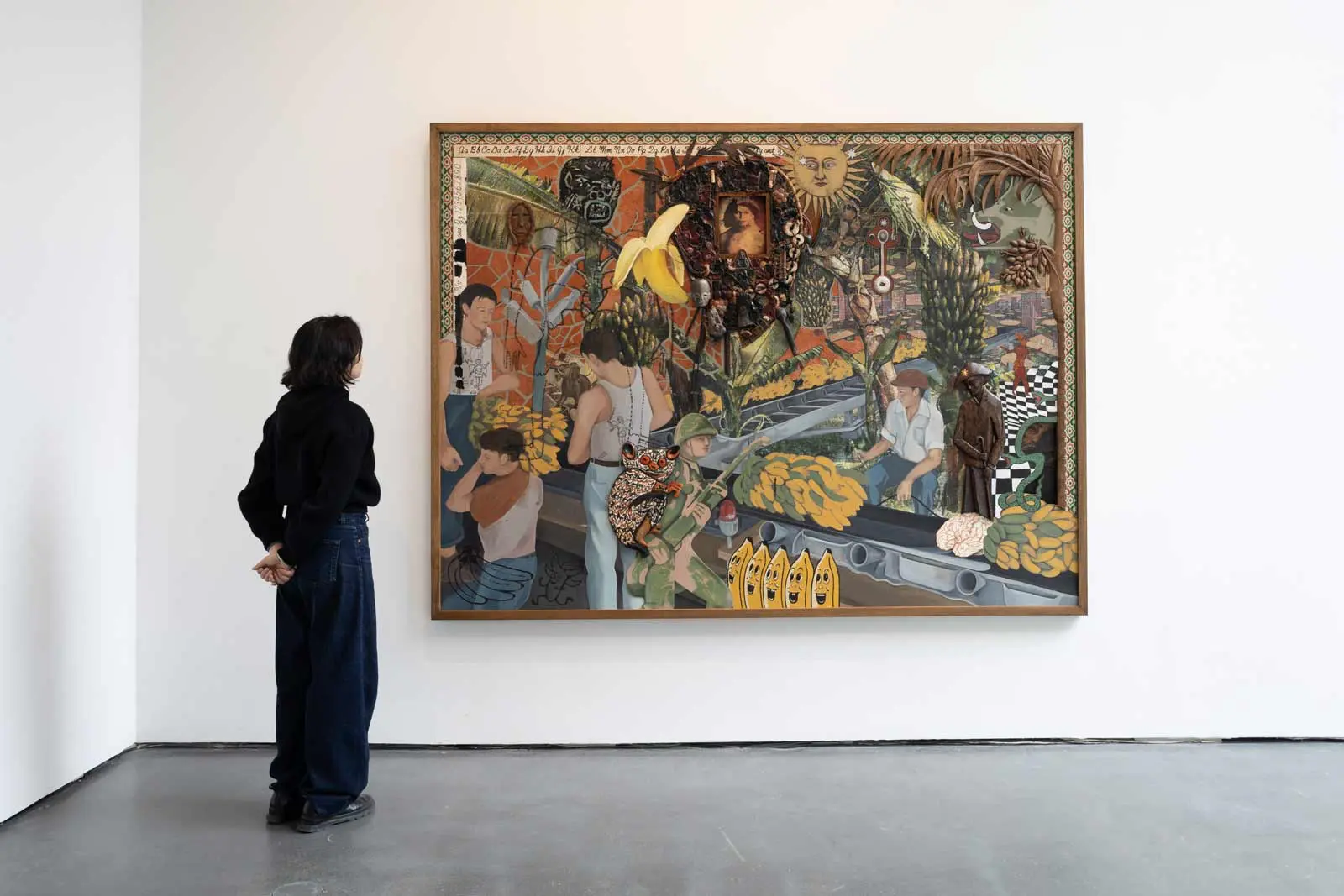
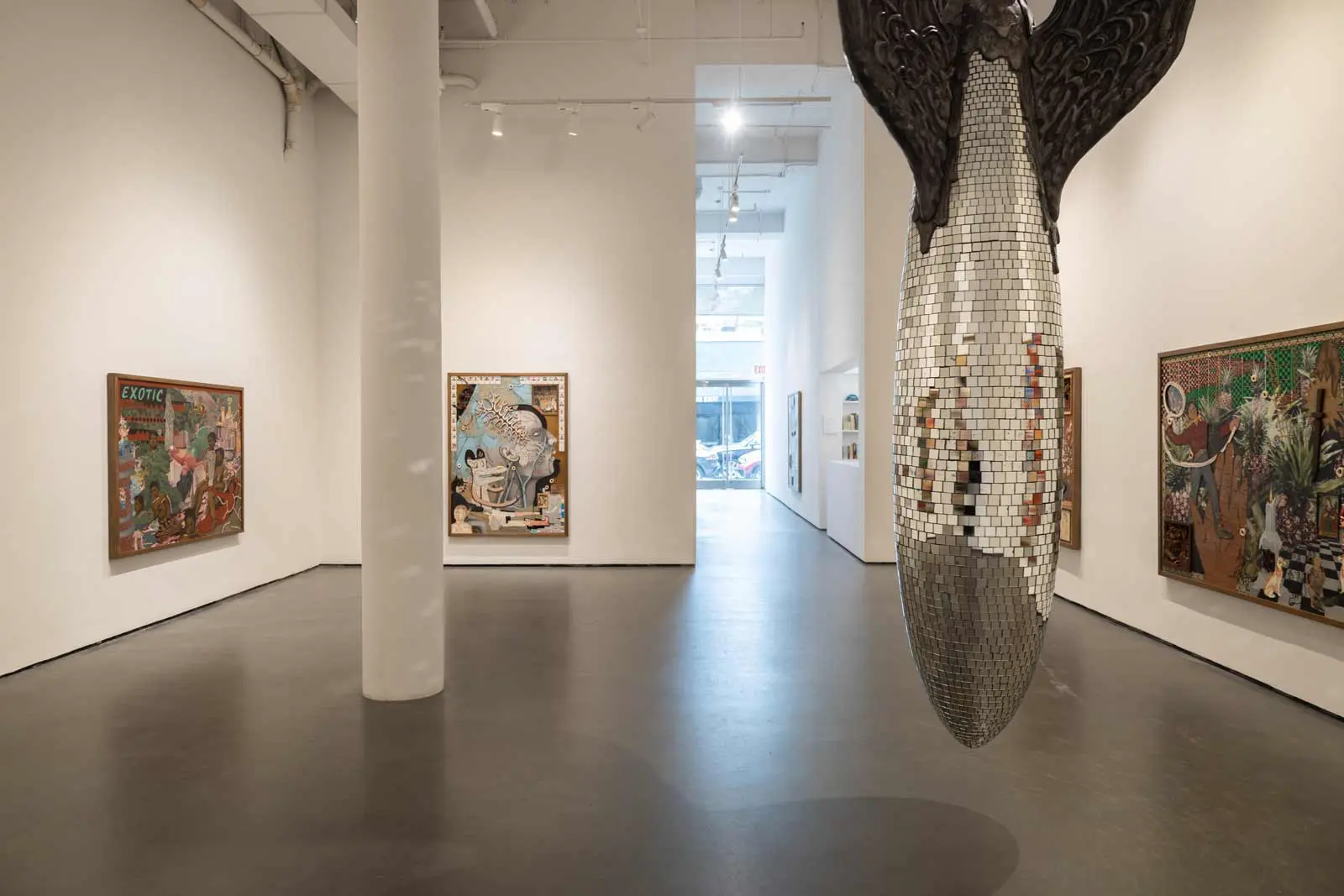
That inheritance slits sharper underneath the New York exhibition. The works do not perform critique cleanly. They are too intimate for that. “God Save the Queen of Banana Catsup” does not ridicule America so much as expose how deeply we learned to desire it. Kawayan himself says the Americans “didn’t come with bullets and guns first; they came with chocolates, tobacco, matchsticks.” It explains something fundamental about contemporary Filipino life. America arrived and remained through schools, television, supermarkets, English, canned sweetness, and convenience.
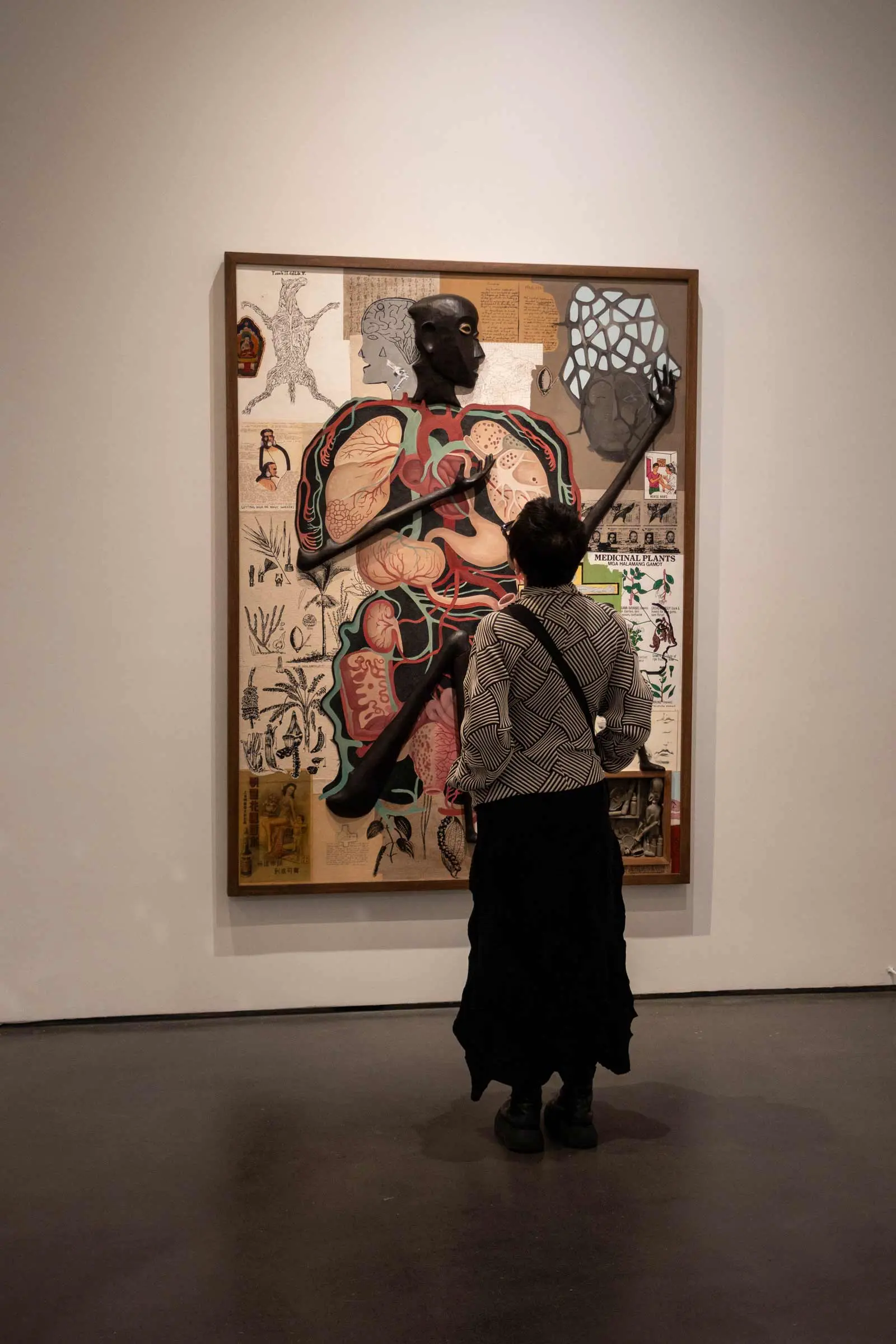
Kawayan’s works feel less like arguments than accumulations. Resin, bones, anatomical diagrams, checkerboard floors, toy soldiers melted into the word “LOVE”. Looking at “Body as Spirit House,” “Atang Ina,” and “Tiger Snake Brand: Ghost in a Can.” I kept thinking about how the Philippines itself feels assembled; Spanish churches, Japanese surplus, American supermarkets, Chinese medicine, indigenous ghosts. Everything somehow survives within the same space. Kawayan calls Filipinos “a culture of copying,” though he says it without shame.
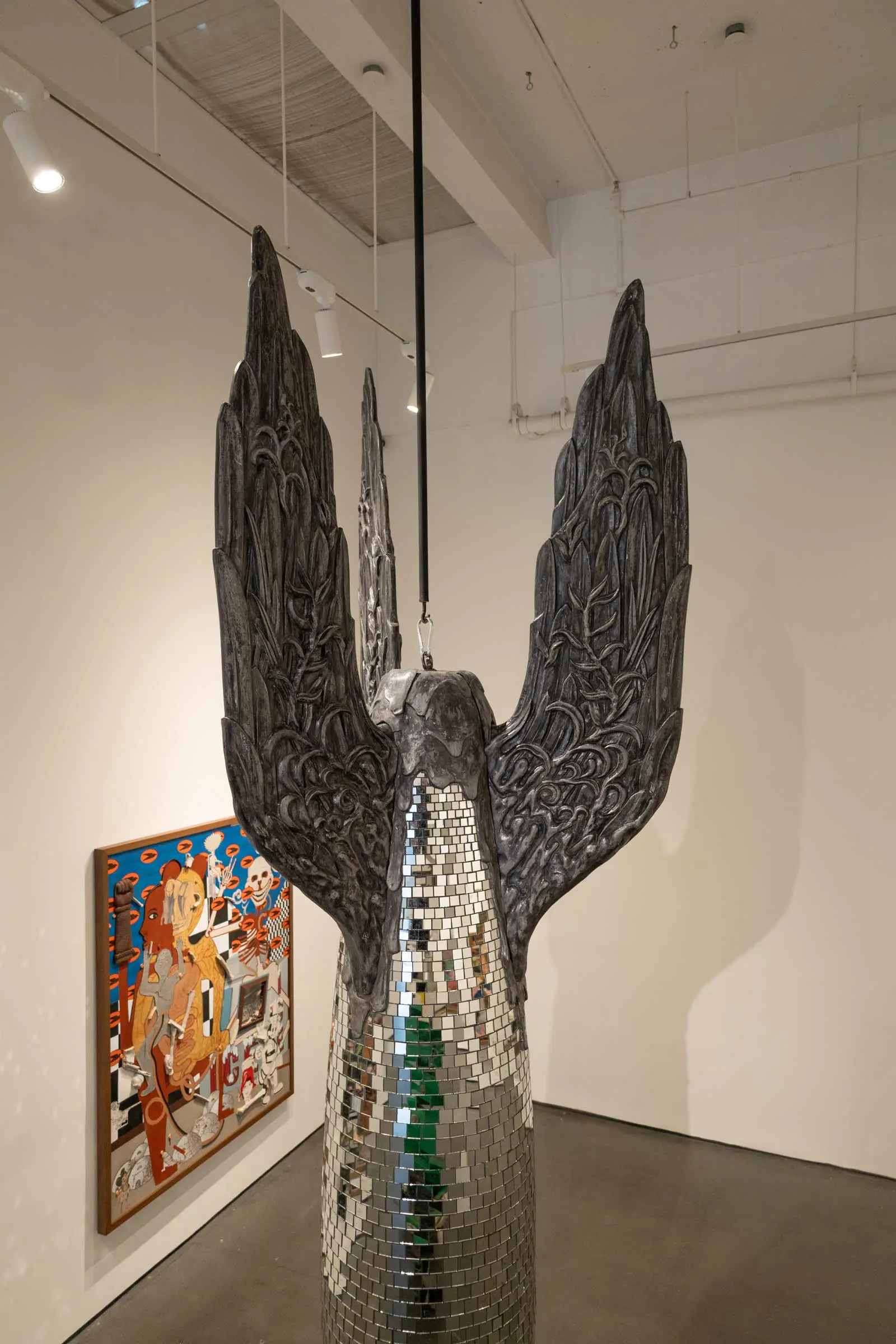
In 2026, shipping feels charged. The crate becomes part of the work, quite beyond metaphor. How do you move a bomb sculpture into America during a period of global anxiety? How do you transport a republic of bananas, chop suey bodies, an entire atmosphere? Somewhere between Manila and New York, aesthetics becomes paperwork.
The timing of the exhibition matters. America in 2026 feels tense with itself. Airports feel tense, too. Kawayan refused to travel to New York, citing nodes of immigration, “conflicts,” and the atmospherics surrounding liminal spaces under administrative surveillance. “It feels like the great experiment has failed,” he says. And suddenly his works, filled with imagery of wounded anatomies and spiritual unease, arrive in New York carrying a different weight. “Bomba (Fallout)” reads less historical. It’s contemporary.
In our conversation, thoughts about crates and crating kept resurfacing. Wooden, treated containers leaving Manila carrying works of art. Kawayan mentions his father, Kidlat Tahimik, and how “the thrill of art-making is the logistics.” I understood immediately what he meant. In 2026, shipping feels charged. The crate becomes part of the work, quite beyond metaphor. How do you move a bomb sculpture into America during a period of global anxiety? How do you transport a republic of bananas, chop suey bodies, an entire atmosphere? Somewhere between Manila and New York, aesthetics becomes paperwork.
What moved me most, though, was not anger. It was fragility. Kawayan spoke about mold consuming 80 percent of his photographs. He spoke about death, hypertension, grief, and the pressure of becoming someone before you have even had the chance to fail properly. His works carry that exhaustion physically. The surfaces feel weathered by climate and memory alike. They feel humid. They feel like Baguio itself: fogged over, layered, difficult to flatten into one narrative.
Shown at Silverlens New York, Excavations from the land of the not so plenty arrives in an America that suddenly feels culturally off with itself, a country carrying the fatigue of an empire watching its own reflection. In “This land we do not inherit from our ancestors… Disneyland we borrow from our children,” Mickey Mouse and Batman drift beside exposed nerves, colonial portraits, and anatomical cross-sections, less like quotations than symptoms. Felt neurologically and logistically in its migration, the Filipino imagination learned how to carry imported fantasies without ever fully mistaking them for home. Artistic pursuit, like any other, is a rat race, and this race is run in metropolitan cities.
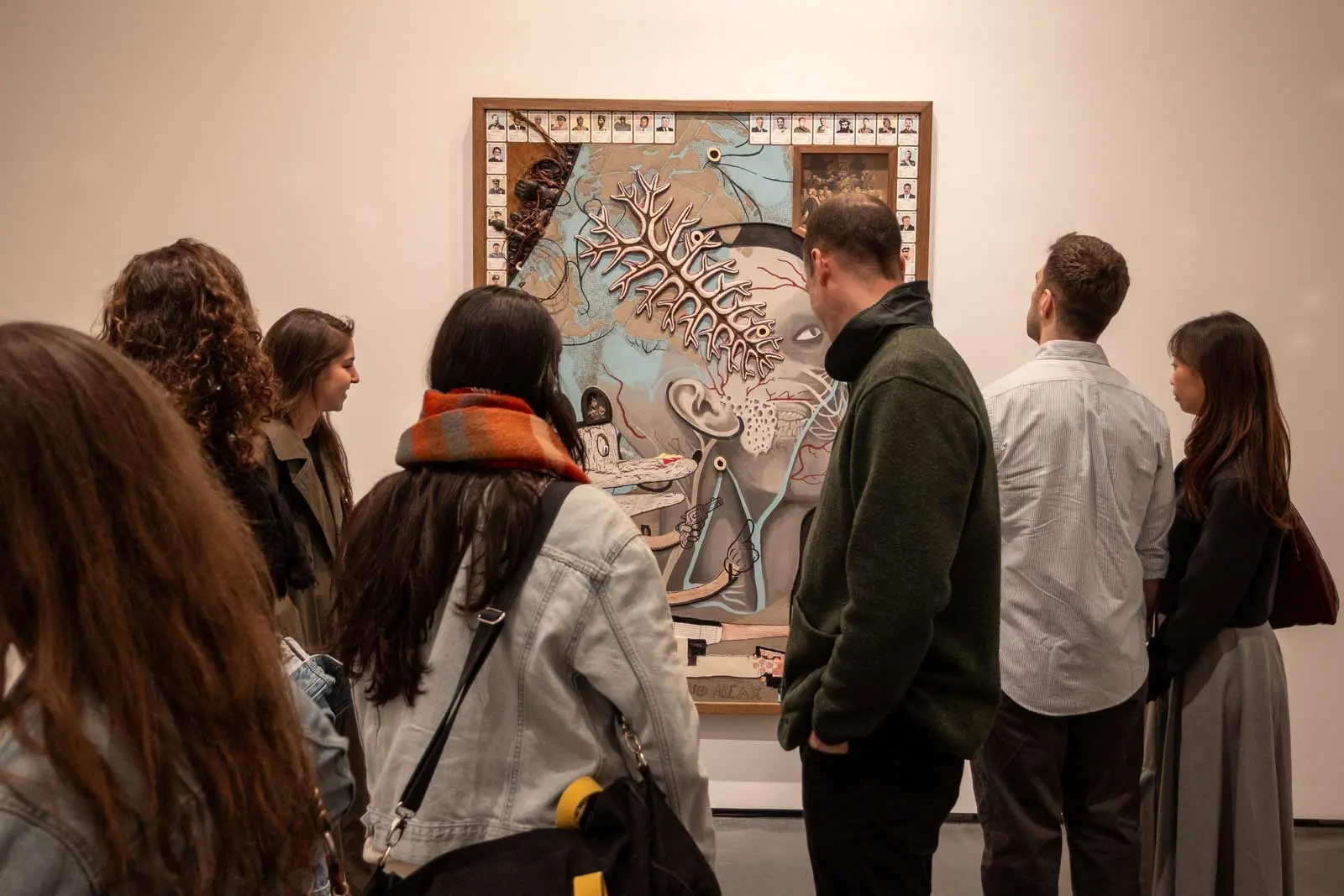
It’s almost like a type of bittersweet Eros, a craving for satisfaction. New York is filled with fast-paced rats. Paris, if the movies are to be believed, has rats who can cook. Lino Brocka would lead you to believe that the rats in Metro Manila are in the claws of night. The supposed antithesis is the rural, the cottage-core fantasy of stepping off the wheel, of sourdough and slowness. But would it really be an antithesis?
Baguio complicates the question because Baguio is a city that was never a countryside. It was drafted. Daniel Hudson Burnham, the American who planned Chicago, sketched it as a hill station, a summer capital, a fantasy of elsewhere built at 1,500 meters. Stanley Kubrick shot Eyes Wide Shut’s New York on a London soundstage; Nicole Kidman drifted through a Greenwich Village home assembled from blueprints and homesickness. Baguio seems to do the same trick at the scale of an entire city: an America constructed outside America, convincing enough for humans and rats alike. Identities are city-built. So as Kawayan’s Baguio arrived in New York, uncertainty reigned: was a copy returning to its original, or was an original finally confronting its copy?
The de Guias are that invented city’s most stubborn family, and each one answers the rat race differently. The grandmother of those Country Club breakfasts, Virginia Oteyza de Guia, did not run the race; she ran the city itself, serving as Baguio’s mayor. Eric Oteyza de Guia, Wharton MBA, the credential the fastest rats kill for, then walked off the track entirely, shed the name, and became Kidlat Tahimik. The mother ran in reverse: Katrin de Guia left the West for the Cordilleras and spent decades writing about kapwa, the Filipino psychology of the shared self. Kapwa, not cottage-core, may be the real antithesis of the rat race. You do not exit the city. You stop running alone.
The brothers inherited the course. All three, Kidlat, Kawayan, and Kabunyan, showed their photographs together at Silverlens in 2007, the same gallery now carrying Kawayan’s excavations to Manhattan. Kidlat, the eldest, a documentaryDocumentaryA nonfiction film that explores real people, events, or issues, using interviews, archival material, and observation to tell its story. Documentaries can inform, challenge, and move audiences, and Philippine filmmakersGo to Documentary Glossary filmmaker who loved playing with forms, cut old black-and-white photographs into strips and wove them into mats; photographed memories made by hand. In 2008, his solo exhibition “Sleeping White Elephants” paid homage to Goya’s “Saturn Devouring His Children” by projecting the demolition of a shantytown onto a figure of concrete blocks wearing the photographed face of a demon named “Capitalist Greed.” The rat race, given its true portrait: the god of the city eating its own children. He died in 2022 in Madrid, where he had flown for the closing of their father’s exhibition at the Palacio de Cristal, the same Madrid show Kawayan remembers by its shipping containers. The logistics of art and the logistics of grief, sharing an itinerary. Kabunyan, the youngest, loaded a yellow Volkswagen Kombi and drove his family from Baguio to Davao in “Ang Lakaran ni Kabunyan: Kabunyan’s Journey to Liwanag” (2020), a lakaran that looks like cottage-core flight but was really a search for kapwa by other roads.
And Kawayan stayed. He stayed alongside Nona Garcia, a fellow artist, his partner in the oldest sense of the word: together they began re-coloring a rediscovered Canao mural by hand, together they curated the Baguio Arts Guild’s return at the Ateneo; the family ecosystem extending itself by partnership of practice rather than blood. In a family that has already lost a home to fire and an archive to flame, Kawayan learned patience from his photographs, fermenting film in Baguio humidity and waiting years to see what the mold leaves behind. The works in New York carry no mold. Customs would never allow it; the crates are treated and sealed, certified clean. But they carry the tempo. Baguio time, fog time, the patience of a rat who long ago decided the race was the wrong unit of measure.
At one point during the conversation, I mentioned Carlos Bulosan (b. Binalonan, Pangasinan; 1911-1956), and Kawayan immediately smiled. He keeps extra copies of America Is in the Heart just to give away to younger artists. That made perfect sense because Kawayan’s America is also in the heart. Not as a dream exactly. Not as an enemy either. More like something ambient. Lingering in accent, appetite, aspiration, malls, military memory, and the strange loneliness of contemporary Filipino life. After a while, it becomes difficult to tell where comfort ends and influence begins.
This story first appeared in the Rolling Stone Philippines’ Voices Issue, now available for pre-order on Sari-sari Shopping and in major newsstands soon.
Get digital access to the latest issue here.
Frequently Asked Questions
Kawayan de Guia is a Filipino contemporary artist based in Baguio, known for mixed-media works that fold together found objects, resin, and cultural symbols. He is the son of filmmaker Kidlat Tahimik and writer Katrin de Guia, and works closely with his partner, artist Nona Garcia.
Excavations from the land of the not so plenty is Kawayan de Guia’s solo exhibition at Silverlens New York. The show gathers mixed-media works exploring how American culture became embedded in everyday Filipino life, from consumer brands to architecture, using objects like resin, bones, and beeswax.
The exhibition explores what the essay calls the Philippines’ “Little Americas” — places like Baguio, Angeles, and Subic shaped by U.S. influence. De Guia examines how America arrived through schools, supermarkets, and language rather than force, saying colonizers came “with chocolates, tobacco, matchsticks.”
Key works include “God Save the Queen of Banana Catsup” and “This land we do not inherit from our ancestors… Disneyland we borrow from our children,” both from 2026, along with the earlier “Bomba / Fallout.” They combine painting, found objects, bone, and beeswax.
The de Guias are a prominent Baguio artistic family. Kawayan’s father is filmmaker Kidlat Tahimik, his mother writer Katrin de Guia, and his grandmother Virginia Oteyza de Guia once served as Baguio’s mayor. His brothers Kidlat Jr. and Kabunyan are also artists.