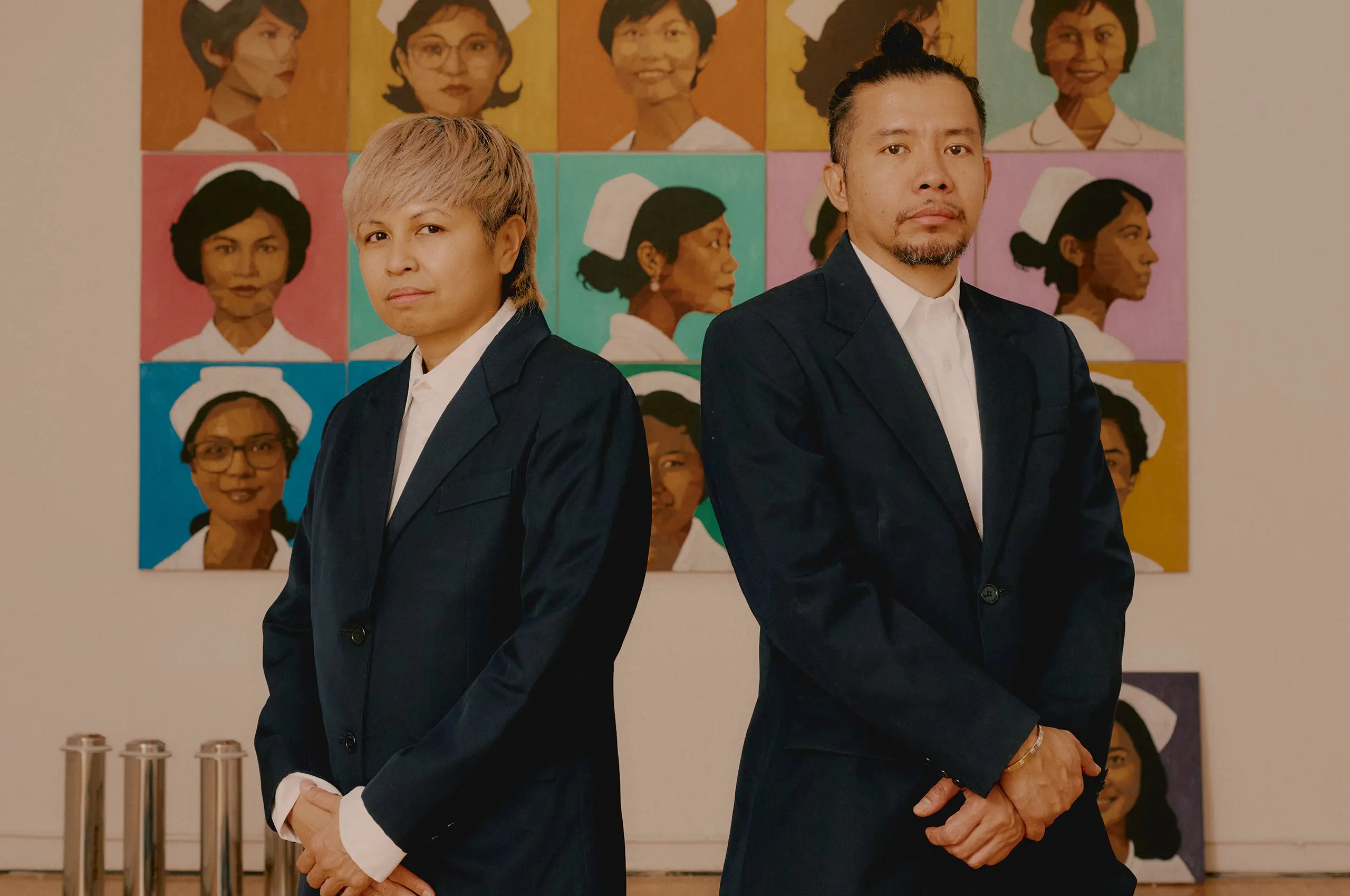
Maureen Catbagan and Jevijoe Vitug are two Filipino visual artists who work at the Metropolitan Museum of Art in New York. In 2017, they started collaborating under the name “Abang-guard,” a play on avant-garde, which has historically stood for the radical and transgressive, if not outright bizarre. It is also a most straightforward reference to their occupation: They have been working at The Met not as artists, but as security guards.
“I just had my 25th year anniversary. How time flies!” Catbagan tells me in an email. Vitug, meanwhile, has worked there for a decade. Catbagan’s mother traveled across countries on temporary assignment as a doctor before she and her daughter settled in the U.S. in 1986. Vitug had already carved out an artistic career back in the Philippines, having won recognitions like the Cultural Center of the Philippines’ Thirteen Artists Awards, when he moved to the U.S. dreaming to live as a full-time artist. He first found work at Walmart, pushing carts. One odd job after another, he finally settled as a guard where they both met.
Of course, they’re not an isolated case, they tell me. Think of the Filipina painter Nena Saguil taking up housekeeping jobs to support an already ascetic life in Paris, or the celebrated David Medalla struggling financially as he moved around London and the U.S. “A lot of people have a hard life to pursue their dreams,” Catbagan says. Many other immigrants have had to straddle art and labor.
Inverting the Coding
“You can think of it as a disadvantage or you can pivot and reempower,” says Catbagan. If the avant-garde wants to break the rigid line between life and art, then here the Abang-guard project presents the glorious absurdity of the museum guard as a performer. “We’re aesthetically inverting the position of guards,” Catbagan continues. “The look of it, the coding of it. We try to transform the power dynamics.”
In 2018, at the ARoS Public Atelier in Denmark, Catbagan and Vitug walked around the white and winding pathways in identical suits, with their pants rolled up, barefoot. They would stand for some minutes and then jerk their arms, point forward, and bend their knees in coordinated motion. It must have been startling to see — two serious guards in uniform suddenly performing calisthenics.
The performance was made for their residency with Flux Factory. On another iteration, they roamed the galleries with tactical vests showing videos of works by ARoS Museum guards. Their bodies became a walking display à la Marcel Duchamp’s portable museum “Boîte-en-valise.”
“We’re aesthetically inverting the position of guards; the look of it, the coding of it. We try to transform the power dynamics.”
Other projects are carried out through clever exhibitionary tricks: In “La Guardia,” viewers come across large wooden crate covers. To see the art, they need to perform the physical labor of looking. They crouch, peer in, and lie down to find works made by other museum guards — people of color who, like Vitug and Catbagan, haven’t had much chance to exhibit as artists.
“How do you beat a system that was never built for you to win? [There are kinds] of systemic racism that no one talks about,” says Vitug. At the center of their work has constantly been the laboring body. The lives of working class immigrants or people of color are coded into the bodily presence of the guard-performer. “We aimed to reconfigure the aesthetic and political strategies of museum display,” Vitug says, “so we could insert our own narrative within that framework.”
Labor Histories on View
As Abang-guard gets its first official solo museum show this year, it’s specifically the Filipino migrant histories that come to the fore. Their exhibition, Abang-guard: Makibaka, opened last March at the Queens Museum, which is located on the grounds where the New York World’s Fair (NYWF) was held from 1964 to 1965.
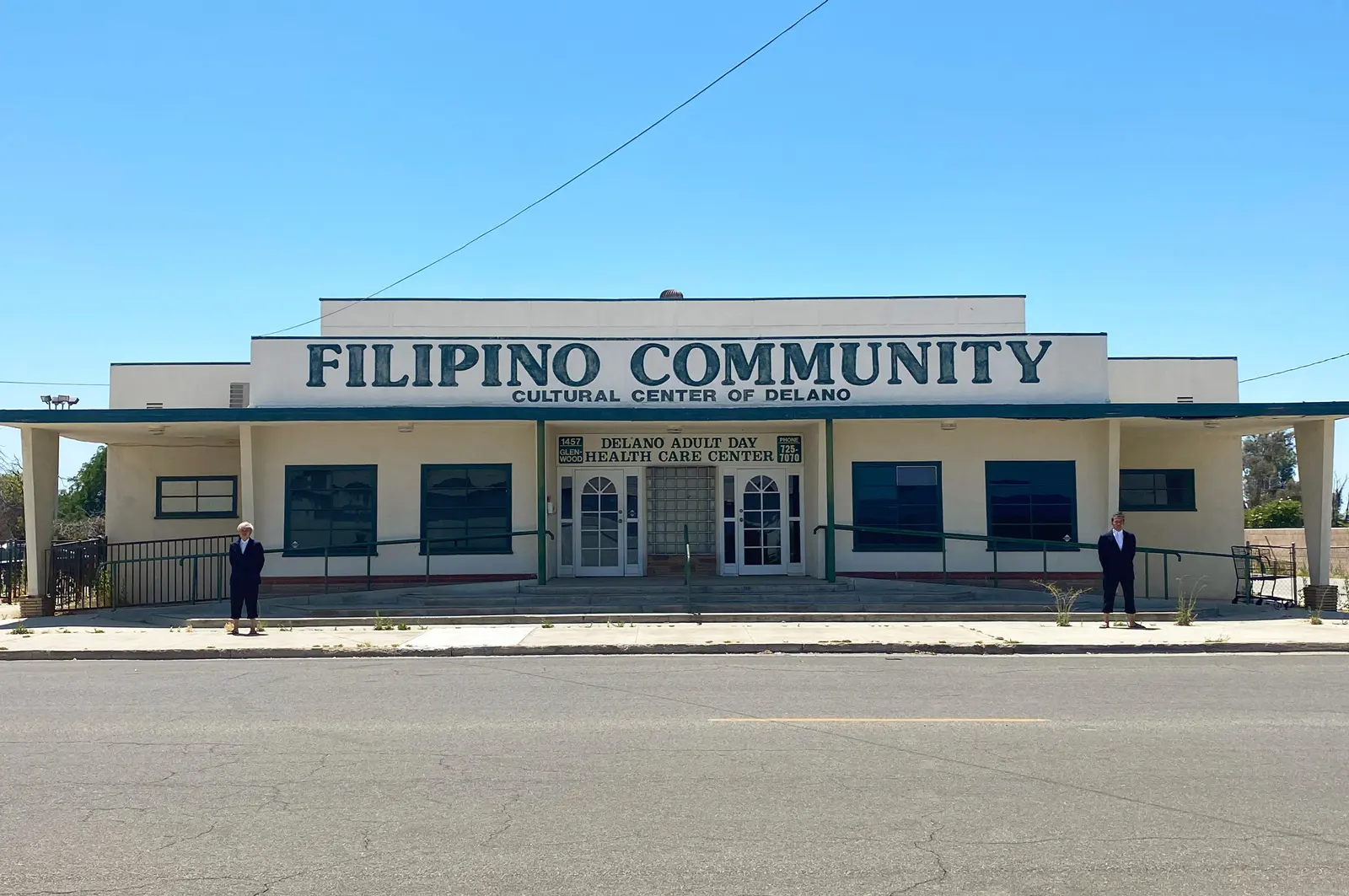
Abang-guard takes this charged temporal marker as a conceptual anchor. Ask them about it and they will give you an hours-long history lecture: It was also in 1965 when Filipino migrant farm workers like the labor leader Larry Itliong initiated the Delano Grape Strike in California, campaigning for higher wages and a retirement home. In that same year, the Hart-Celler Immigration and Nationality Act was signed, bringing a wave of Filipina nurses into American shores.
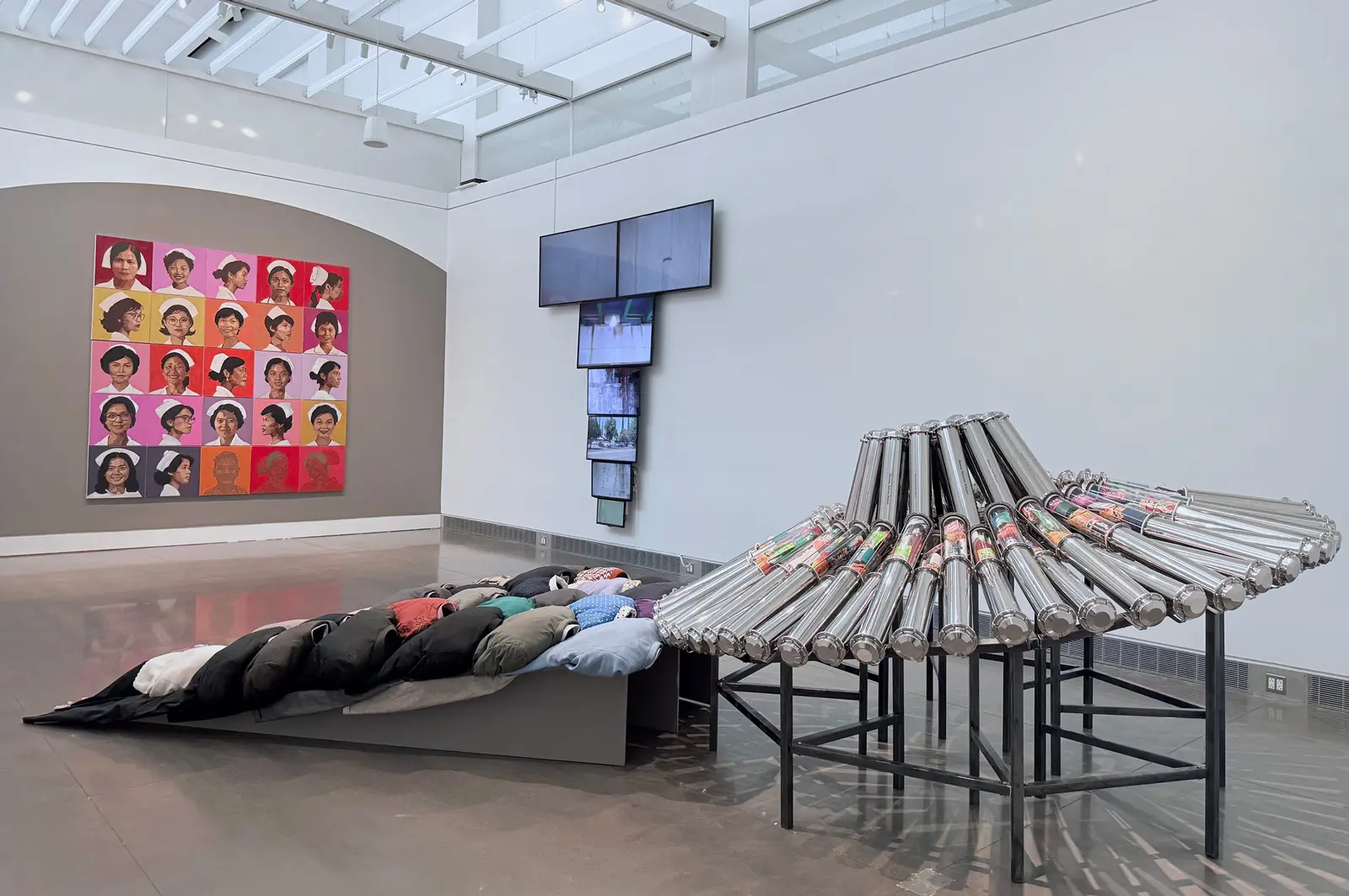
At the exhibition stands a time capsule in the shape of an enormous salakot, the dominant form of the NYWF Philippine pavilion architecture. Inside the capsule are care package items for the many Delano Grape Strike organizers, bundled like offerings to ancestors. There are several layers of story and data heaped into each work. The paintings, done in the style of famed American male artists, are portraits of Filipina nurses, while others lay out an iconography of the American dream, the cruel promise of abundance in migration, and — as in the 1966 killings of nurses — its tragedies.
“We aimed to reconfigure the aesthetic and political strategies of museum display, so we could insert our own narrative within that framework.”
This is all part of Abang-guard’s politics of visibility. Their video installation, where screens are arranged like an inverted monument, frames them as ones who guard the historical sites of Filipino communities in Stockton and Delano. Their day job gets a lively twist: here, they are guardians of memory, protecting a history that has been somewhat invisible or peripheral. They’ve archived the stories of second-generation migrants, tracking down what they call a legacy of solidarity, care, and economic support.
“We wanted to show people how the Filipinos were part of the nation-building of the United States,” says Catbagan. Avant-garde artists once entertained the absurd. And perhaps now in the volatile climate of the U.S., there are few things more absurdly ironic than the hostility directed to immigrants, considering that it’s a country built on their work and blood.
It took months of research to gather these stories. But the effect that propels them is also a kind of bodily knowledge. The burden of dream and labor is a weight they’ve carried on their bodies, as guards who have stood for hours, for years, on the margins of institutions. “It’s coming from our lived experience as guards,” Vitug says simply. Here is America seen from where they stand.
This story originally appeared in The Guilty Pleasure of Showbiz Gossip Issue. Now out on select newsstands and on Sarisari.Shopping. Get digital access to Rolling Stone Philippines issues here.