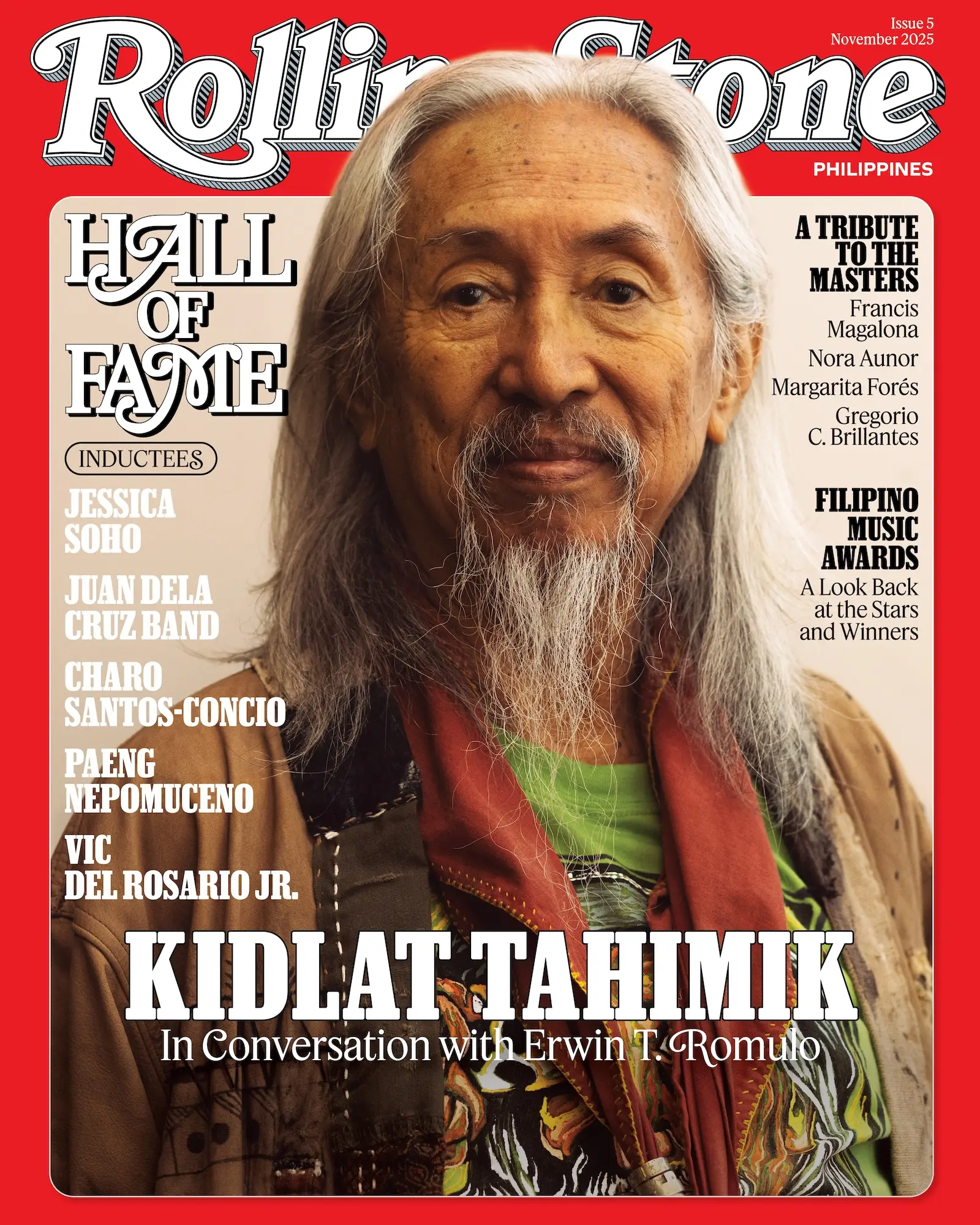
The first shot of Kidlat Tahimik’s film, Orbit 50: Letters to My Three Sons, begins with a storm, scenes of Baguio under heavy downpour. “20 days, no sun,” he says in voice-over. To him, this is a welcome portent. He was born in 1942, which was “the year of the Horse, in the cycle of Water.”
“In a few days’ time,” he says, “I will complete my 50th orbit around the sun…”
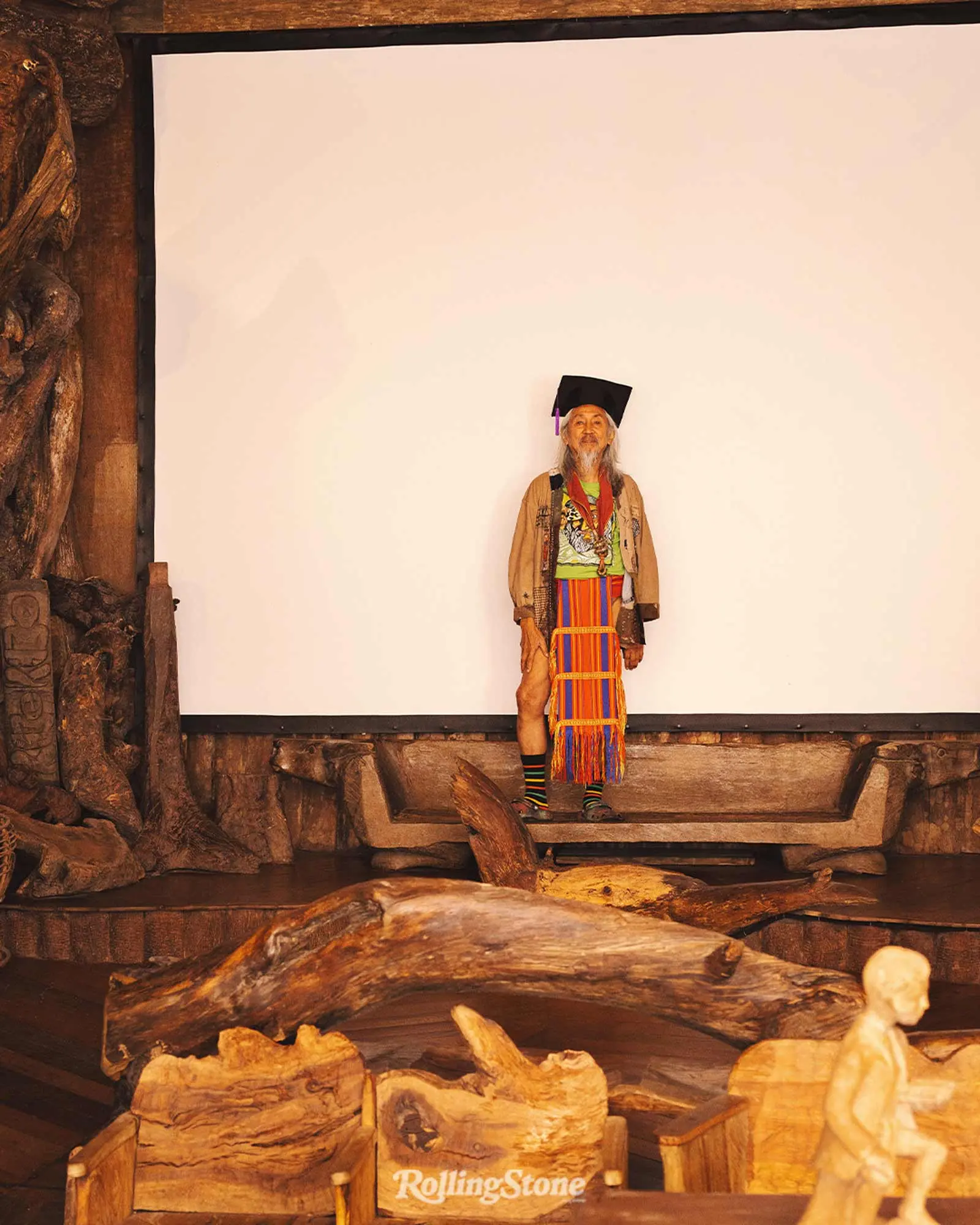
We are meeting Tahimik at his home. It feels fortuitous that we’re doing the interview on his birthday — his “83rd orbit around the sun,” to borrow his phrasing — and in similar conditions: Baguio in the middle of a typhoon. It’s been 33 years since he made Orbit 50. To be sure, the film isn’t about the weather or astrological signs. Neither is it a feature-length film. Shot on video, with a running time of 16 minutes 40 seconds, it’s part epistolary and part edited home movie. He made it when he was turning 50. “What can I share with my three sons [Kidlat, Kawayan, and Kabunyan de Guia] that the cosmos gave my life,” he says in the film. Ultimately, it’s them who give him the important lessons.
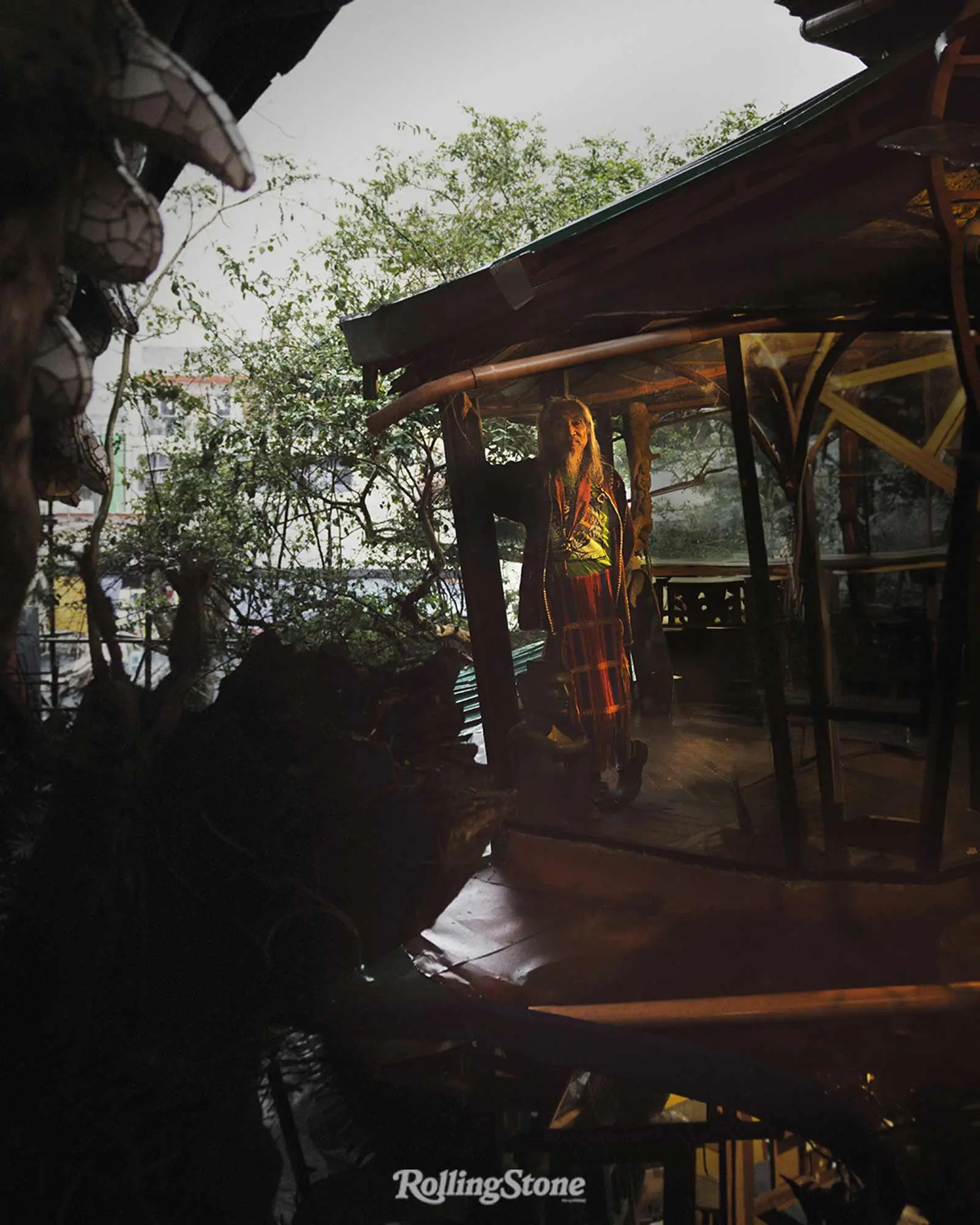
I met Tahimik here when I visited him last January. He told me then he doesn’t leave home often, not since Katrin fell ill. He says that again now. Katrin is in the other room. Like the last time, she won’t be coming out to join us. He always glances towards their room whenever he mentions her. They met 54 years ago in Munich. They’ve lived in Baguio since 1980.
Before becoming a filmmaker, Tahimik was going to change the world as an economist.
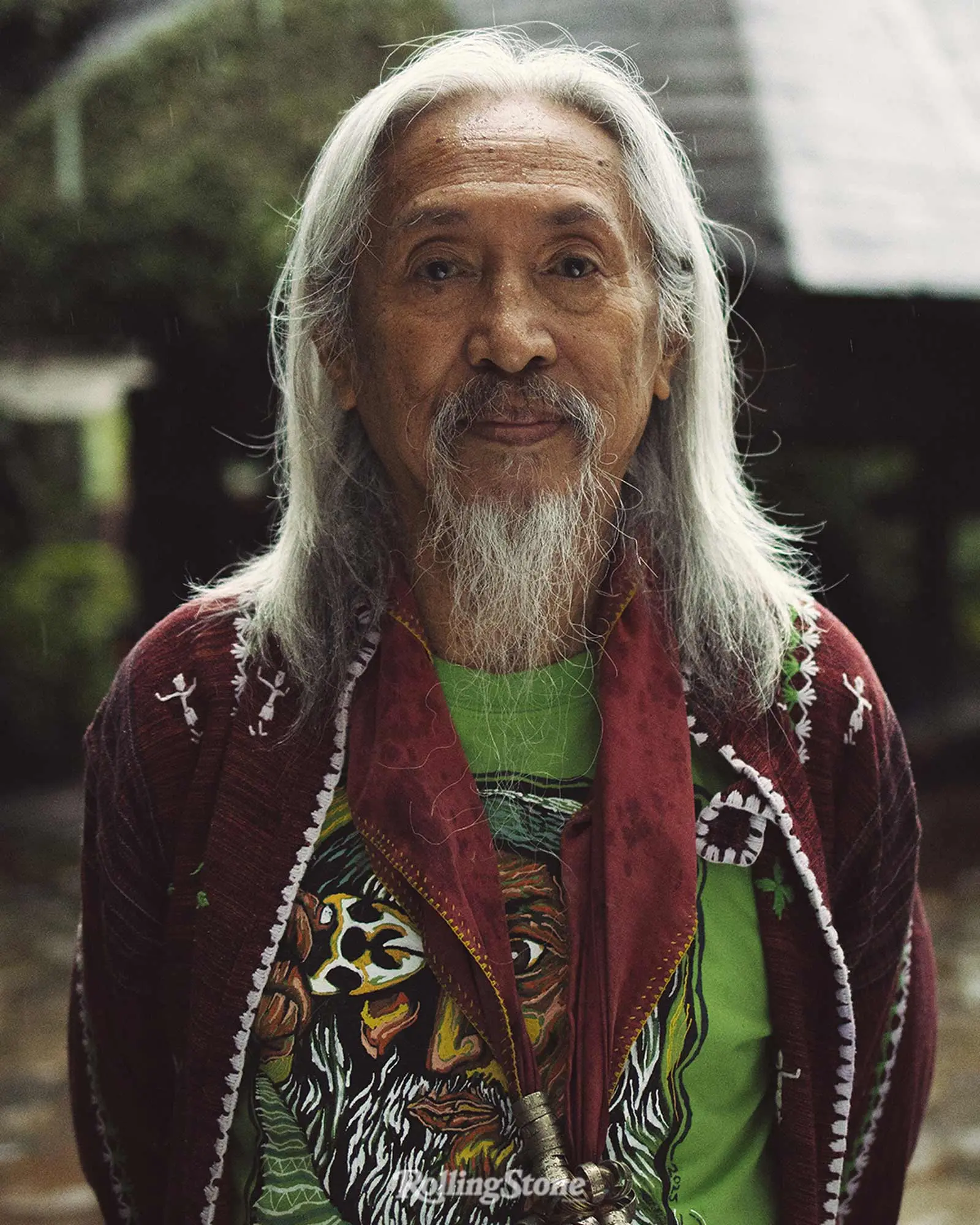
Economists love to claim Tahimik as one of their own by pointing out that he graduated from Wharton, the business school of the University of Pennsylvania. They tend to skip saying that he tore up his Wharton degree as “a promise to never go back to that life again.”
In recent years, Tahimik has become more prominent as an installation artist, with exhibitions around the Philippines — the Ibagiw Festival in Baguio, Arete at the Ateneo de Manila University, Art Fair Philippines in Makati, and the National Museum of Anthropology in Manila. He has also exhibited in venues abroad, like the Palacio de Cristal in Retiro Park in Madrid, Spain. The latter setting was particularly meaningful for him because it was “built in conjunction with the General Exhibition on the Philippine Islands in 1887.” It was also at the exhibition’s closing that his eldest son, Kidlat de Guia, died suddenly of natural causes.
We speak about Kidlat the son, and that time, how difficult it was to get passports and visas during lockdown. I tell Kidlat the father that I was messaging Kidlat the son one particular morning. Everything that could go wrong had gone wrong so I called to cheer him up. It was a mess, basically. And it was during the pandemic. At one point during our conversation, Kidlat the son just laughed and said, “It’s a Kidlat Tahimik production. What did you expect?” This makes Kidlat the father smile.
“I will continue to learn from you, my sons, in my next 50 orbits,” says Tahimik in Orbit 50. That’s how the film closes: with a promise for the future. Before I leave, I tell him it’s still my favorite of his films, also that I look forward to its sequel.
Erwin T. Romulo: Happy Orbit Day.
Kidlat Tahimik: I think this is the best birthday gift that I can get. Suddenly, I have a typhoon swirling over us.
The elements, basically.
Well, as a natural element, but then as a metaphor also for our cultural strengths. So, I didn’t realize when I had that for my ending for Perfumed Nightmare, where I blow down all the Europeans in a typhoon fit, that it would become a very major theme in my life. Do you remember that?
I remember that.
And somehow, the typhoons have also entered almost all of my films. The main line there is, when the sleeping typhoon blows off its cocoon — the colonial cocoon — the butterfly will embrace the sun.
Was it already a big topic then? Examining our colonial history in the arts, especially?
Well, I think colonialism, as far as Filipinos were concerned, was a big thing for certain nationalists, like, say, [Renato] Constantino and O.D. Corpuz. It was still very much a UP Diliman and Ateneo area kind of an orientation. But now, as a lot of writers have all these colonial and post-colonial discourses, it’s something that has become — I don’t want to use the word “trending,” but it’s a very “in” topic.
Everyone’s decolonizing.
I’m beginning to realize that my idea, or at least my framing of colonization, has evolved over the years. Kinapa ko, I think in the beginning. I started as an angry young UP graduate. “Putangina niyong mga kolonyalista!” I later realized it was coming from growing up in Baguio, the Hill Station. I grew up very American. I realized I was already so Americanized even before I went to Philadelphia for my MBA. And actually, thanks to my German wife, Katrin, I realized even more that I needed to de-Americanize myself. Because I suddenly realized, with my immersion in Europe and with Katrin, who opened my eyes to Kapwa Psychology, I later mellowed my anti-colonial feelings.
I think in the beginning, it was very much cliché. Everybody was like, “Go home, Yankee!” “Let’s get rid of the bases and imperialists and blah, blah, blah.”
It’s funny when the first critics were saying Perfumed Nightmare was a very autobiographical film. I said, “No, it’s not. I’ve never really been a jeepney driver.” And it was more a creation. But no, they said it was more autobiographical in the sense of an awakening. I realized that more only after I left the Philippines.
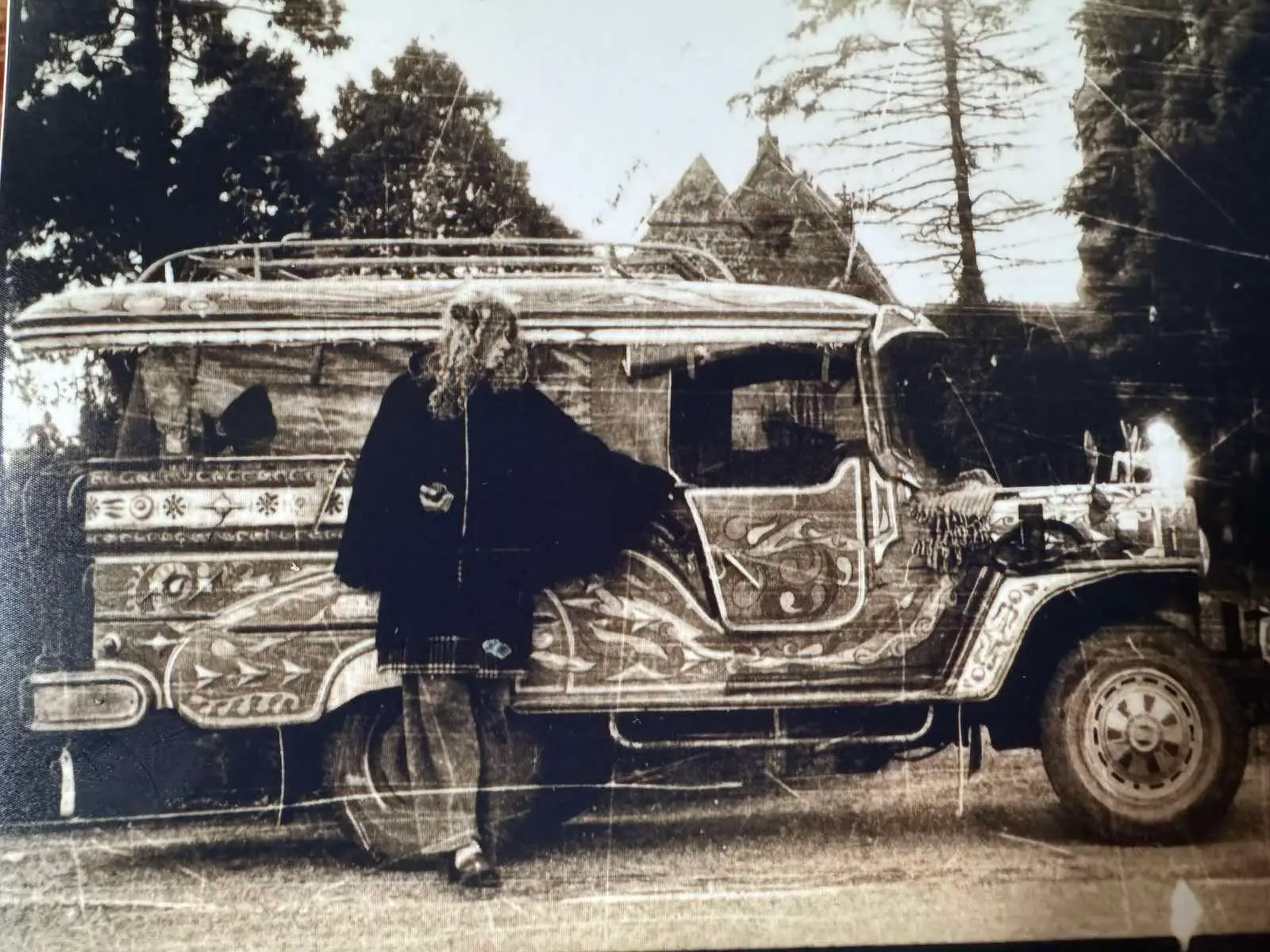
“This is where kapwa culture, that Katrin has made me very aware of, comes in. I keep thinking that if we strengthen the kapwa culture, it can be a very strong self-regulator or self-preno.”
Was there a eureka moment where you kind of made the switch? Because you were working in finance in Europe.
Okay, my thesis at Wharton was the debt servicing problems of developing countries. And I opened with a Shakespeare line. I chose that line from Shylock [in The Merchant of Venice], where Bassanio is lamenting that he has lost all his goods at sea. The ship is bringing his export goods, import goods, and the money that he had borrowed for that was Shylock’s. And now he was going to lose a pound of flesh. So it was the same analogy.
What was the exact line?
I don’t remember the exact line, but it was maybe a three-liner to introduce the debt servicing problems of third-world countries. We’re all tied to crop exports mostly. Now it’s all computer chips and all these kinds of software, but before it was mainly sugar and tobacco. The moment you have a typhoon, ‘yung utang mo, ‘di mo mababayaran agad. Anyway, that was the general thought of it.
But yeah, you’re asking if I had a eureka moment. I think it came later when I was working in Paris as a researcher for the Organization for Economic Co-operation and Development. I worked there as an economic consultant. And I think I was doing fertilizer distribution studies. I became the expert on fertilizer distribution systems in third-world countries… Were you already born in ‘60?
No, I was born in 1976.
I was working with this organization and discovering ways to increase a lot of yield. The first selling point was that, “Wow, all these poor countries will not have to import food anymore!” But, it was really more of a ploy for European and American companies to sell more chemical fertilizers, more pesticides, more tractors. It had that hidden agenda. I think that was my eureka point. I realized that the longer run effect was for the benefit of Europe and the Americans. That’s when I decided to write a play. Don’t forget, I was a drama major.
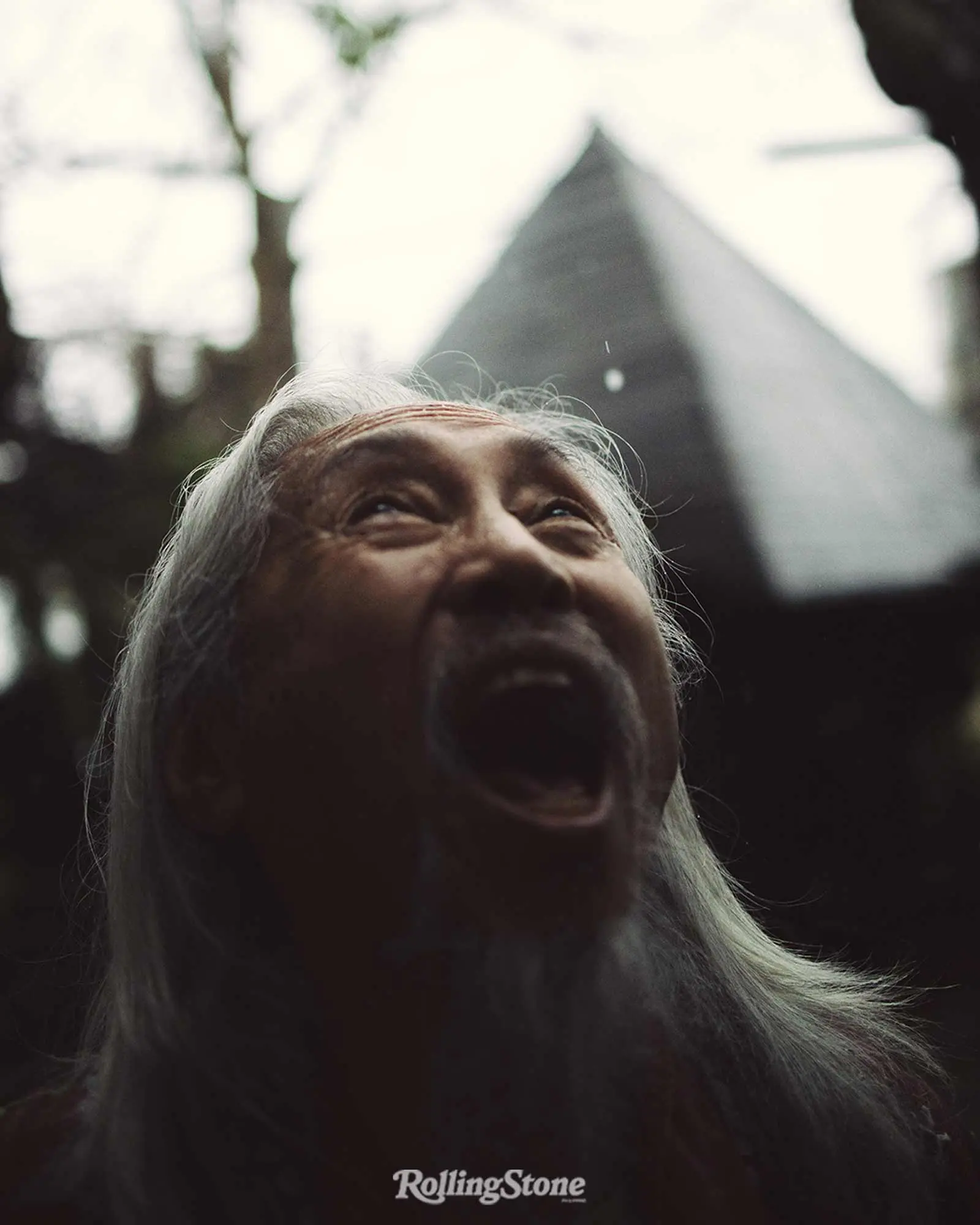
I didn’t know that. Just that you were head of the student council.
I was a drama major at UP, batch 1963. I was with Lino Brocka, Ben Cervantes, and Boots Anson, who was one year behind us.
So while I became an economist, I had this constant urge to break out of that cocoon and go back to the theater. That became my outlet. I wrote a theater play, and it was about a third world country trying to break out of the economic grasp of the developed countries. That was my eureka moment.
How are you today? It’s your 83rd birthday.
My 83rd orbit, I’ve just completed it. I think I have to accept my physical condition that I can’t just go out and do field productions like I do. I’m still strong enough to climb up the rice terraces. At the moment, I’m a 24-hour caregiver to my wife, which sometimes can be just frustrating because I want to do this, I want to do that. But I think I’m still creative.
Have you been following the news lately?
You know, everybody’s talking about reforms; do this, do that. It’s a whole cultural problem that creates that unbridled greed. I mean, greed is part of every culture. But there are preno systems within our culture.
Preno systems?
I call it the cultural preno. It was already in Katrin’s book when I talked about culture as both an engine of a people, a collective engine to move in one direction. But our culture also has a preno system to balance your forward thrust. It’s like a sports car engine. Even if your engine is really good, but if you don’t have a good preno system, you will never get to your goal.
Like a yin and yang.
Yeah, that’s it. It’s the same. It was just a physical, mechanical metaphor. But the yin and yang, samsara and nirvana, you know, we have to just balance those forces.
But when colonialism imposes its own set of values, I think it tampers with the brake system.
You’ve seen this all before. What is it like to see this, and not get cynical.
Yeah, the thing why it’s recurring is because the solutions are always, for me, band-aid solutions. They always think it’s just plugging the holes. I think that’s a cultural problem.
With my own biases about film, I say Hollywood is a big contributor to our loss of brakes. We’re always being infused with whatever values come in, whether it’s in entertainment or whether we go to get an MBA or whether we are swallowed by American culture, the Wall Street culture, growth for growth’s sake, especially in your own bank account…
I think 99 percent of people who studied in Wharton or Harvard or Cambridge come back, and they have their specific great models for development, but it’s based on the premises of Western capitalistic growth.
But I think in the end, this is where kapwa culture, that Katrin has made me very aware of, comes in. I keep thinking that if we strengthen the kapwa culture, it can be a very strong self-regulator or self-preno.
“As a German living in the Philippines, Katrin has been able to see certain differences in the way we approach life or how we approach problems. So, kapwa, as a value, she has pointed it out as a strength.”
Can you tell me more about Katrin?
When her book (Kapwa: The Self in the Other (2005)) first came out, I don’t think people really understood it. But I think now it’s become — to use our word earlier — trending. Katrin, as a foreigner, as a German, framing Philippine culture in this way has made it more palatable for people to recognize the field of indigenous Psychology by Dr. Virgilio Enriquez. He was her mentor; it’s a field that is just slowly getting to be recognized. For me, the main thing that struck me about Enriquez was his question, when he said, “How can we understand Filipinos if we already studied them through Sigmund Freud and Carl Jung?”
We have to develop our own methodology based on our core values. And that’s our starting point. And it can be scientific, but most of our people who got their PhDs in Psychology and are now the heads of the Psychology department are resisting that.
They are?
There’s a strong resistance. Katrin almost didn’t get her PhD because the Psychology department was very conservative.
What was your relationship with her like?
I always say there’s nothing more polar than a Filipino-German relationship. Culture-wise.
How do you make that relationship work?
You always get into a kind of gridlock. And then you realize, “Hey, we’re not really fighting.” We don’t hate each other, but that gridlock is because your protocols from your culture are different from our protocols in our culture. So a German wife has many protocols. Even just the small thing of closing the door because the winter air comes in. My wife often tells me to [pointing to bottles on a table] always close the lid. These are very simple things, but now I am beginning to also see that the word “protocol” is now an important word in my analyzing of what happens to us as a couple and maybe what happens elsewhere. And as a German living in the Philippines, Katrin has been able to see certain differences in the way we approach life or how we approach problems. So, kapwa, as a value, she has pointed it out as a strength.
How would you define love?
I think love starts with a kapwa feeling. So let’s just say it’s a cultural water table of ginnhawa. Later, it can become a great love, explosive love. It can become many things that we see in films, pero, I think, with a very steady kapwa love, which becomes also a sustained friendship and a sustained including of the other, nagiging bonding ‘yon ‘di ba? So, which comes first, the bonding or the love? It can come either way.
†Since this interview, Katrin Muller-de Guia, artist, author, scholar, and proponent for Filipino Psychology, passed away in Baguio. She was 75.
Read the rest of the story in the Hall of Fame issue of Rolling Stone Philippines. Pre-order a copy on Sari-Sari Shopping, or read the e-magazine now here.