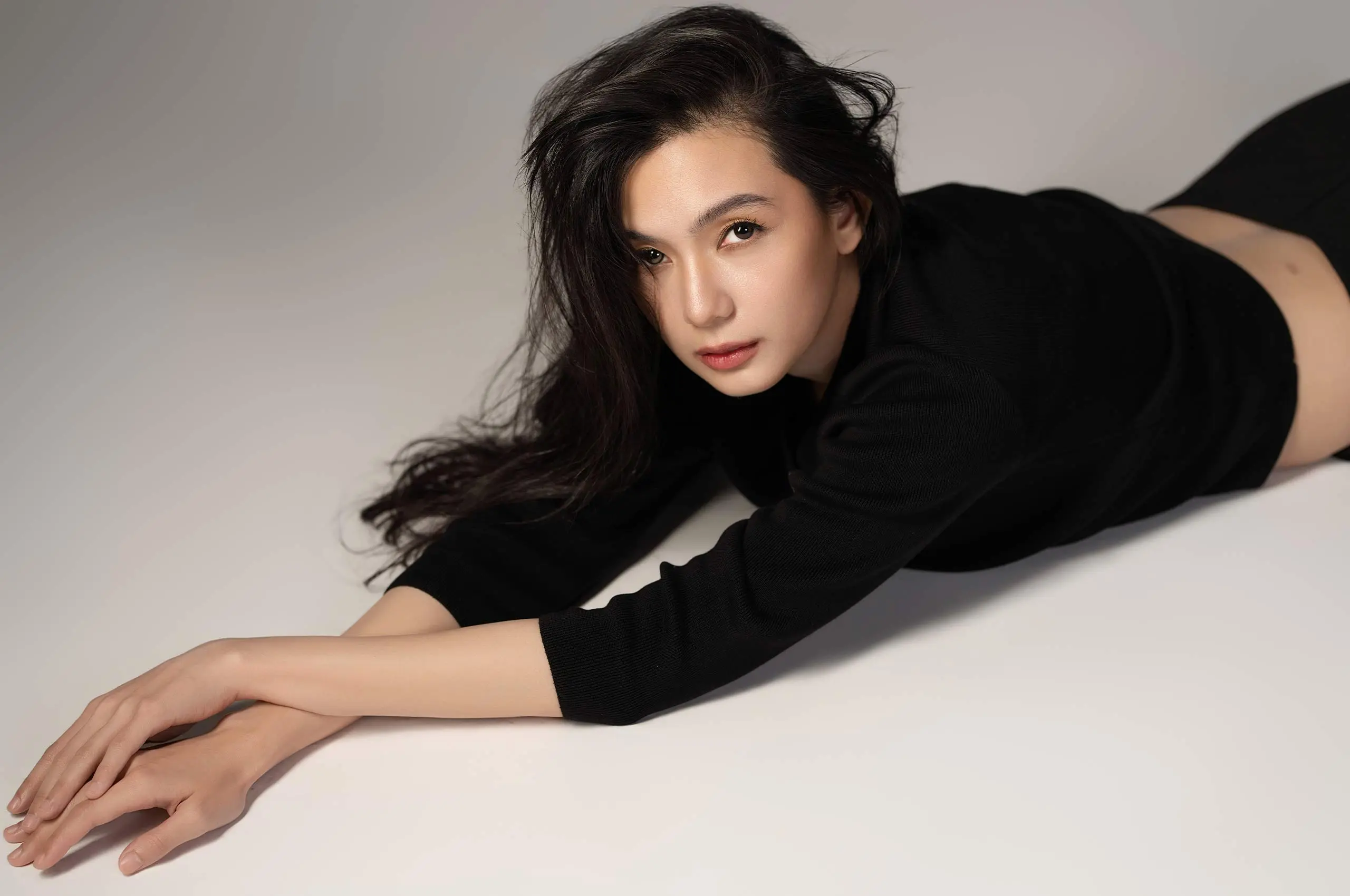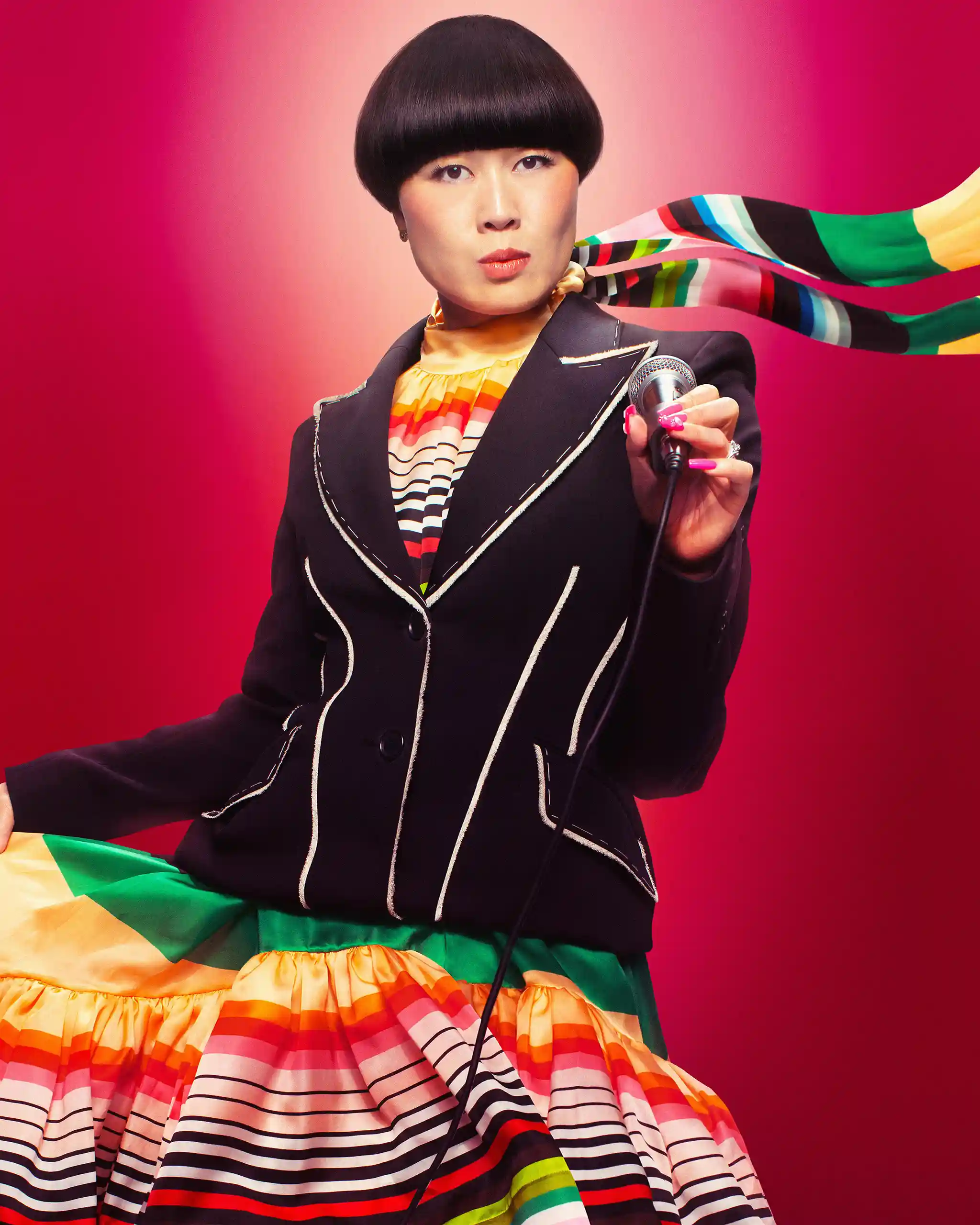
A few weeks ago, I snuck into a corporate event. I’m not proud of it, but I’m also not sorry. Nobody stopped me anyway, which is how I found myself in the too-cold ballroom of Conrad Manila, where the crowd had moved on to wanting to go home. It was a Monday evening, the program was an hour late, and the dessert plates were already on their way out. Finally, at 9:30 p.m., the host introduced the reason I went in the first place: “The main act of the evening, flown in especially for us: Atsuko Okatsuka!” The applause sounded thin and a little unsure.
With a freshly blow-dried bowl cut, baby-blue earrings and matching nails, and an asymmetrical white blouse, a brief flicker of concern crossed Okatsuka’s face. When she was here last, she sold out three nights of the Full Grown Tour to Gen Z and millennial stand-up fans. That night, she was the main event of a corporate gala for mall executives and tenants.
Okatsuka looked for an opening. The hour she was taking on her Big Bowl Tour called for quiet and focus; the ballroom offered neither. She raised the lights, circled the room, and interviewed a few tables. After several painful attempts, she offered a clean cut: “I don’t think a stand-up comedy act is fit for an event like this. What do you think?” She said goodbye and exited. Comedy’s promise is love; its price can be shame. Okatsuka, a consummate professional, knows when the calculus doesn’t add up. To bomb out is sometimes the wisest choice.
That morning, I had the best seat in the house: Okatsuka’s rapt audience of one. Over tea at the hotel lounge, she talked of her love of observing people. “That’s very important in comedy — to watch people, how they live, what they think,” she tells me. But it was first a skill she picked up out of survival. As an immigrant in America, she learned to read faces and bodies when words failed. It was how she understood and made herself legible. “All my life, all I want is to be accepted, to find where I really belong,” she says with a chuckle.
Not all comedians like people. Some take to the stage as an outlet for their misanthropy. Not Okatsuka. In my bag, a jug with her tour sticker that reads “Atsuko Is My Friend” knocked around as proof. Onstage, she’s said it plainly: She’s dedicated her life to making people feel good, even with every terrible thing we do to each other and ourselves. “I love people,” she says without hedging.
From TikTok to El Capitan
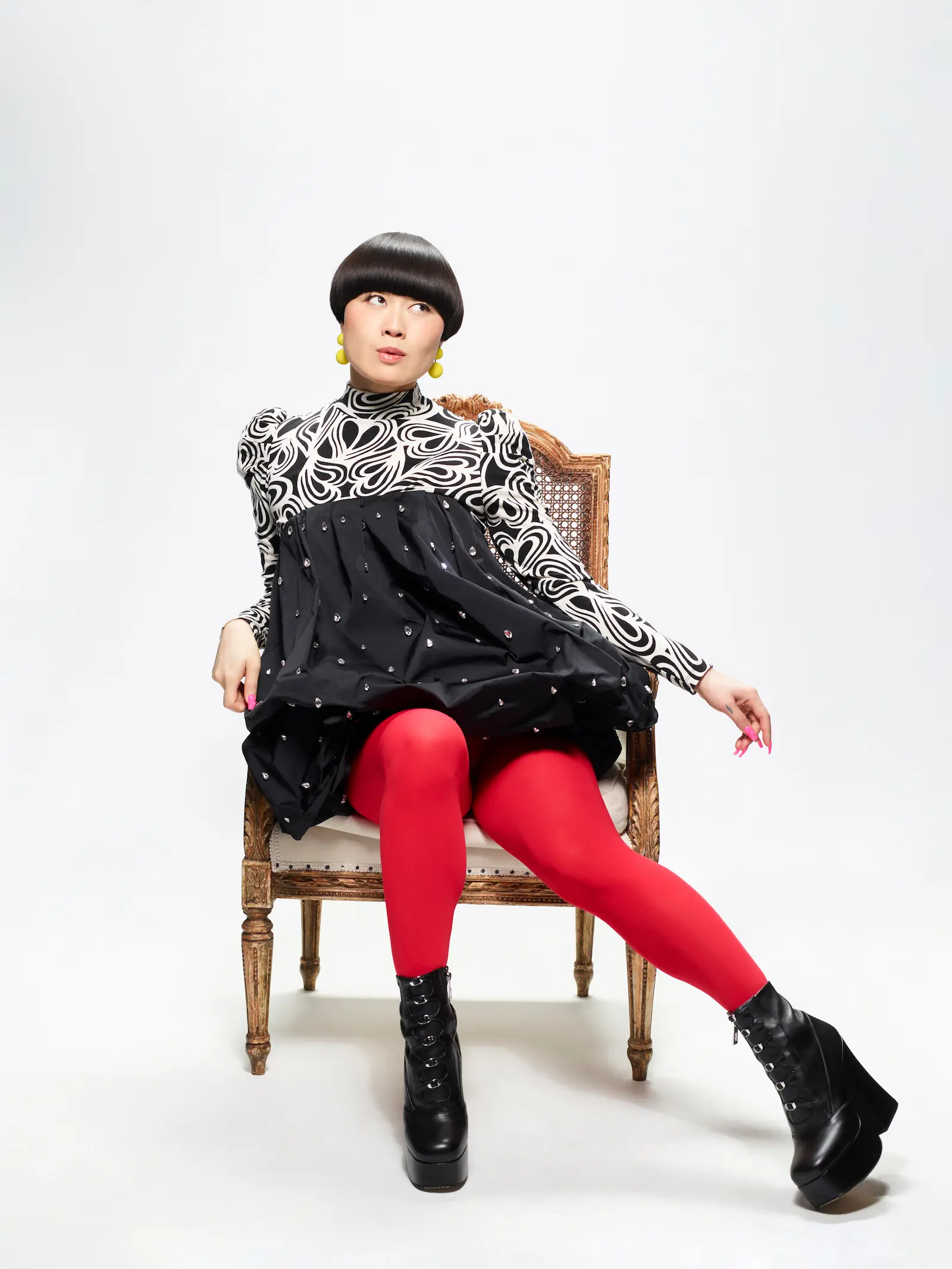
Stand-up is hard. Harder still when you’re a woman who isn’t white. While equality and accessibility have improved, things could still be better. In the past five years, only one in four commissioned comedy specials went to women. Besides gender, stand-up is also still primarily dominated by Americans, of whom Netflix’s comedy slate comprises 89 percent. In that landscape, the list of women of Asian descent with major hours is still short: Margaret Cho, Ali Wong, Zarna Garg, and Okatsuka. Following her meteoric rise to internet stardom (thanks in part to her viral Drop Challenge, where she’d drop down to the floor to the beat of Beyoncé’s Partition), she became the only other Asian-American woman with an HBO stand-up special, The Intruder (2022), roughly two decades after Cho. More recently, she taped her follow-up Hulu special Father (2025) at El Capitan, Disney’s movie palace on Hollywood Boulevard, and became the first woman ever to perform on that stage.
“We could never afford to watch movies in there,” she tells Jimmy Kimmel during an interview, recalling the days that she and her Grandma Li would walk past and marvel at the historic venue. “But years later, here I am doing a craft in a language that isn’t mine.” Amidst the applause, she adds, “I didn’t have to pay to get in. Other people had to.”
Okatsuka’s brand of comedy is a sincere sort of silliness. The “toddlercore” wardrobe and buoyant physicality let her approach harder things without hardening into scorn or sarcasm. The observations are unhurried, and the payoff is often deliriously absurd. Take, for instance, her dreams of a tandem bike for her and her actor-painter husband, Ryan Harper Gray. It’s a way to let everyone know that you’re together. More practically, no one would steal a tandem bike. When I tell her that it’s probably too dangerous for such a thing in Manila, she reasons, “But you’d be seen more, because now there’s two of you. So people would dodge you faster.”
“I mean, I guess… We’d die together, so that’s not so bad.”
“That’s true. And that’s double the money your family gets in benefits or if they sue.”
Okatsuka has a large global fanbase. Outside of North America, Okatsuka visited 16 cities on her Full Grown tour, from Reykjavík to Jakarta, which is why her comedy extends beyond American life, like the state of universal healthcare. Okatsuka hypothesizes that the harder a country laughs, the more they are suffering, often because of poor healthcare. By her estimation, the Philippines ranks second after Indonesia.
“That’s why Belgium doesn’t laugh. They have it too good,” she tells me.
When writing her jokes, she thinks about audiences beyond the United States. “I try to make sure it makes sense internationally,” she says. How? She points to the way she was wired. “Yeah, it’s my brain. I was an international kid. English is my third language. It helps that I didn’t do good in school, so I’m not using big vocabulary. I’m not a lawyer.”
“I wanted to make movies about the things that I love. I joke about the things that I love, but the things we love are complicated and complex.”
The Many Attempts of Atsuko’s Becoming
Okatsuka grew up across three cultures: Japanese, Taiwanese, and American. Born in Taiwan, raised in Chiba with her father (who had full custody), Okatsuka went to the U.S. with her grandmother for a “two-month visit.” She, her grandmother, and her mother stayed, undocumented, in an uncle’s garage in Los Angeles. Hence, the word she uses for it: kidnapping.
She grew up translating herself. “Sometimes, when I’m trying to express something, I literally use a sound,” she says, then grunts. The translation extended past language into identity. She kept trying on selves and different looks to match. At 17, she tried piercings.
“I had a nose piercing, one nipple, belly button. None of them healed well. In the States, you have to be 18 to get piercings without a parent. But in Venice Beach, there’s this woman we called ‘Mama-San,’ she would pierce any child, any age. She doesn’t care. She just wants money. She does not give a fuck. So I went to her. But because she was doing it illegally, it wasn’t healing well.”
“Did they all close up?”
“Yeah. One was almost infected. My nipple.”
Life in L.A. came with an Orange County chapter: flared jeans, Abercrombie & Fitch, a few bleached pieces in her hair. Her love of dance led to cheerleading. She was the only Asian girl on a squad of mostly Latinas and Black girls. “For a couple of performances, they put cornrows in my hair,” she says. “There are pictures of me looking like Sean Paul.”
She pursued a Psychology degree at the University of California Riverside before switching to film at CalArts. Along the way, she met Gray. If you follow her work or her socials, you probably know him by name. He’s in the quick snaps at the grocery and the longer videos, like the one about his recent vasectomy. They “married” in 2017 (they discovered the paperwork was never filed, so they officially married in 2023). He’s both co-conspirator and muse. He co-produced a game show called Let’s Go, Atsuko, where her famous bowl cut first appeared. “When Let’s Go, Atsuko was bought as a TV show and we filmed the pilot,” she says, “I thought: I should have a game show host look; something clean, an homage to Japanese game shows. I also had this (hairstyle) as a kid, so it felt full circle.”
“You have to try so many things and realize, ‘Ooh, that’s not me,’” she says. “That helps, though! To do things you don’t like to do, or wear things you don’t like, or know what you don’t like. It will help you get to who you are quicker.”
Officially her creative director, Gray works on her visuals and her merch while also helping her write. “He can think as an extension of me,” she says. Father, the Hulu special Gray directed, takes its title from a simple domestic audit: Okatsuka hadn’t done the laundry in their years of marriage. By her own telling, she was the irresponsible spouse, a.k.a. the “husband.”
“I am father. Now, Ryan, that’s mother,” she tells the crowd.
Before Okatsuka pursued comedy full-time, she wanted to become a filmmaker. Her 24-minute documentary In Waiting trails her grandmother and mother across L.A., accompanying them to psychiatric appointments, errands, and gentle bickering against the backdrop of suburban California. Okatsuka is barely in the film: an occasional voice from behind the camera, a mostly silent observer.
“I wanted to make movies about the things that I love. I joke about the things that I love, but the things we love are complicated and complex.”
Deep into the Joke
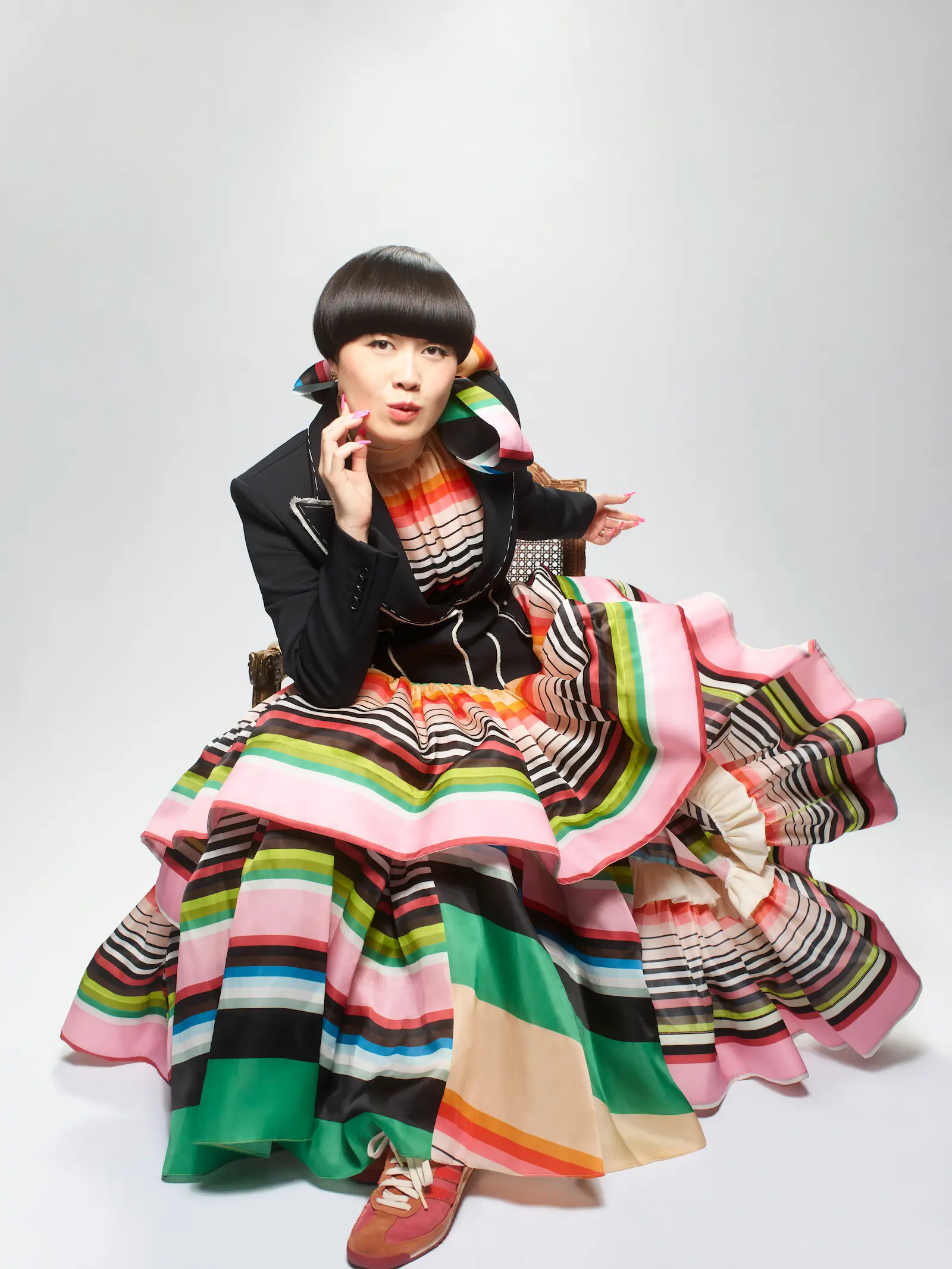
“I’m an open book. That’s my problem,” Okatsuka tells me. The big arcs of her life aren’t hidden: the grandma who “kidnapped” her to the U.S.; growing up with her mom, who was diagnosed with paranoid schizophrenia; and a reunion and re-telling of the past with her father (via an interpreter) on the podcast This American Life. How does she know when private matters are ready to become public material?
“I’m still learning,” she replies. “Initially, it was when it felt like [the story] has become a funny joke, then I can talk about it. But if it’s not ready to be a joke, then I’m not ready, the audience is not ready. Then it’s only a sad story.”
“These days, I’m trying to look at the bigger story first. And trust that the audience is willing to go on the bigger story with you… because sometimes, when you go deeper, it becomes even funnier,” she tells me.
In one of her sets, she recounts a reunion with her dad. A beach in Japan made it obvious: side by side, they share the same body frame. Then she flips what should have been a heartfelt realization into something kind of gross: “Ryan always tells me I have a hot bod… I have the body of a Japanese engineer.”
Despite every tragic thing, Okatsuka keeps finding the right joke. She yes-ands her way through the wild stuff — being an undocumented immigrant, a dysfunctional family, and the question of where you belong — and somehow lands on a story’s funniest, slightly off-kilter resolution. From a distance, tragedy often turns into comedy. When I asked about her tour stops in Taiwan and Japan, she referred to them as a homecoming.
“Sometimes, you really want to be seen by your own people the most. It’s that classic, ‘I don’t deserve to come home until I’ve accomplished something big. Then I could come home.’ They say, ‘Go away, go away,’ then when you do well in America, it’s like, ‘Please come back.’ When you find success outside of your home, right, then your parents go ‘Please, oh my god, we miss you. Where have you been?’ Bitch! I’ve been trying to come home.”
After a beat, she adds, “Taiwan was a little more shy than Japan as an audience.”
“Really?”
“Better healthcare, maybe?”
Maybe the crowd at Conrad is just another one of those little tragedies. Or maybe it isn’t. By morning, she’s moved on to Philadelphia, where rooms and crowds await her set. If the Manila ballroom moment will ever make it to her material, I imagine it’ll be funny; I know it will be deep.
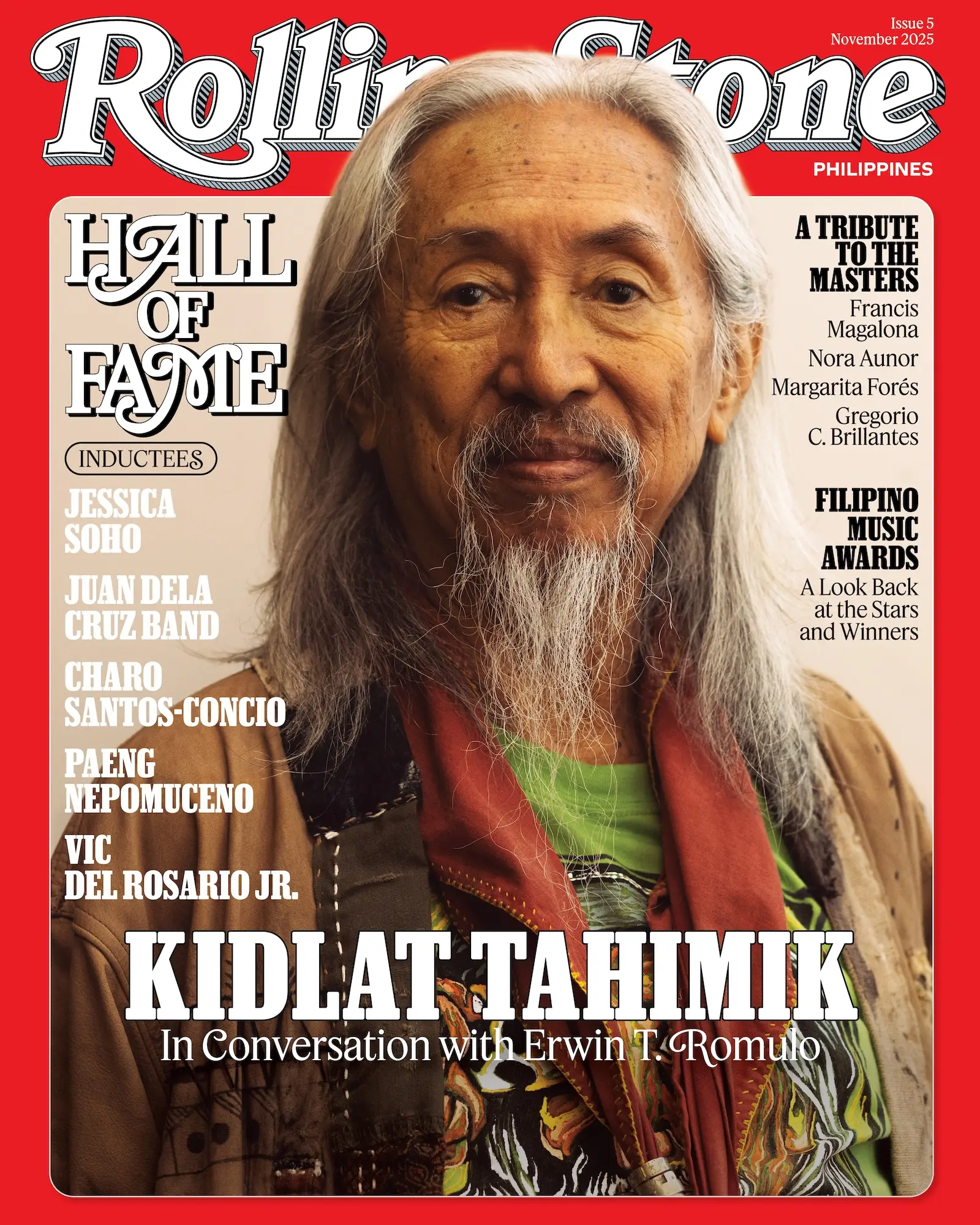
Rolling Stone Philippines November 2025 Issue, Now Available at SariSari Shopping