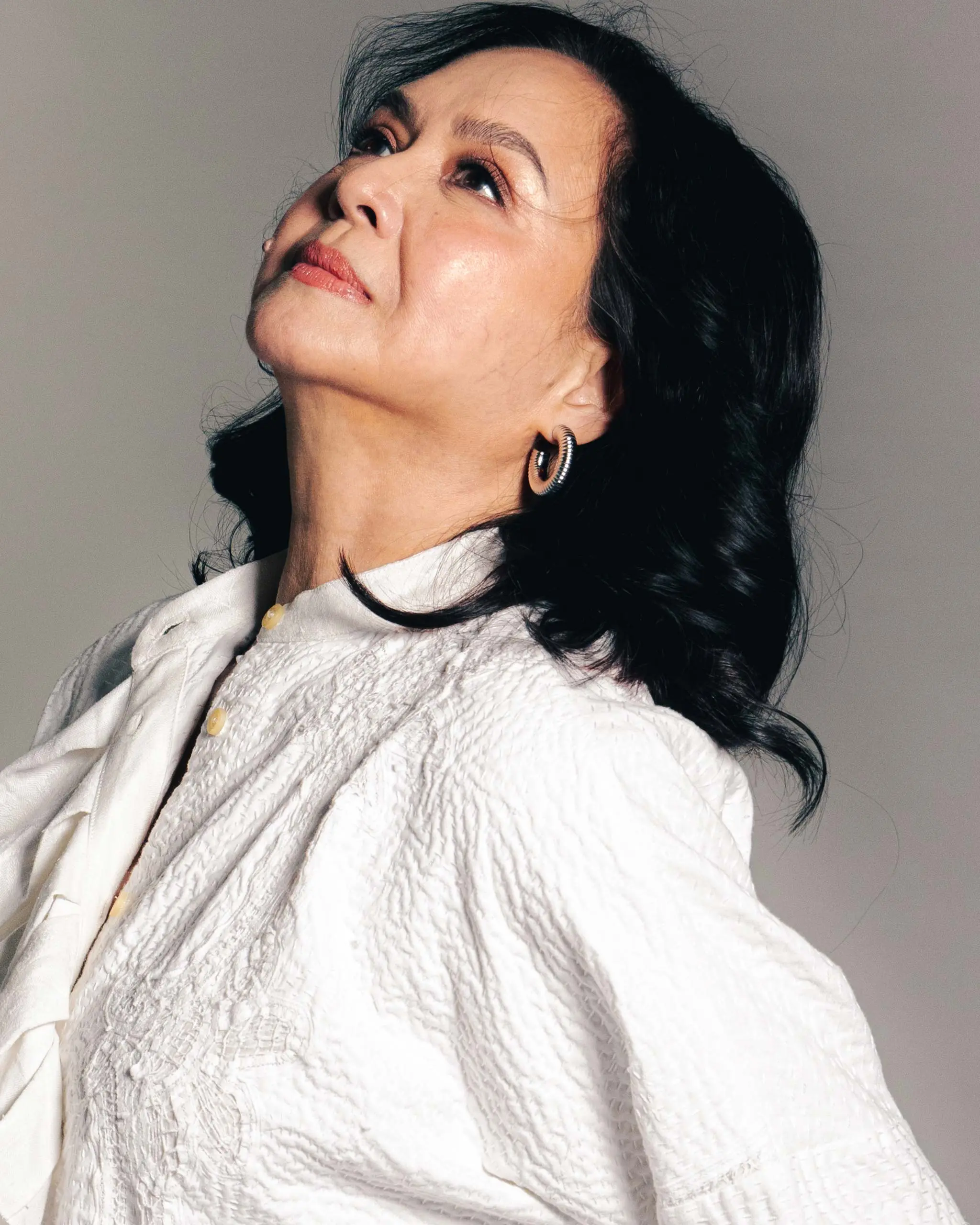
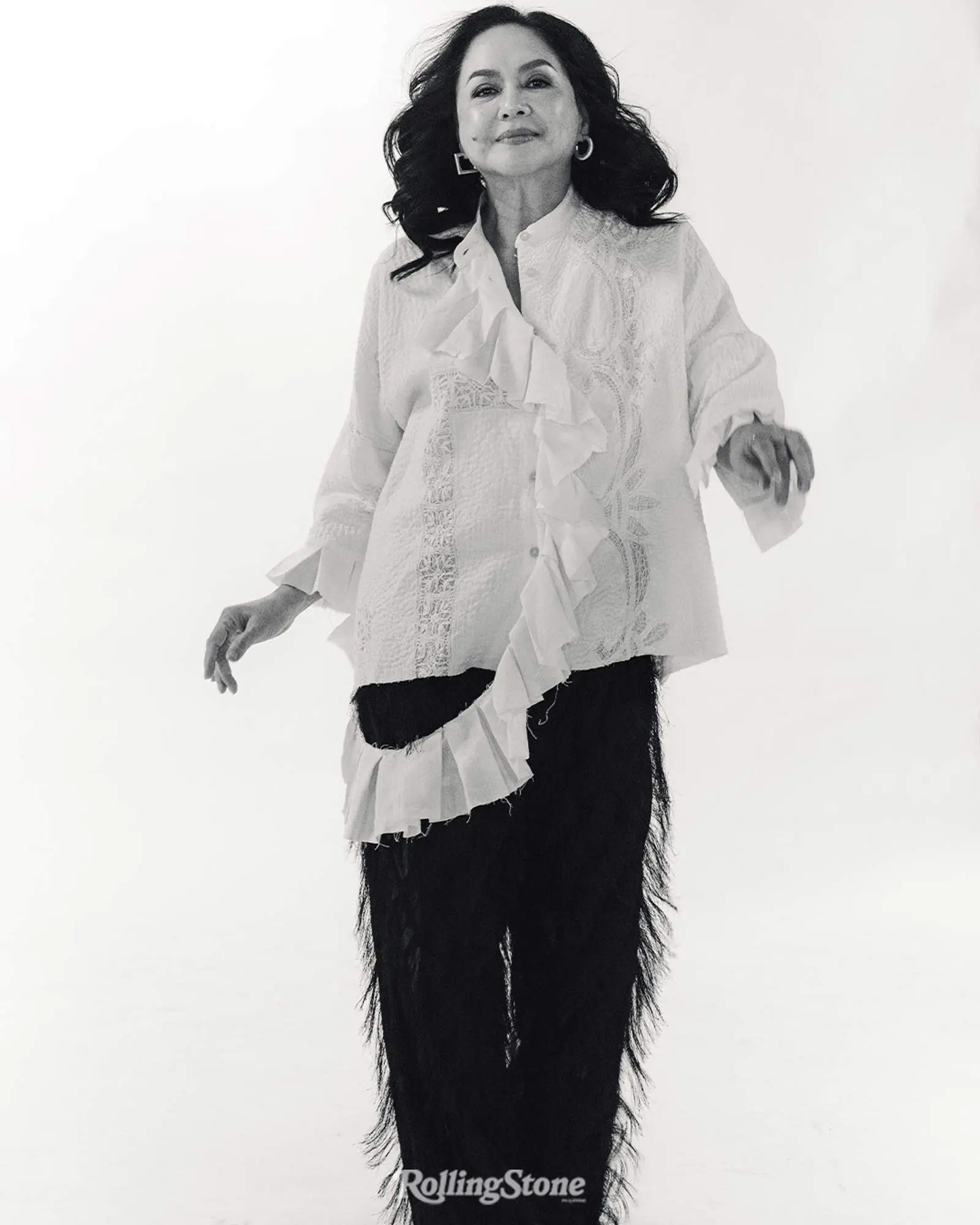
Charo Santos is changing in her dressing room, and her entourage is swinging through the doors, scurrying to prepare her first look. The studio’s staff huddle outside and chirp at her presence, which commands everyone’s attention even when she’s out of sight. One person mistakes her dresser for a meeting room, asking a bystander if he can enter.
“Sinong nandiyan?” he says. “Si Ma’am Charo,” they retort, as if her first name suffices as a clue. The onlooker resigns to this immediate understanding that some names simply don’t require introductions.
This hectic environment doesn’t faze Santos, who has seen every nook and cranny of the Philippine entertainment industry. As an actress, she has appeared in some of Philippine cinema’s most dramatic roles, including Mike De Leon’s 1976 supernatural horror Itim, which saw her win Best Actress at the 1978 Asian Film Festival; Lino Brocka’s 1990 crime film Gumapang Ka sa Lusak is also of note, sweeping the 1991 awards season with Best Director at the Filipino Academy of Movie Arts and Sciences (FAMAS) Awards, and Best Film at the Gawad Urian Awards.
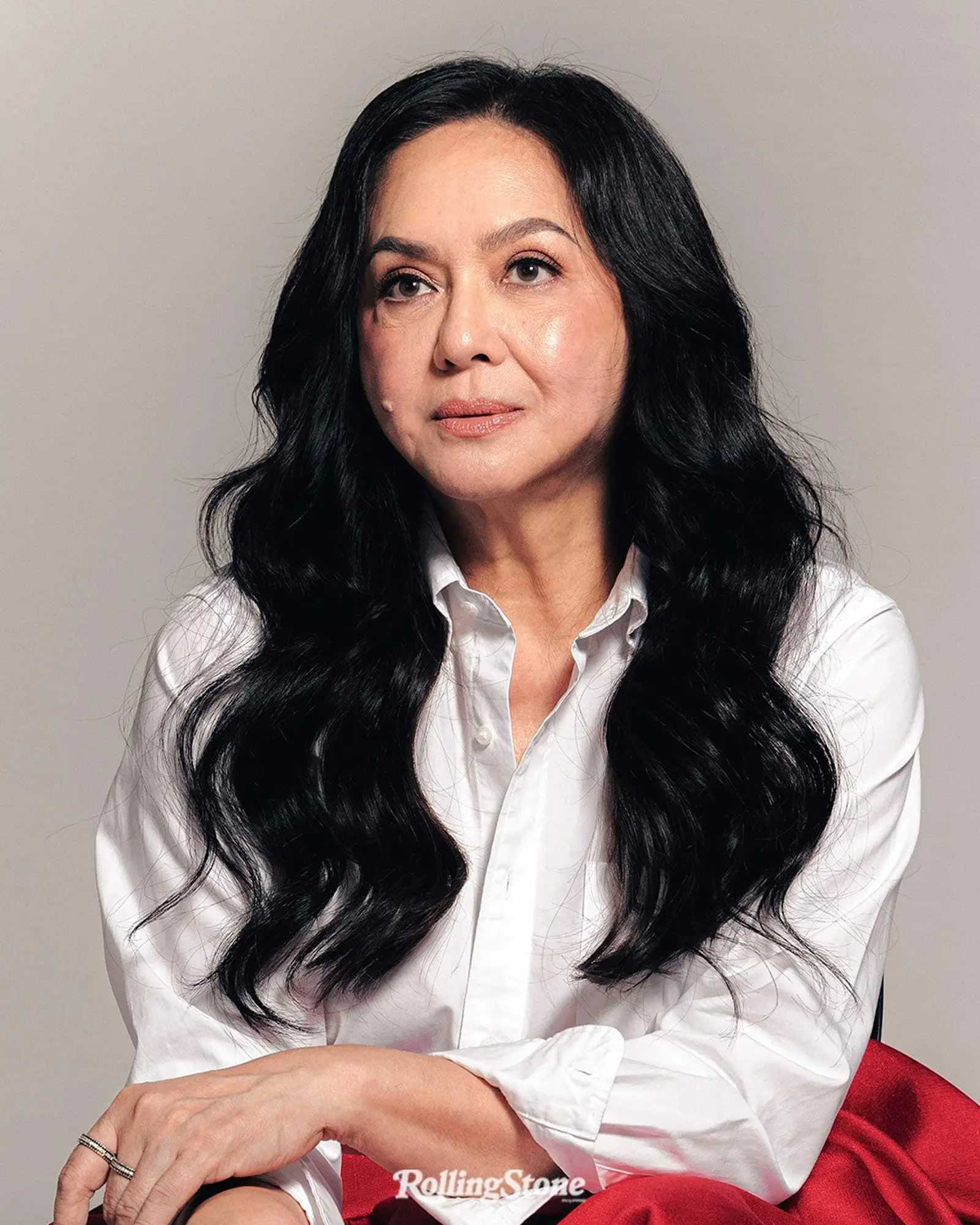
Behind the camera, Santos is hands-on and doesn’t shy away from the nitty-gritty that comes with being a producer. Having helped bring more than 350 films and television shows to life, she certainly knows how the deadliest of details can make or break a production. On our set, Santos shared a trade secret as the technical crew clipped a lapel mic on her red silk top.
“You know you can remove this, right?” she tells the team, pointing at the clip of the lapel mic. “And use Leukoplast tape. The more maarte the garment, the more you’ll need it,” to which the crew studiously took notes. Whether it’s producing Peque Gallaga’s historical war film Oro, Plata, Mata, Ishmael Bernal’s religious drama Himala, or Erik Matti’s neo-noir thriller On The Job, Santos not only has an enviable oeuvre, but she belongs to a profession that is not for the faint-hearted.
This resilience allowed Santos to take on the role of chief executive officer of ABS-CBN Corporation in 2012, managing the largest entertainment and media conglomerate in the Philippines until 2015. There, she weathered the company’s dips in ratings, shifting audience preferences, and the advent of digital streaming with the grace and composure of a seasoned stateswoman. Yet, at 70, despite the many lives she’s lived as Philippine entertainment’s beloved matriarch, demanding excellence at every instance, she still has the curiosity of a newbie just entering the industry. In this illuminating interview, Santos chronicles her beginnings, what she has learned about “growing up,” and why, at the very core of her being, she is, above all, a storyteller.
Napakaganda ng taste mo sa pelikula and I think it’s obvious in the projects that you’ve been involved in, whether that’s Himala or Oro, Plata, Mata. I want to know what’s your favorite film in the whole world?
Andami, mahirap e. In my teen years, I fell in love with the movie An Affair to Remember of Cary Grant and Deborah Kerr. That makes me a romantic at heart.
Why do you like that film?
Outside of the beautiful performances of Grant and Kerr, it was this sense of longing for each other, of wanting to see each other again but destiny got in the way. There’s something very romantic about it. There’s also a bit of tragedy in it. It’s the complexities of life. Sometimes what’s meant to be doesn’t happen. And me as a viewer, I try to imagine what could have been.
How does being a romantic inform the way you navigate life?
It’s a beautiful feeling of going through the experience of discovering things, just like falling in love, just like discovering the beauty in another person. So there’s always this sense of curiosity, of wanting to know the person, of discovering what’s beautiful about the person. I think that’s how I navigate life. I always want to discover new stuff. I’m not afraid to take risks. I go for adventures. The journey is the one that excites me and I look at the lessons learned after.
I read a profile about you where you said that you would wait outside the studio gates of ABS-CBN and just watch out for the stars and your idols. Who were those idols that you were waiting for?
Ang mga idols na inaabangan ko? Guy and Pip. I was really an avid fan of Nora Aunor and Tirso Cruz III and I didn’t care about any other love team but Guy and Pip. I used to collect their photographs, read everything about them. I would buy comics from the sari-sari store, even if our father would apprehend us about reading comics. I would always listen to the radio programs of my favorite stars and imagine a world where these two people are so in love. Kinikilig ako! When I see chemistry between an actress and an actor, I already imagine all the beautiful things in life. There’s this sense of kilig. I start feeling giddy. I start imagining, “Ano ba ako? Si Snow White ba ako at si Cinderella?” I don’t know. [Laughs] You know, this thing of finally meeting your Prince Charming.
What do you think about this idea of kilig in Filipino culture? Especially in film, I feel like it is such an important ingredient when it comes to the chemistry between the actors. The plot, kailangan may konting kilig, may konting hugot. How have you made sense of that in your career?
Most of the Star Cinema movies are romantic comedies. And I think, modesty aside, Star Cinema portrayed romance the best. The way we pair actors also, we kind of see chemistry between the female lead and the male lead and it becomes magical, that chemistry becomes magical. Kilig offers relief. I think it brings a lot of relief to the viewers, and it brings you to a place where you imagine the beautiful things in life even for two hours.
“I’m very, very passionate about what I do. There’s nothing halfway about me.”
When you first became an actress in the ‘70s, in Mike De Leon’s Itim, the magazines were portraying you as a “nice girl,” but also “too intelligent,” “too confident” at “masyadong mataas ang standards.” How did you navigate those labels, and did it affect the way that you chose your roles?
I’m not sure about the “too confident” ha kasi I was a very, very insecure provincial lass. I grew up in the province and that was my first opportunity to act in the movies. Maybe I handled it with grace, but grace doesn’t mean perfection so I just knew how to handle my fears. But just like any newbie in the industry, oh my God, nakakatakot working with veterans and I didn’t have any acting experience in cinema. Of course, I had my stage experience in my teen years, pero iba na ‘yung big screen e. It was very intuitive on my part. I just followed my emotions, understood the motivations of my characters, and understood the context of the setting of the narrative.
So it was like a survival instinct?
Yes, and listening to what your gut tells you. Not being afraid to ask questions. Just go where the river brings you, you know, just go with the flow. But I was very unsure of myself. Maybe it helped that I was working with two professionals who didn’t make me feel that I am a lesser mortal than any one of them. Mike De Leon, my director, was very supportive, and Itim is a small film. You know, my roots, my beginnings are independent cinema. I was never a product of the big studios. But the irony of it is, when I went to the mainstream part of entertainment, I became the head of a big studio. So, I guess the learnings from my beginnings in independent cinema, and my training in my two years with the late Mother Lily Monteverde of Regal Films, brought about a balance between commercialism and artistry.
Do you believe in this dichotomy between mainstream cinema and independent cinema today? Since you made your comeback in 2016, you’ve been working on smaller productions. Is the mainstream-indie line getting more blurred?
I think independent cinema is really more about the voice of the author, the voice of the director. Mainstream cinema is really more about a big studio type of setting where there are business objectives to be met, where you have thousands of employees you have to feed. Independent cinema is on a per project basis so after one film you can go to town and fulfill your vision as a creator. That’s great, but you’re only thinking of one project.
In a big studio setup, it’s like a factory. You have to come out with 10 to a dozen films. You have employees who are dependent on the production outfit for livelihood. You want to make sure, as head of a big studio, that you’re able to bring in the profits to sustain the business, that you’re very clear about your business objectives. But it’s not mutually exclusive. You can be in mainstream and still come out with quality films. You can be in independent cinema and still engage with the audience. Independent cinema, I really hope and pray, can widen its reach to a bigger audience because they do things differently. The messaging or the execution is different from mainstream. I think one day we will find that balance. You see a lot of good work coming out lately, given the opportunities of the different platforms. Parang ngayon wala nang masyadong hindrance e. If you have a great idea, you know who you want to talk to, there’s a platform for you. Unlike before, it was just cinema or television. Now, you have the digital platform and you can do anything and everything, and you have a global audience. It’s not just about the Filipino audience. You can reach other audiences in other parts of the world. These are exciting times for content people, for creators. I’m excited for you.
And look at me, a grandmother who is still discovering and learning how the digital platform works. I’m now doing TikTok. The comments I’m hearing are very affirming. I think my content is engaging a new set of audience: the Gen Zs and I’m having fun, really. I want to be able to also send across a message to everyone that, “Hey, it’s not scary. It’s not threatening.”
What drew you to the production side of cinema? Because you were an actress first and then you became a producer. You were taking classes with Doy Del Mundo, you did your thesis on Maynila Sa Mga Kuko ng Liwanag.
I finished communication arts at St. Paul College University. I cross-enrolled in De La Salle University for a film course under Dr. Doy Del Mundo. Well, as I mentioned earlier, I’m a product of independent cinema. I don’t belong to any studio and therefore I’m not assured of any continuous projects, right? So sabi ko, “I want to do something more stable for my future.” I wanted to do something more steady. It could pay less, but it’s something more steady. So after five years of acting, I told myself, I think I want to try production. In the five years that I have been acting, I would be observing the way my producers would run the show. I would ask questions and I guess I had that courage to step up to the plate and say, “I can do the same.”
It’s still the world of entertainment, but now I’m behind the scenes, organizing things — I’m good at that! Quite efficient. You’re running a small team so you have to know how to deal with people, with everyone, from the most important star to the utility boy. I enjoyed it as much as I enjoyed acting.
After line producing Himala, Oro, Plata, Mata, and a lot of action pictures, my training in production helped me adjust to a corporate setting, which was my role in ABS-CBN.
Did you have a vision when you were a producer in Star Cinema of what you wanted to bring to the table? And do you feel like, by the end of your tenure in ABS-CBN, you had accomplished those?
I really wanted to tell good stories in whatever form and structure.
I love that simple answer. I guess one of the more memorable parts of your career was when you returned to the big screen for Ang Babaeng Humayo in 2016. And it has been 17 years since Esperanza. So what was it about that comeback that made you feel like this was the time to do it?
I was just drawn to the material. Lav Diaz asked me if I wanted to go back to acting. I just told him, “Yeah, why not? Just send me the synopsis.” So he did. And after reading the synopsis, I said yes right away. So I didn’t overthink things. My heart leapt and thought that this was a good project.
“I know there’s no such thing as perfection, but I tell everyone, ‘Please give your audience perfection.’”
Was it intentional to have that hiatus for a long period of time?
Yes, that was intentional because I didn’t want to be in a position where there’s conflict of interest. I was head of a production studio. I should not be competing with our talents.
But while you were in this corporate job, did you dream of acting again? Or were you really consumed by your work?
I was consumed by my work. I really put acting aside. I did not think of it, I did not look for it. I was just so consumed with my work in ABS-CBN. No time to think about acting. I was thinking of career pathing for all our talents, but not for me.
How would you describe your style as an actress versus as a producer and where do those styles and skill sets intersect for you?
I really prepare for a role. I prepare for the work that I do. I’m very conscientious. And I work hard. I give it my all. I’m very, very passionate about what I do. There’s nothing halfway about me. So whether I’m acting or whether I’m doing things behind the scenes, it’s the same kind of passion that I give my work. Very committed, very hard working, very focused. I know there’s no such thing as perfection, but I tell everyone, “Please give your audience perfection.”
Read the rest of the story in the Hall of Fame issue of Rolling Stone Philippines. Pre-order a copy on Sari-Sari Shopping, or read the e-magazine now here.
Hair and Makeup artist PERRY GAMBOA
Stylist PATRICIA CORONADO
Style Associate KATHRINA VAPOR
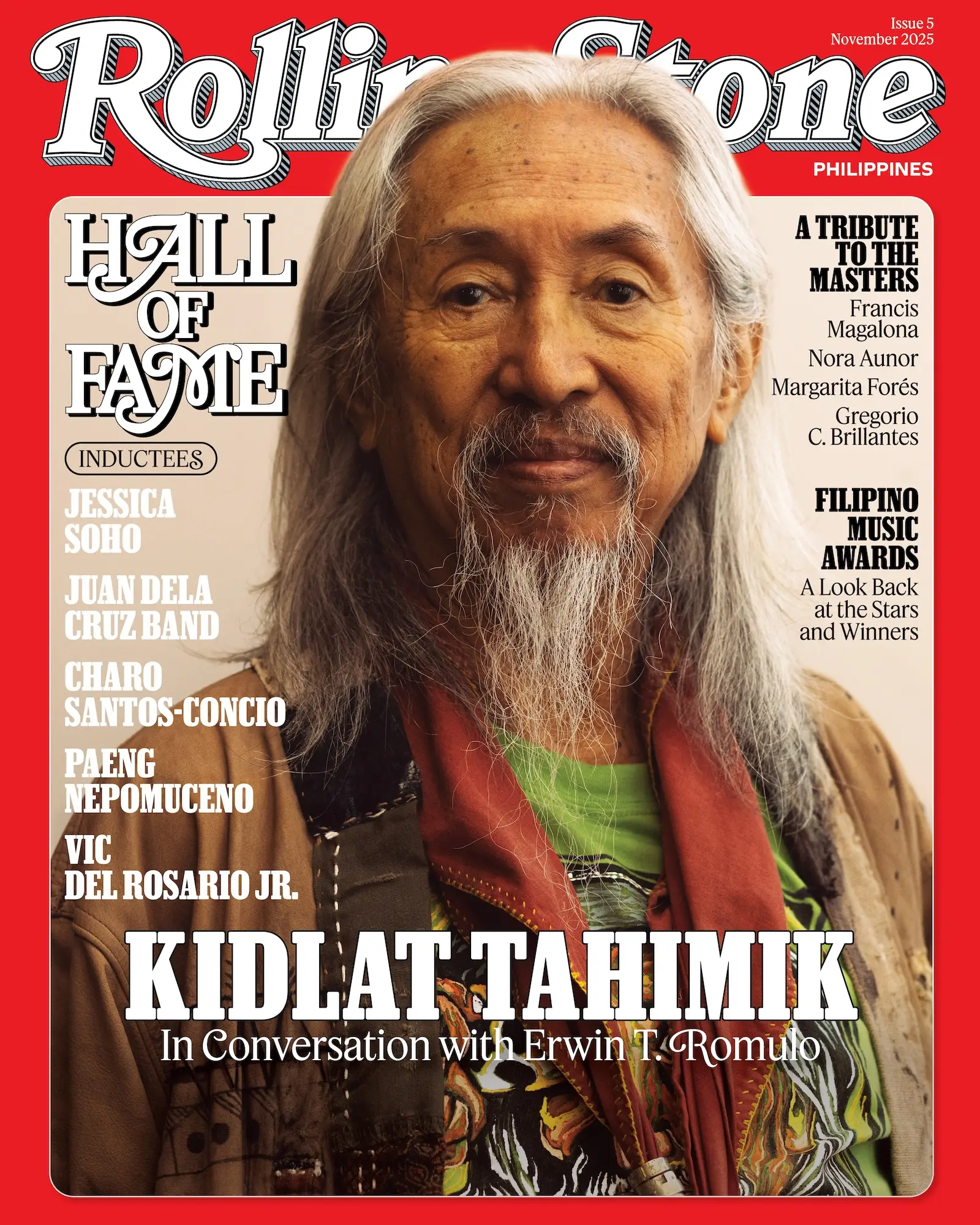
Rolling Stone Philippines November 2025 Issue, Now Available at SariSari Shopping