Benny Safdie‘s solo directorial debut, The Smashing Machine, tackles the turbulent life of American mixed martial arts (MMA) pioneer Mark Kerr during his rise in the Ultimate Fighting Championship in the U.S., as well as thePride Fighting Championship in Japan between 1997 and 2000. Former World Wrestling Entertainment (WWE) star Dwayne Johnson, also known as “The Rock,” stars as Kerr; Emily Blunt plays his on-and-off girlfriend Dawn Staples, and real-life MMA fighter Ryan Bader appears as Kerr’s close friend and trainer Mark Coleman.
The premise alone raises questions: Could Johnson, known more for blockbuster caricatures, embody the fragility of a man fighting addiction, ego, and the brutal realities of MMA? To his credit, Johnson delivers his strongest performance yet. Gone are the glossy stunts of Fast and Furious and the bombast of Black Adam. Under Safdie’s direction, he reveals a dramatic range that has eluded him for decades.
Safdie leans on handheld camerawork and an unorthodox score to sidestep sports-biopic clichés. Instead of the expected testosterone-driven soundtrack, the film opts for something more melancholic: saxophone-led jazz motifs, Frank Sinatra’s “My Way” scored against Kerr’s opioid dependency, and even Cleaners From Venus’ “This Rainy Decade” during a fight sequence. The choices are telling from the get-go, which is Safdie wanting to frame Kerr not as a gladiator, but as a man trapped in cycles of self-destruction.
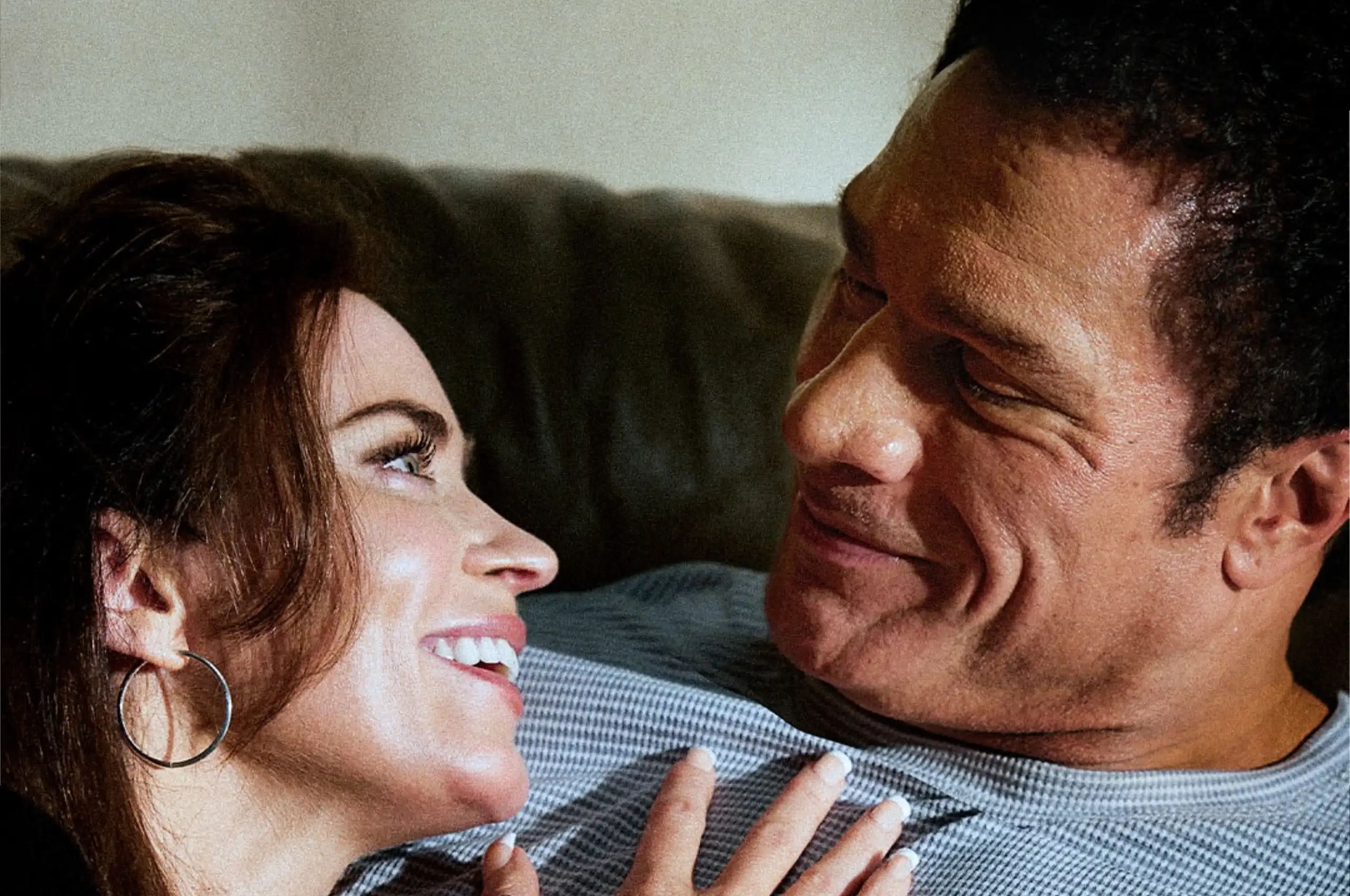
Even the domestic quarrels between Johnson and Blunt avoid melodramatic excess, instead simmering in dysfunction that feels grounded rather than soapy. However, the traces of “Safdie-isms” linger, such as the trademark shaky camerawork paired with claustrophobic tension and anxious pacing. As a result, the film is more restrained, less chaotic, which suits its subject but also risks flattening its impact.
Lacks A Punch
The fingerprints of film production company A24 are here, but so is Johnson’s as he doubles as the film’s producer. That duality is part of the problem. The Smashing Machine often feels like a redemption arc for Johnson himself, rather than a piercing study of Kerr. The film’s narrative emphasizes Johnson’s performance over Kerr’s legacy, turning a groundbreaking fighter’s story into a proving ground for an actor eager to shed his action-hero skin. Safdie captures the beats of a character study, but the core — Kerr’s influence on the sport, his public battles with addiction, and his role in reshaping MMA’s violent infancy — fades into the background.
Kerr becomes an afterthought in his own biopic. Rehab scenes and glimpses of vulnerability hint at the complexities of a man trying to reconcile his body with his addictions, but they never develop beyond fragments. By the second half, the pacing falters, circling around Kerr’s inner turmoil without fully interrogating the consequences of his career. The film nods at the controversies that nearly got MMA banned in its early years, but it avoids unpacking Kerr’s part in that narrative.

The result is a film that nails the fundamentals of a sports biopic: You get the rise, the fall, and the redemption but it doesn’t wrestle with the broader forces of the sport’s politics and Kerr’s life hurdles thrown at him. Safdie directs with precision, Johnson surprises with depth, but Kerr’s legacy as a pioneer is under-explored. The story chooses interiority over history, personal drama over systemic change.
The Smashing Machine is both a victory and a missed opportunity. The film proves Johnson can act, and that Safdie can stand on his own as a filmmaker. But it stops short of elevating Kerr’s story beyond a familiar framework. As the Safdie brothers branch into solo projects, this effort feels like an intriguing yet incomplete round. Whether Benny will be a contender or opening spar against his brother Josh, whose upcoming sports film Marty Supreme is also highly anticipated, remains to be seen.