Movies will inevitably reflect the world around them, and 2025 was not a year with much good to reflect. Globally, it was the usual maelstrom of climate change, bloody, ugly genocide, and baby-tempered politicians calling the shots. In terms of national affairs, flood-control scandals, nepotism, and political mudslinging made it hard for us to find much to celebrate as a country. Within the circles of Filipino filmmaking, conversations on censorship, quote-unquote sensitive subject matter, and an industry that may or may not be floundering all seeped into the narratives that our filmmakers brought to the silver screen.
But this is not to say that the best Filipino films of the year are, by any means, preachy. They are resolute in the stories they aim to tell, but they are also adept at drawing us into the worlds that they build. Beyond the simple criteria that they were made by Filipino filmmakers and released in the Philippines in 2025 (as some of these premiered internationally in 2024), these films earned their spot on our list for their ability to tell stories that are deeply attuned to the strange time and place we find ourselves in.
With that, and in no particular order, here are the movies that defined our current moment and helped us make sense of 2025. —Mel Wang
‘A TENDER AWAKENING’
Illness comes to life and demands attention
Daphnee Ferrer’s experimental horror A Tender Awakening begins by lulling us into dreaming of a body suffering from Polycystic Ovarian Syndrome (PCOS). Warped images of hands clawing at one’s bellyfolds suggest a morbid fantasy: that illness can be forcibly excised, torn from the body through sheer will. Clay-rendered cysts seem to take on lives of their own, slipping beyond corporeal boundaries as they stretch across the frame, changing size and shape. As they evade capture, they obscure the faces of the women whose bodies they once belonged to, denying us easy identification. Infrared scans of torsos and abdomens grant women anonymity amid profound vulnerability while transvaginal ultrasounds expose sites of horror buried too deep for the naked eye — images at once clinical and deeply invasive. Originally presented as a looped video installation, the film’s cyclical structure mirrors the chronic nature of living with an incurable illness. Miko Peralta’s score and sound design are our only cogent anchors, tethering us to the present through its eerie hums and squelches.
Illness is a profoundly singular and isolating experience, made more so by the scarcity of art that depicts it with equal incisiveness and care. Ferrer’s film closes on a gesture of unexpected warmth: three women standing side-by-side, bodies rendered hot pink under the infrared light, their outstretched arms slowly folding into a collective, self-embrace. —Jason Tan Liwag
‘BABY FAT’
12 minutes into the whirlpool that is girlhood, dysmorphia, and diaspora
Directed by Margarita Mina, Baby Fat is a pink-hued love letter to all Filipinos living in the in-between of their homeland and somewhere far away. The short follows Sitti (Hannah Barry), a young, chubby Filipino-American tween who has a Filipino dance coming up at her school’s cultural program. Her mother (Paulina Yeung) has asked for a tita back home to handcraft a baro’t saya for Sitti, but the tween is more concerned with scrolling through TikTok and eating French fries than getting closer to a culture that barely feels like her own. Things go awry when Sitti, still wearing her malong, sits right down on her plate of ketchup-smeared fries. The shot of a traditional dress, so lovingly handmade ruined by blotches of ketchup, can conjure up all sorts of ideas: diaspora, colonization, cultural loss, body dysmorphia, girlhood. Mina keeps her 12-minute short loose, messy, and punchy, and it all swirls together like a malong left on a spin cycle in an American laundromat. —Mel Wang
‘BLOOM WHERE YOU ARE PLANTED’
A triptych of struggles rooted in a storied land
The first full-length documentary to win Best Film in Cinemalaya history, Noni Abao’s Bloom Where You Are Planted, is a deftly stunning directorial debut that best represents the state of Philippine moviemaking and, by extension, the state of the country in 2025, in that it exposes the forces of cultural and political repression that every so often push our nation a little bit closer to the edge. Shifting between animation, talking heads, and archival footage, the director maps the lives of activists Agnes Mesina, Amanda Echanis, and Randy Malayao, and uproots the political reality that connects them to Cagayan Valley Region and its forest of history, which cinematographers Mike Olea and Steven Evangelio present to us with a painterly instinct and a camera that slides between locked-down and guerilla setups. What allows the movie to be so alive and astutely realized is the sense of criticality and tactility that Abao and his comrades extend to the subjects, searching for the fissures and cracks in their small, intimate, and laboring lives readily maligned by corporate greed and state-sanctioned terror. Our past and current nightmares as a country have rarely been rendered more vividly and incisively than they are here. —Lé Baltar
‘CEMENTO’
A beloved hometown eroded by faux expansion
I already wrote about Justine Borlagdan’s shrewdly calibrated experimental documentary in a year-end roundup of 2025’s best Filipino short films for this publication’s latest print issue. Yet, I cannot stress enough how Cemento works because of the incredible sonic and visual texture the director steeps it in. From the get-go, Borlagdan makes a compelling case for something as granular and ordinary as cement as evidence of a grander violence, which he interrogates through lived experience, research, and sheer attention to detail. Invoking Neferti Tadiar’s notion of the metropolis, he lays bare the parallels between Metro Manila’s congested and view-constricted landscape and his Bulacan hometown, now ravaged by aggressive construction and expansion, as a function of neoliberal control and surveillance. The resulting effort, which remains largely underseen, at times plays like an atypical road movie, in both the literal and metaphorical senses, offering us an anxious vision of a future that perhaps we’re already living. —Lé Baltar
‘CHAMP GREEN’
A father’s disapproval stands between his daughter and her dreams
Midway through Clyde Gamale’s Champ Green, Jengjeng (Marian Namanama) confides in her older sister Pedit (Meca Simborio) that she wants to apply for a college scholarship. Their father (Sol Eugenio) disapproves, fearing she will end up pregnant like her sister. Nearby, a newly opened Korean biscuit factory promises an escape from farm life, yet Jengjeng’s future already feels decided by the forces surrounding her. In nearly every frame set inside their Bukidnon hut, Gamale and cinematographer Daryll Anuran keep a wall of certificates and medals in view — a reminder of what was and what could have been. Again and again, her father and other community members lament, “What a waste.” Is there any way to convince them otherwise?
There is a weariness in Champ Green that is rarely committed to the screen. Gamale has always been attuned to the smallest details of living — from the electric charge of glances and skin-to-skin contact in Ang Halikan sa Water Fountain to the quiet poetry of an amusement park visit after a cancer diagnosis in Ang Abnormal Nga Tubo. In Champ Green, dreams are so fragile, and risks often cost too much to bear. But the gestures of love are simple and unmistakeable: a carefully assembled set of review materials, a glass of warm powdered milk drink, a few loose bills saved up in a cigarette pack. In just 20 minutes, Gamale shows how life wears down even the most loving people — and how, with a little patience and fortitude, even the hardest hearts can soften again. —Jason Tan Liwag
‘CINEMARTYRS’
Movies and their magic, but make it sui generis
“How do we reckon with a history we hardly recognize?” is the question that fascinatingly looms over Cinemartyrs, Sari Dalena’s Cinemalaya meta docudrama that took over two decades to make. Set in the 1990s through the early 2000s, the movie follows young director Shirin, Dalena’s self-insert, played by Nour Hooshmand, as she and some colleagues set out to reenact forgotten genocides in Philippine history. The result is many things: a curious riff on Dalena’s 2001 documentary Memories of a Forgotten War, co-directed by Camilla Benolirao Griggers; a feminist retracing of Philippine cinema’s roots, highlighting pioneer female filmmakers Consuelo Osorio, Carmen Concha, and Susana de Guzman; and a tone-shifting paean to the bygone era of alternative and experimental filmmaking, featuring the likes of Kidlat Tahimik and Lav Diaz in yet another Jesus Christ figure. All these to warm you up for a banger coda. Merited by its title, this is a Dalena movie through and through, one that seems committed to making bold choices at every turn; sometimes hilarious and often stubbornly off-kilter and guerrilla, this is the exact definition of cinematic daring. —Lé Baltar
‘DIAMONDS IN THE SAND’
In Janus Victoria’s superb debut film, the Philippines offers lonely Japanese salaryman Yoji (Lily Franky) the last bastion of happiness. Unmoored by any meaningful personal connections in Japan, Yoji gambles on a life in the Philippines for a second wind. In Minerva (Maria Isabel Lopez), Yoji finds a kindred spirit or perhaps a new guide to life. His first few minutes in Manila stand in contrast to the life he’s used to in Tokyo. The lights are more vivid, the street corners are noisier (“The music is still loud. You said it will stop at 10 p.m.,” he complains to the hotel desk), and neighborhood bums offer him a drink even though he’s a total stranger.
Despite differences in quality of life, the two countries aren’t that far apart in the world happiness index. Yoji, enamored by the boisterous life in the streets of Manila, rediscovers what it means to connect to another human being and finds that bonds are forged by something other than kinship. Shot by frequent Kurosawa Kiyoshi collaborator Ashizawa Akiko, Diamonds in the Sand unfolds at a languorous pace, allowing silences to slowly link up to the ties that Minerva and Yoji are searching for. —Don Jaucian
‘DREAMBOI’
It’s always a good idea to let trans filmmakers tell their own stories
In Dreamboi, trans desire is depicted front and center, where Diwa (EJ Jallorina) slowly opens herself up to her desires, fueled by the audio erotica made by the titular adult content creator (Tony Labrusca). In some levels, the film operates as a horror film — darkened hallways leading up to a sketchy restroom, cruel figures bent on making Diwa’s life hell — underscoring a society that’s trained to erase the power and experience of transgender people. A hyperpop beat gone cinematic, Dreamboi is a powerful film about a trans woman taking charge of her destiny and her body. Director Rodina Singh has shown us that there is a spectrum of ways to portray the trans experience, and that it’s always a good idea to let trans filmmakers tell their own stories. —Don Jaucian
‘HASANG (GILLS)’
An indigenous reincarnation tale from Guimbal, Iloilo hits an absurd high
In a world yellowed by the heat of the climate crisis, Boni (Igan James Nualda) seems to have seen the worst of it. His classmate Clyde has died of heatstroke and reemerged as a goldfish. At home, his grandmother’s cough has only worsened, her nebulizer reaching its end. Instead of spending more on prescriptions, they prepare her for the afterlife as a tilapia, rehearsing imaginary swims and mastering a series of glug glug glugs that have become the language of the reincarnated.
Between these moments of casual absurdity, grainy black-and-white photographs transport us to Guimbal’s past — lush mountains, rivers where love once seemed possible. Offscreen, Koji Tapispisan’s sound design alerts us to machines terraforming their small community beyond recognition. On its surface, Hasang may seem indebted to Yorgos Lanthimos or Luis Buñuel. But rather than creating bourgeois satire, filmmaker Daniel dela Cruz uses indigenous belief as an entry point into the provincial lives most affected by global warming, examining how “development” distorts everything central to their lives and legacy. The result is a lament for the unrecoverable wilderness, and though resilience may allow our spirits to adapt, Dela Cruz insists that gills become useless in a world without water. —Jason Tan Liwag
‘HOY, HOY, INGAT!’
Hitting the road has never been this surreal
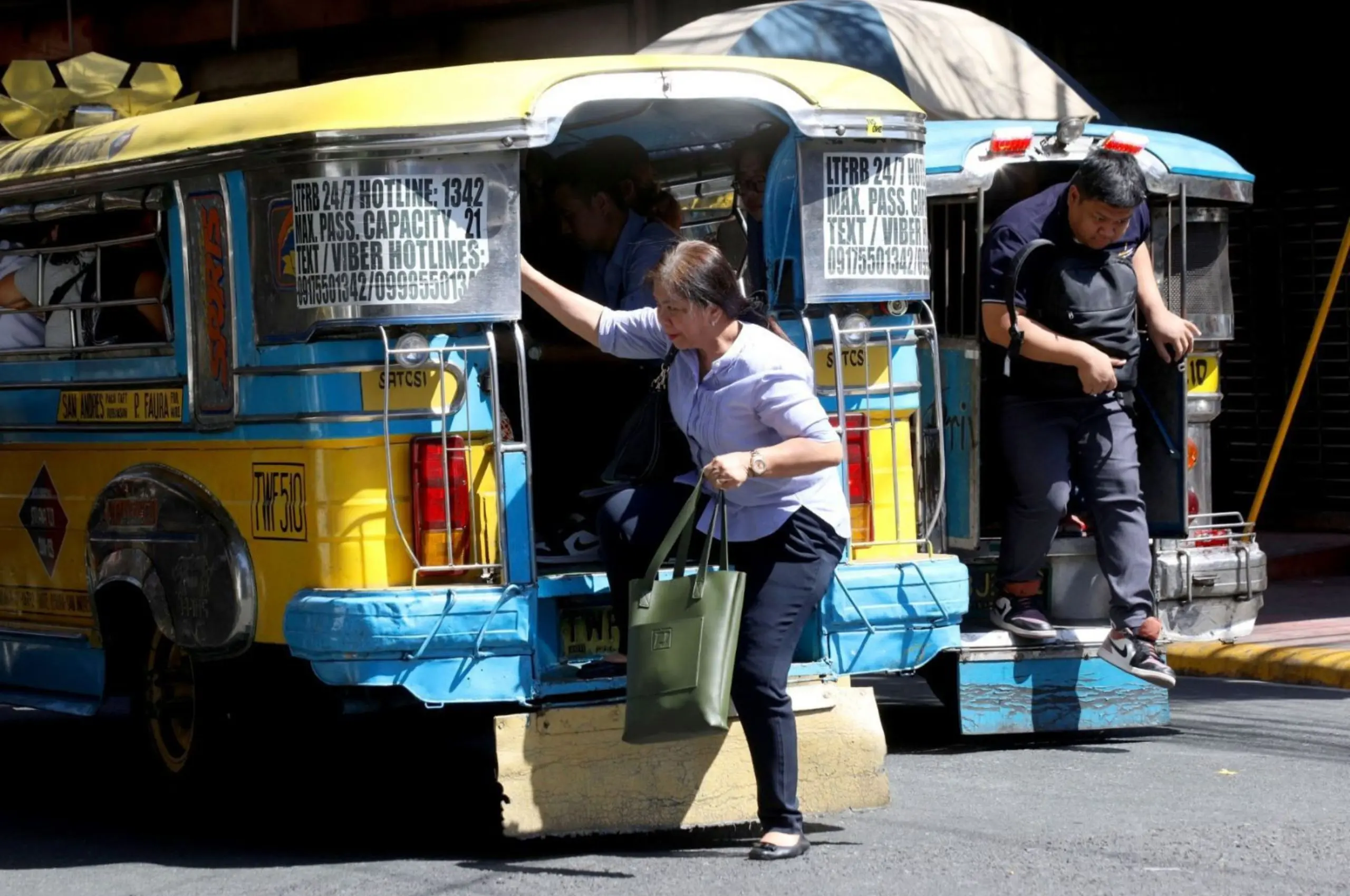
Using the social geography of the urban poor as a narrative through line, Hoy, Hoy, Ingat! by QCinema returnee Norvin de los Santos stages a sibling story of hope and hardship that alternates between dream and waking reality. VR Relosa plays with real ruggedness an ailing, hardworking young man, who hatches a scheme to rescue a treasured family jeepney held at an impound lot to provide for his younger sister (delightful newcomer Alycia Rae Avila) and resume their lives in the countryside. Because the movie positions the passenger jeepney as a visual centerpiece, I found myself recalling Kidlat Tahimik’s Mababangong Bangungot, which also draws attention to the so-called King of the Road, now threatened by the Philippine government’s modernization program. Apart from this, the 20-minute short shares Mababangong Bangungot’s vibrant stream of consciousness, heightened by Tara Illenberger’s mercurial editing. Initially an intimate piece of tragicomedy, de los Santos audaciously transforms Hoy, Hoy, Ingat! into a searing, sweat-stained social portraiture. —Lé Baltar
‘I’M BEST LEFT INSIDE MY HEAD’
A reunion in an orphanage takes a tragicomic turn
Amid the glut of trite melodramatic films about mental health and dysfunctional families, it’s hard not to fall in love with Elian Idioma’s animated short, I’m Best Left Inside My Head. Its premise alone is so audacious: Alec Dominguez (voiced by Idioma himself), the golden child of two gay philanthropists, returns to his childhood orphanage, only to face a rude awakening. But the film’s real delight lies in its relentless humor. Every detail is irreverent, inappropriate, and unmistakably Pinoy; a series of intrusive thoughts rendered in vibrant claymation. The jokes are everywhere and spare no one: a bulletin board reads, “the filmmakers definitely did not set this in the pandemic to save time on animating mouth pieces;” the resounding echo after a character Boy Tao, heavily implied to be a creep and a pedophile, says “grateful;” a makeshift banner declares, “Welcome back, mga ampon! XD;” even a friend and his translator trashtalk other guests over dinner using Korean.
Beneath the chaos, however, I’m Best Left Inside My Head uses this comedy to reckon with privilege and the invisible lines that divide people with shared origins. What begins as a sweet but awkward reunion between orphans escalates into a horrifying reckoning with crab mentality and survivor’s guilt. The result is a comic-horror story about a young man whose luck in life just cannot be shared and how the self-loathing over that privilege, when left unchecked and unexpressed, curdles into something ridiculously grotesque. —Jason Tan Liwag
‘KAPAG NAGWALA ANG KALABAW’
An honest look at the messiness that comes with unionizing, organizing, and surviving
There’s a sharp, beating pulse to Paul Serafica’s Kapag Nagwala Ang Kalabaw. Weaving elements of Ericson Acosta’s poem, Walang Kalabaw sa Cubao, the 20-minute short feels more like an urgent chant than a look at the struggles of Cubao’s BPO workers as they unionize. And their struggle, to put it bluntly, is unglamorous: handing out flyers to those who’ll look at them, hosting streetside coffee sessions to get the word out, and organizing earnest, if not always well-attended, dance rallies to highlight the muck and grime they must wade through in order to be fairly compensated and survive. But they are persistent in their cause and, like the carabao that inspired this short film, they are more than willing to plow through the mud. —Mel Wang
Watch here.
‘MAGELLAN’
An auteur’s dismantling of an empire
Lav Diaz turns in another tour de force on the startling specters of our colonial past, this time by abandoning his monochromatic default and torquing his latest feature into a mesmerizing 16th-century pictorial fresco only his mind could conjure. Magellan, like many a Diaz opus, demands from its audience as much as it rewards them, yet it’s also among his most accessible works, as has been the consensus since its world premiere, remarkably as an out-of-competition title, at the Cannes Film Festival this year. The film collapses time in the life of the famed Portuguese conquistador, played by Gael García Bernal, via temporal leaps, the last thing you’d expect from a director as ruminative as Diaz, though the result remains true to his core: an epic that eviscerates conventional notions of a biopic as it delightfully deconstructs and weaponizes the myths surrounding the knight-errant and the making of our nation. With beefed-up production value and cinematography that could rival this year’s best-looking and big-ticket movies, Magellan would have been so worthy of all the awards-season heat if Hollywood critics and awards pundits only bothered to look elsewhere. Diaz calls into question the limits of art and history, while feverishly paying homage to their wonders. —Lé Baltar
‘OPEN ENDINGS’
The boundary between the platonic and romantic is always a messy place to explore
Charlie (Janella Salvador), Kit (Klea Pineda), Hannah (Jasmine Curtis Smith), and Mihan (Leanne Mamonong) have all been romantically and sexually involved with one another, but these relationships have blossomed into something deeper, ultimately forming them as a group of friends that some people disapprove of (“You’re friends with your exes??”). Open Endings challenges our notions of relationships, those that exist in the borders between the platonic and the intimate. Is the friendzone really better than romance, whose nature is inherently unstable and volatile? It’s a tale as old as time, but it’s always refreshing to see a modern portrait of intimacy in sapphic relationships, as evidenced by how warmly the Cinemalaya audience has responded to Open Endings. Whether you buy it or not is up to you. But how can you not when these actresses — especially Mamonong, who makes her feature-length acting debut here — lovingly craft characters who are so authentic they just might be your own messy friends. —Don Jaucian
‘PINIKAS’
In Southern Leyte, the story of the mail-order bride gets a surprising subversion
Much of the writing around Pinikas has simply lauded it for existing. Shot in 2019 without studio backing or Manila-based grants and released only this year, writer-director Cris Fuego’s film deserves far more than survivalist acclaim. It follows Maya (Angela Villarin), a young woman from Pintuyan, Southern Leyte, whose livelihood selling dried squid (pinikas) is upended by her involvement with the fisherman Nilo (Jade Makawili) and the unexpected arrival of a foreigner named Luke (Kevin Reams).
The film’s pathos lies in its lucid depiction of how young women absorb the failures and demands of the men around them, from fathers and brothers to anonymous strangers online. Whereas other sociorealist dramas punish women for choosing familial responsibility over personal desires, Pinikas neither condemns Maya’s sacrifice nor does it reward her endurance with sentimentality. Instead, it exposes a provincial economy of care that expects women to perform emotional labor, often at the cost of leaving their dreams half-fulfilled.
Though Fuego never denies the precarity of Maya’s life, especially as grief takes over their family, he rejects despair as its endpoint. At the center of Pinikas is a commanding performance by Villarin, whose grit and ambition anchor the film’s tragicomic core. By showing us Maya’s resolve despite her circumstances, Pinikas resists turning its protagonist into a product of her circumstances, affirming how there are always ways to become whole again. —Jason Tan Liwag
‘REPUBLIKA NG PIPOLIPINAS’
A mockumentary that magnifies the a government’s failure to support its own people
Renei Dimla’s mockumentary could not have arrived at a better time, especially now that the failures of the government are more magnified than ever. Tired of the Philippine government, farmer Cora (Geraldine Villamil, in one of the best performances of Cinemalaya 2025) establishes her own micronation called ‘Pipolipinas.’ The Corazon Aquino administration granted their plot of land under the Comprehensive Agrarian Reform Program, but later, another landowner claimed rights to it and sold it to the government.
Now, Cora is being evicted from a land that her family has tilled for generations. And for what? A landfill for garbage from South Korea. The comedic treatment dominates the film, but the heartbreak undercuts everything else. Cora remains steadfast in her plight despite the trials she faces, and yet we realize this is happening to people today. It’s hard to laugh at Cora’s situation when her story is one of many cases of land grabbing still perpetrated by politicians and wealthy families to this day. —Don Jaucian
‘SOME NIGHTS I FEEL LIKE WALKING’
A group of friends on a dark, mournful quest to fulfill a dying wish
Is director Petersen Vargas’ grief-fuelled queer drama also a road trip barkada movie? Sure, in its most warped sense. Some Nights I Feel Like Walking sees the director (2 Cool 2 Be 4gotten, Un/Happy For You, A Very Good Girl) return to his indie roots as he weaves through the stories of four sex workers grieving the recent loss of their friend. To fulfill his final wish, Uno (Jomari Angeles), Bayani (Argel Saycon), and Zion (Miguel Odron) return their dead friend’s body to his hometown, making their way from Manila all the way to Pangasinan.
Vargas’ drama snakes its way across highways and back roads, messy in a way that mirrors the complex joys, griefs, and frustrations being exchanged among the group of friends. Adding to the quiet chaos of Some Nights is the pulsing, rhythmic music by Alyana and Moe Cabral and the ever-moving cinematography of Russell Adam Morton, all of which come together to create a sense of urgency as the friends find themselves on a dark, mournful quest. —Mel Wang
‘SUNSHINE’
An honest coming-of-age that sees Maris Racal shine as a worried gymnast with a choice to make
A late period begets a special type of horror. And Sunshine, played with stunning vulnerability by Maris Racal, finds herself falling into a downward spiral after discovering that an unplanned pregnancy might derail her Olympic dreams. Director Antoinette Jadaone’s latest drama follows its titular character as she wanders the alleyways around Quiapo Church, hoping for a quick fix for her growing problem. Unfortunately, as Sunshine realizes, abortion is not an easy topic to face head-on, much less so for a woman born and raised on Filipino Catholic guilt.
However, Sunshine is so much more than a movie about abortion. It’s a classic bildungsroman, where our young heroine must decide how to make her way as a gymnast bound for the Olympics, how to carry herself within a community that is quick to judge (there’s a scene with a nasty OB/GYN that hits a bit too close to home), and, most importantly, how to simply be.re than earned the prestigious Crystal Bear award it took home at the Berlinale earlier this year. —Mel Wang
Watch it on Netflix.
‘THE RIVER FLOWS IN DIFFERENT PLACES’
Two households, both alike in dignity and displacement
In the last three minutes of Lot-lot Hermosura’s The River Flows in Different Places, one of the Filipino-Palestinian mothers makes a connection between her two nations of origin: how the citizens of both countries are family-based, religious, hard-working, colonized, and struggling. “You can feel that they understand what you have been through, because they have undergone the same thing.”
Much of what’s devastating about the documentary is communicated in these parallelisms. Through archival footage, still photography, and haunting red-and-white animated frames, Hermosura and producer-editor Yani Ali trace how Israel’s ongoing settler-colonial occupation has terrorized Palestinian life long before October 2023. Basic necessities such as food, water, electricity, and education are routinely withheld, while identification cards that permit mobility take decades to be released. In one of the film’s most haunting scenes, a mother recounts witnessing a phosphorus bombing, her testimony accompanied by intercutting images of an ordinary road and a toy car in the absence of first-hand footage.
What emerges is not only a theft of land, but a systematic and calculated erasure of life. Hermosura’s achievement lies in extending this critique of displacement to the Philippines, where Palestinian families are priced out of major cities and forced to take refuge in a Christian church. By exposing how structurally unprepared the country remains to support refugees, the film indicts a system in which the survival of the oppressed depends on the benevolence of the private few.
Though Gaza and Manila are thousands of kilometers apart, The River Flows in Different Places forges bridges between them, insisting that if our struggles are inextricably tethered, then so too are our liberations. —Jason Tan Liwag
‘WHEN IT RAINED MALUNGGAY LEAVES’
An examination of home and the many ways of leaving
There are many things left unsaid and unanswered in Cedrick Valenzuela’s When it Rained Malunggay Leaves. Valenzuela centers on the act of leaving and the hollow places that it leaves in our bodies. In this film, Ariel and Anita (immaculate performances by Gabby Padilla and Tanya Gomez, respectively) play a sort of chess match, thrust upon the typical mom-daughter reunion. It seems they have been separated for years, perhaps intentionally by the daughter, with a gulf already growing between them. They go through the motions — preparing meals, engaging in brief conversations — but the cracks are apparent. Valenzuela’s sparse direction lets us in on a world we once knew, for those of us who left home already, or a world we will come to know, for those who are planning to leave home. The parting shot can be bittersweet or hopeful, depending on where you stand, but it is also a reminder that home can mean more than just the room you once slept in when you were a teenager. —Don Jaucian
‘YELO’
Two women burning with desire
Sensual and sweltering, Gab Rosique’s QCinema drama about two women living together and dreaming of better lives in Cubao evokes Alex Phillips’s Anything That Moves — part Giallo, part Bomba picture gorgeously shot on Super 16mm, which premiered at this year’s Fantasia Film Festival — in that it meets to a tamer degree the latter’s hypnotic energy and vulgar visual grammar. Jessa (Catch Espinosa, playing a character racked with anxiety) runs a thrift shop frequented by a faceless American expat, who instantly develops a relationship with her friend Candy (an alluring Emi Felix), whose affection Jessa longs for.
Rosique brings to life a grounded, though still slippery, understanding of trans and queer desire chiefly considered in the context of migration and the American Dream — thematic assertions the director only ever glances at textually but visually drapes in extreme heat, radio broadcasts, and clothes hanging lonely, as if waiting for their bodies to return; its retro temperament is clearly the film’s sweetest spot. The city never sleeps, and neither does the desire to shed one’s skin, for better or worse. —Lé Baltar
HONORABLE MENTIONS
City’s Laundry and Taxes (dir. Diana Galang), Coding Si Papa (dir. Michael Pogoy), Dangpanan (dir. Stephen Kelly Mahusay), Figat (dir. Handiong Kapuno), Food Delivery: Fresh from the West Philippine Sea (dir. Baby Ruth Villarama), Haplos sa Hangin (dir. Mikko Baldoza), NOMO KWEEN: The Last Woman Standing (dir. L.A. Oraza), Ours Was A Timeless Night Burning (dir. Lauviah Caliboso), Quezon (dir. Jerrold Tarog), Si Kara: Ang Babaye Nga Nag Daba-Daba (dir. Dale), Sine-sine (dir. Roniño Dolim), Sunog sa Sugbo (dir. Jon Owen Lepiten), Surface Tension (dir. The Serrano Sisters), Uwian (dir. Vhan Marco Molacruz), Vox Humana (dir. Don Josephus Raphael Eblahan), and Where Are The Films in Leyte? (dir. Linus Masandag and Lebron Ponce)