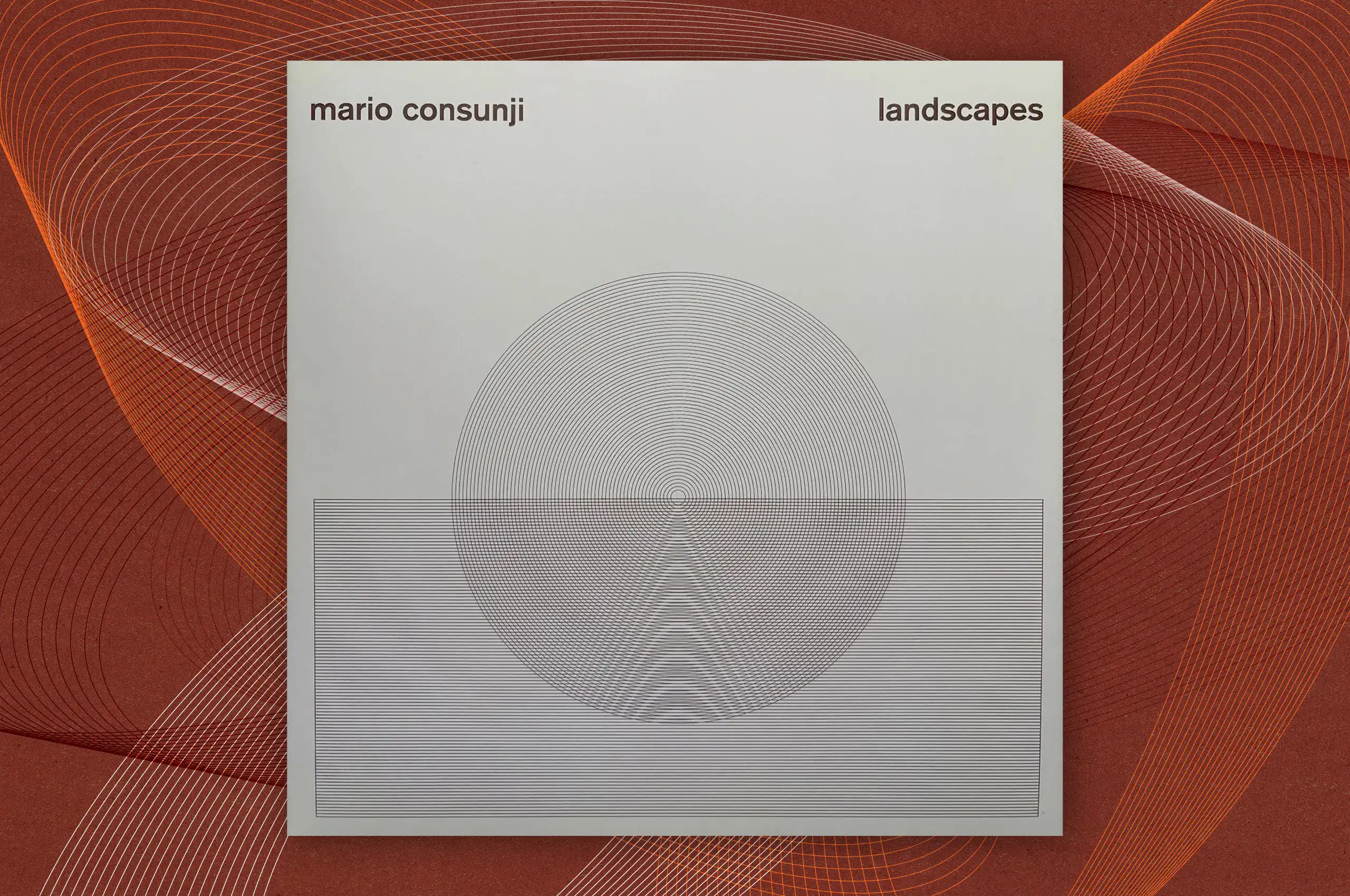
Electronic musician Mario Consunji has worn several hats in the local music scene, but his latest one is the most personal yet. Known for his minimal synth project Big Hat Gang, Consunji has long been a fixture in Manila’s experimental and electronic music communities. With the release of his latest album, Landscapes, he takes a step outside of his comfort zone he built through aliases and monikers, and puts his own name front and center.
The move feels overdue. Consunji has been releasing music since 2011 through Number Line Records, a key hub for independent electronic and indie pop artists in the Philippines. Big Hat Gang gave him a platform to shape his sound with distance, exploring the edges of ambient, synth, and experimental textures. With Landscapes, the veil comes down. And for the first time, listeners hear Consunji without the layer of a persona. The project is built on the question of what it means to start fresh after years of production.
“I’d like to think all my previous releases were a bit shy of being moody,” Consunji tells Rolling Stone Philippines. “[The latest release] isn’t. Probably because I wasn’t really set out to do so.”

mood Setter
Landscapes was not made for headphones alone. The work was originally created as an audiovisual piece for Kaput, the experimental rave project spearheaded by visual artist Derek Tumala. At the eighth edition of the event, Tumala and Consunji staged a performance that blurred the quiet meditations of ambient with immersive 3D visuals of a dystopian world bursting with color and light. Their set unfolded alongside other collaborations, including crwn with creative collective And A Half and Tarsius with visual artist Miggy Inumerable.
Consunji’s pairing with Tumala was striking throughout the entire affair. Where the rave leaned on intensity, they offered stillness. His compositions floated around the room while Tumala’s visuals presented images of collapse and renewal. It was an unlikely mix, yet the tension made sense. For Consunji, the show was not just another booking but a reason to learn again from scratch, stripping back what he knew to build something new.
The record also reflects Consunji’s career-long curiosity about where ambient music fits in the larger landscape of Philippine sound. He has worked extensively in sound design, and those experiences continue to shape his understanding of ambient as a form.
“I think stints with sound design did this to me,” he says. “I probably attribute ‘ambient’ to this because of sound design. Is ambient music also sound design, or vice versa? What is music then? Just some questions resulting from a line of thinking when I was doing this.”
Pushing the Envelope
That kind of questioning runs through his practice. Ambient has often been written off as background or mood music, something to ignore rather than engage with. Consunji pushes back by placing his work in contexts where it cannot be sidelined, whether at an art exhibition or a rave. The effect is to force a rethinking of what counts as ambient, and why it still matters. Like many artists in the genre, Consunji is also drawn to vinyl. Pressing Landscapes on wax reframed how he heard the record and gave him another goal for the project: Permanence.
“I just love the idea of finding something, new or old, and the whole romance of it being a product of some artist’s obsession,” he says. “Just being in the actual shops themselves has so much cultural value that I would be so honored to be one of the artists in the bins. So I decided anything of note from me had to be on vinyl.”
His process has also evolved to include sampling, which he treats less as a crutch and more as a science. For Consunji, sampling provides context to a track, tying abstract sound to emotional triggers.
“Sampling has become a new tool for me to add some kind of context to a track, but lately I find that there are some sounds that just really evoke feelings,” he explains. “Whether it is evolutionary or something from memory, theorizing about it a little bit and applying it a little bit is fun for me.”
That willingness to experiment has kept him prolific. Over the course of more than a decade, Consunji has transitioned from label releases to independent work, from sound design to live performance, and from niche raves to vinyl shelves. Landscapes is the culmination of those paths, a body of work that treats ambient not as background but as a core mode of expression. For Consunji, ambient has never been about pace. It has been about presence.
“I just love the idea of finding something, new or old, and the whole romance of it being a product of some artist’s obsession.”
He fondly looks back at the artists and moments that shaped his interest in the form by mentioning the local DJs he’s made friends with over the years: hearing David Sorrenti’s ambient sets, listening to Dino Amparo’s demos for Blue Dissolve, and trading notes with Mario Serrano about Italian composer Gigi Masin. Each memory adds to the map of how ambient has always lingered within Manila’s music circles, even when it was dismissed as too slow or too boring.
“That’s OK,” he says. “Nowadays I [needed to hear that] also.”