

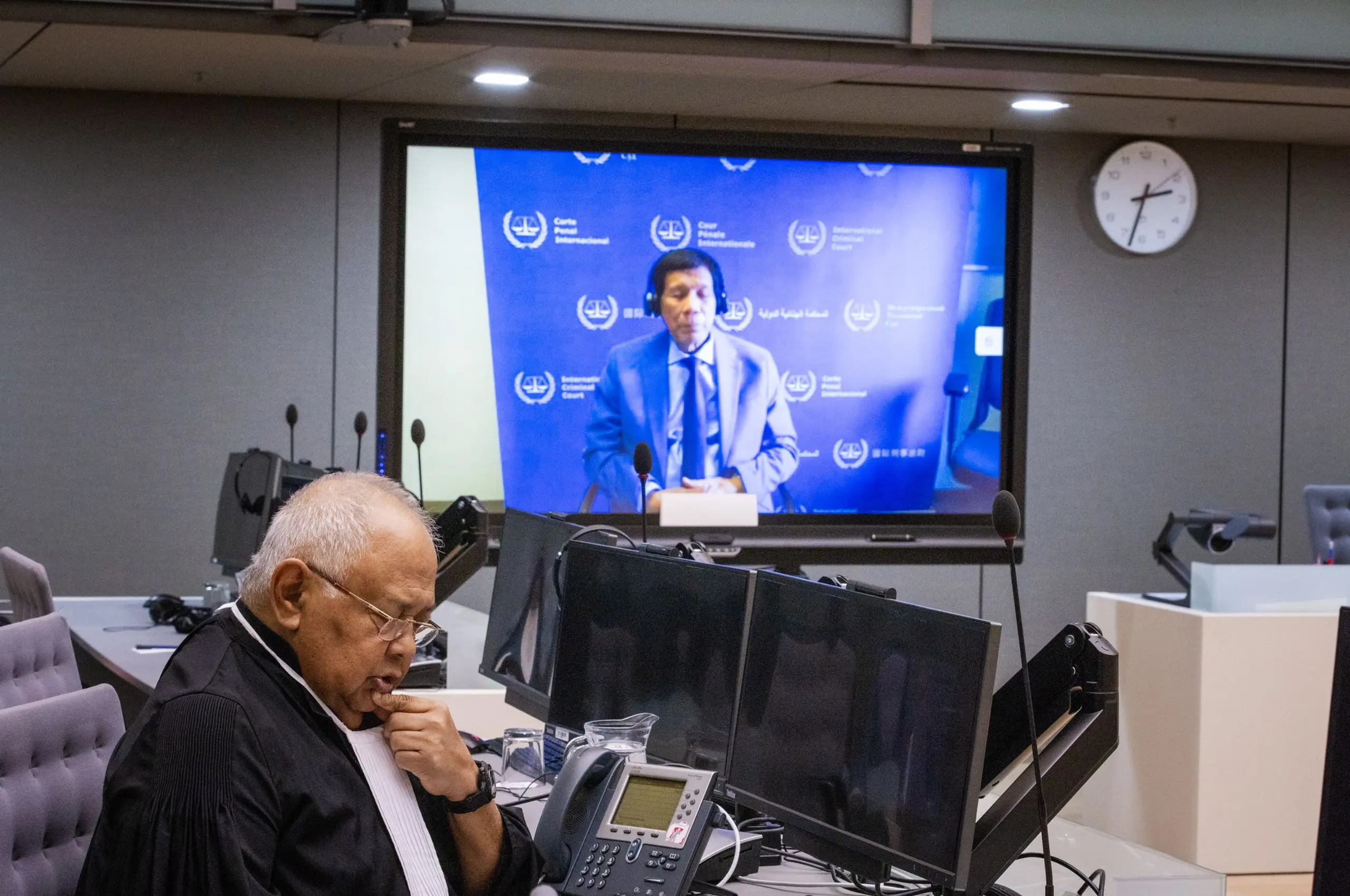
On the evening of Monday, February 23, Filipinos tuned in to watch the first day of the International Criminal Court’s (ICC) pre-trial or confirmation of charges hearing tackling the crimes against humanity case of former President Rodrigo Duterte.
Duterte was notably absent from the hearings, with permission from the ICC. But the families of the victims of the war on drugs were present to watch.
“Today marks an important day for international justice for the people of the Philippines,” said ICC Deputy Prosecutor Mame Mandiaye Niang in his opening remarks. He called the launch of the pre-trial hearings “a reminder that those in power are not above the law.”
The defense, led by lawyer Nicholas Kaufman, asserted Duterte’s innocence and sought the dismissal of the case. “We hope that when you conclude your deliberations, Your Honors, that you’ll dismiss these grievously misplaced and politically motivated charges. We will ask you to send Rodrigo Duterte back to his family, and we will ask you to give back to the Filipino people their Tatay Digong.”
During the hearing, the prosecution also played clips of Duterte admitting to creating the Davao Death Squad and giving out kill orders. In response, Kaufman said that Duterte’s speeches were “calculated to arouse fear and obedience, to instill fear in their hearts, and to inculcate a respect for the law in their minds.”
Who’s Winning?
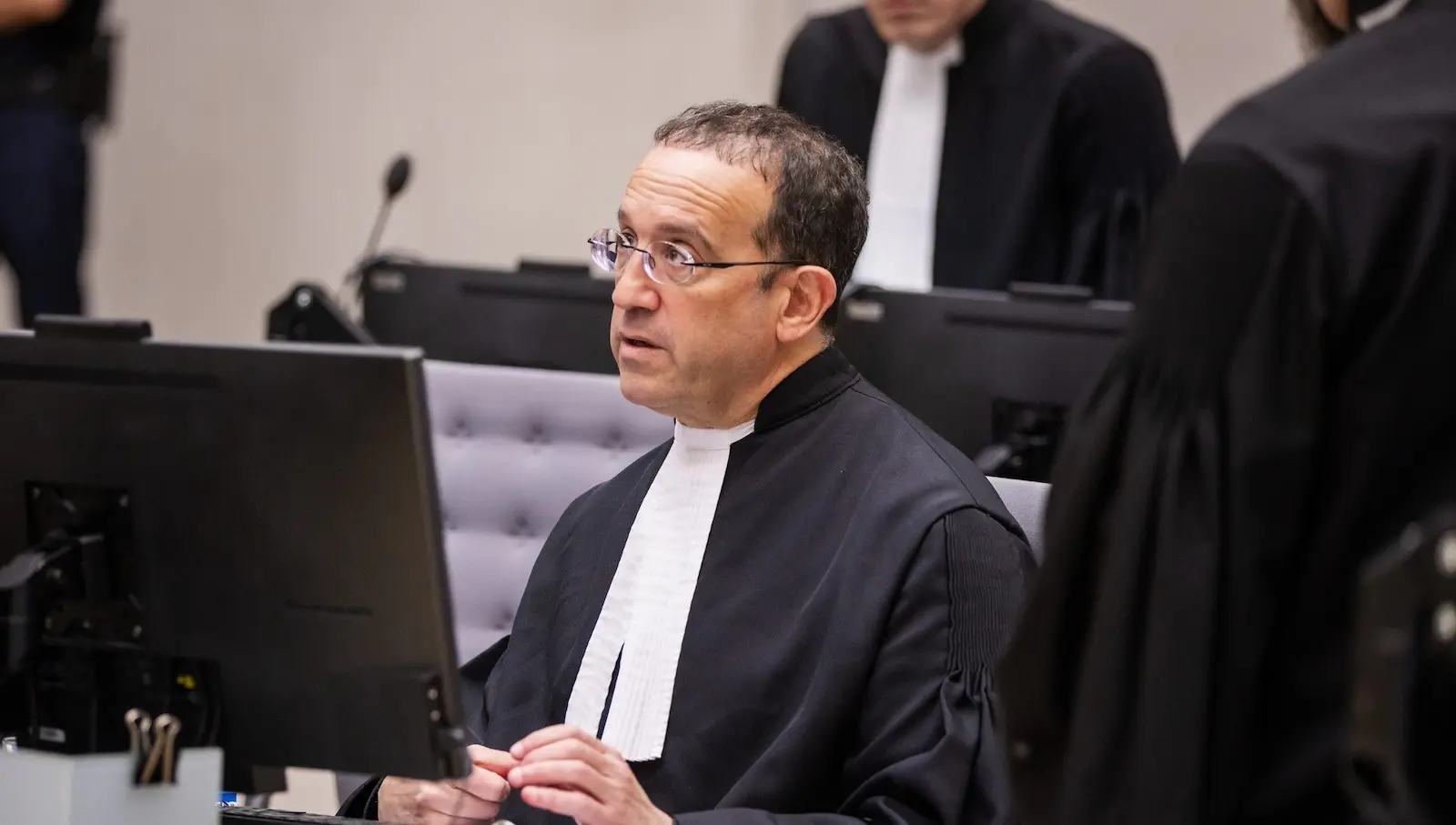
Attorney Kristina Conti, who serves as an assistant to counsel at the ICC, told NewsWatch Plus that the prosecution is “trial-ready.”
“There’s a subtext to the proceedings,” Conti said. “Absent ang akusado or ang suspect, pero mukhang present na present siya sa pamamagitan ng mga videos niya […] At hindi na ito ma-de-deny, siya na siya ang nagsalita doon sa mga videos na iyon.”
Conti also said that Kaufman’s opening speech was “more political than substance,” likening it to a macaroni soup, “[na] parang tatlong piraso ng macaroni lang ang nahagip ko.”
Likewise, Rappler reports that human rights lawyer Neri Colmenares said, “It’s hard to present evidence at trial to defend [Duterte], so for me, I’m more confident that charges will be confirmed.” The former congressman, like Conti, is also serving as counsel to victims of the drug war.
Colmenares added that Kaufman’s speech was more politically loaded than legal, and suggested that it might help Vice President Sara Duterte in her bid for the presidency. “Para sa akin, halos buong statement ni Kaufman hindi legal e, kundi political. Will it benefit Sara Duterte? I don’t know, but maybe, because it will feed into the narrative of the Dutertes that Sara can use,” he said.
On the other hand, Salvador Panelo, who served as Duterte’s chief legal counsel during his presidential term, expressed disappointment that Kaufman did not question the ICC’s jurisdiction over the case.
Duterte’s son, Davao City Representative Paolo “Pulong” Duterte, also raised the matter of jurisdiction in a statement on social media. “Kung justice talaga ang hanap nila, sana una nilang tanungin, may hurisdiksyon ba kayo? Because last time we checked, the Philippines already left the Rome Statute. But apparently, sa ICC, optional lang ang sovereignty, depende kung sino ang target,” he said.
Frequently Asked Questions
The International Criminal Court opened confirmation of charges hearings regarding former President Rodrigo Duterte’s drug war. While Duterte was absent, prosecution counsel declared trial readiness using recorded speeches, while defense lawyers argued the charges were politically motivated and sought case dismissal.
Rodrigo Duterte was absent from the pre-trial confirmation hearing with explicit permission granted by the International Criminal Court. Despite his physical absence, prosecution counsel presented video recordings of his speeches as evidence of state-sanctioned violence during the administration’s anti-drug campaign.
Defense lawyer Nicholas Kaufman asserted Rodrigo Duterte’s innocence and urged the court to dismiss all charges, framing them as politically motivated. Kaufman contended that Duterte’s public statements were calculated rhetorical tools designed to enforce law and order rather than formal orders for extrajudicial killings.
Victims’ counsel, including Kristina Conti and Neri Colmenares, characterized the defense’s opening arguments as political rhetoric lacking legal substance. They emphasized that prosecution evidence, including Duterte’s own taped confessions regarding the Davao Death Squad, firmly established a strong basis for charge confirmation.
The ICC retains jurisdiction over alleged crimes against humanity committed while the Philippines was a Rome Statute state party. Although Duterte allies and family members challenged court authority, international legal frameworks affirm jurisdiction over acts occurring prior to the official withdrawal in March 2019.
Recommended Video