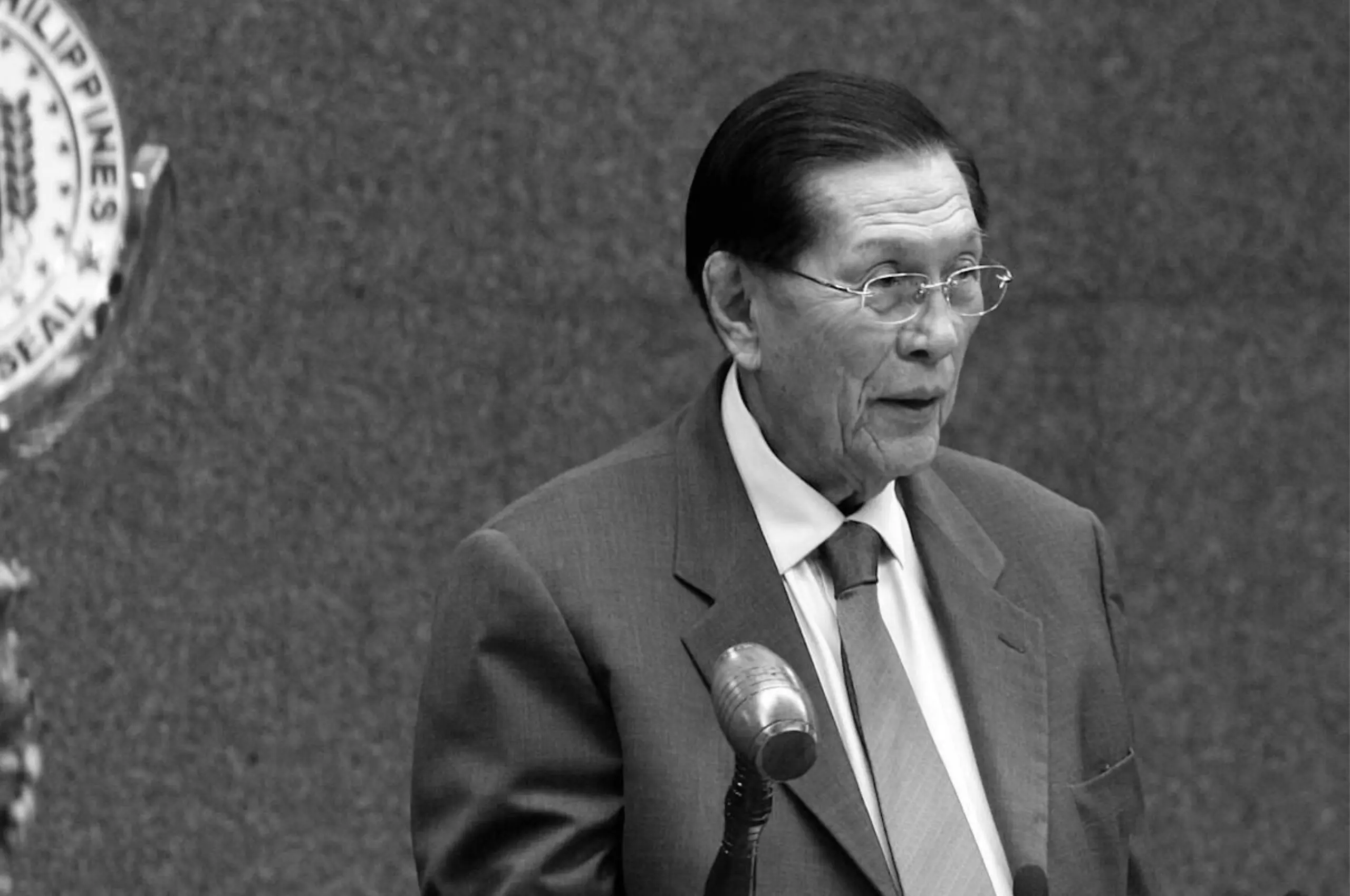
Juan Ponce Enrile, a longtime lawmaker and chief legal counsel to President Ferdinand Marcos Jr., has passed away. His career was defined by his loyalty to the Marcos family, a relationship that began under Ferdinand Marcos Sr.’s regime and continued into the presidency of the dictator’s son decades later.
On Tuesday afternoon, November 11, Senator Jinggoy Estrada said that Enrile was rushed to the hospital due to pneumonia and had “slim chances of surviving.” News of the centennarian’s passing was confirmed by his daughter Katrina Ponce Enrile.
Born out of wedlock as Juan Valentin Furagganan, his biological father had him legally change his name to Juan Ponce Enrile before he pursued studies and a career in law. Official records state that he was born on February 14, 1924. But according to his son, former Congressman Juan “Jack” Ponce Enrile Jr., records from the Aglipayan church in Cagayan state that he was born on June 22, 1922, making him 103 years old.
Hailing from the north, he became an early ally to Marcos Sr., for whom he would serve as Bureau of Customs commissioner, finance undersecretary, and justice secretary. But Enrile would cement his legacy later on as the minister of national defense during the martial law period.
The politician’s memoir claims that Marcos ordered him to prepare all the documents needed to implement martial law in the country. With the abolition of the Philippine Congress and its political parties, as well as the weakened judiciary, much of national power was consolidated under Marcos and the military — and therefore Enrile, as defense minister.
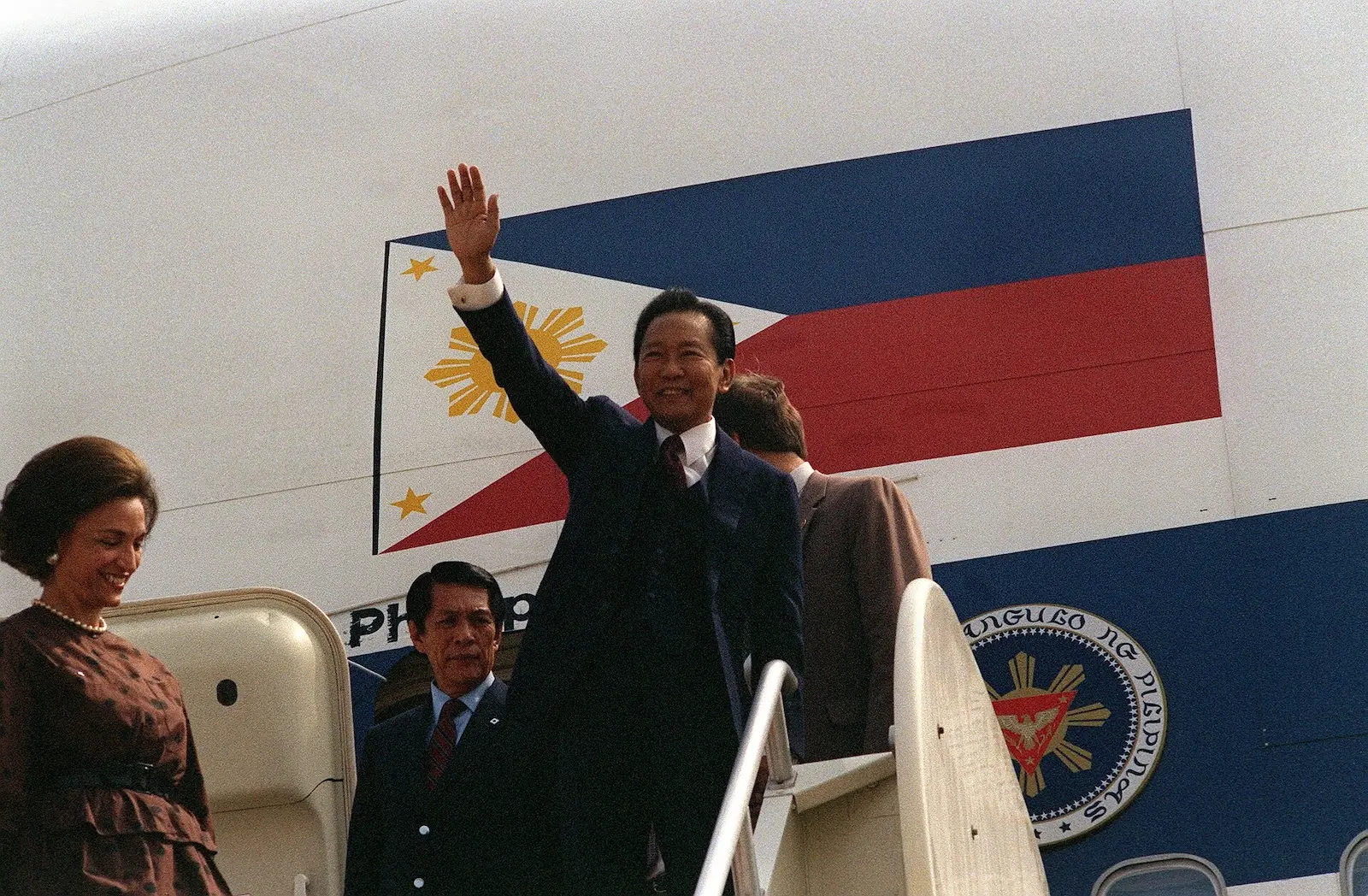
His power, however, waned in the early 1980s after Marcos snagged control of the Armed Forces of the Philippines (AFP) from Enrile’s grasp. In response, Enrile aligned himself with the Reform the Armed Forces Movement (RAM) led by then-Lieutenant Colonel Gregorio “Gringo” Honasan.
In February 1986, RAM and Enrile launched a coup d’état in an attempt to unseat Marcos, but the plans were exposed to the dictator. The coup failed, but it also gave way to the People Power Revolution, which saw Marcos and his family exiled.
After Enrile showed support for Corazon Aquino’s rise, an investigation revealed that he and RAM had also planned another coup to oust the new president. Enrile was consequently removed by Aquino from his position as defense secretary in November 1986.
His career as a legislator, spanning nearly three decades from 1987 to 2016, saw him elected to four non-consecutive terms in the Senate. He authored and sponsored key measures on national defense, energy policy, and economic regulation, though critics often viewed his influence as deeply tied to political dealmaking and alleged cash gifts. He also served as Senate president from 2008 to 2013.
This period in his life was marred by the Pork Barrel Scam, in which Enrile allegedly received P172 million in kickbacks from public funds. Despite being suspended from office in 2014 due to his involvement in the scam, Enrile served his final senatorial term to its end in June 2016.
A decade after being indicted for plunder and graft along with Estrada and former Senator Bong Revilla, Enrile stood trial before the Sandiganbayan. On October 24 this year, amid public outrage over another corruption controversy, the court acquitted Enrile.
Enrile’s long life allowed him to witness and repeatedly shape the country’s political tides, surviving dictatorships, transitions, scandals, and shifting loyalties. To supporters, he was a master strategist whose endurance signaled political brilliance. To critics, his longevity in power embodied the impunity of the country’s political elite. Either way, he leaves a legacy of fear and influence that outlasts generations.