On Tuesday, October 14, the Office of the Ombudsman announced that it has lifted restrictions on public access to the Statements of Assets, Liabilities, and Net Worth (SALN) of government officials. This comes amid calls for transparency as lawmakers and other top officials face corruption accusations related to the Department of Public Works and Highways’ (DPWH) anomalous infrastructure projects.
In 2020, former Ombudsman Samuel Martires issued a memorandum stating a SALN can only be given to the official or a duly authorized representative, a requester acting on a court order in relation to a pending case, or the Office of the Ombudsman’s Field Investigation Office (FIO) for the purpose of conducting fact-finding investigation, effectively barring the media from accessing such documents.
The new memorandum reverses these restrictions placed during former President Rodrigo Duterte’s administration, and serves as Jesus Crispin “Boying” Remulla’s first act as the newly-appointed ombudsman.
“This decision is guided by a simple principle: the public has a legitimate right to know how those in government acquire and manage their wealth,” the Office of the Ombudsman said in a statement. “Transparency in this area is not a slogan — it is a safeguard against corruption and a deterrent to abuse of power.”
According to Assistant Ombudsman Mico Clavano, the memorandum will take effect 15 days after its publication, which means that the Office of the Ombudsman will begin entertaining SALN requests on October 29.
Requesting a SALN
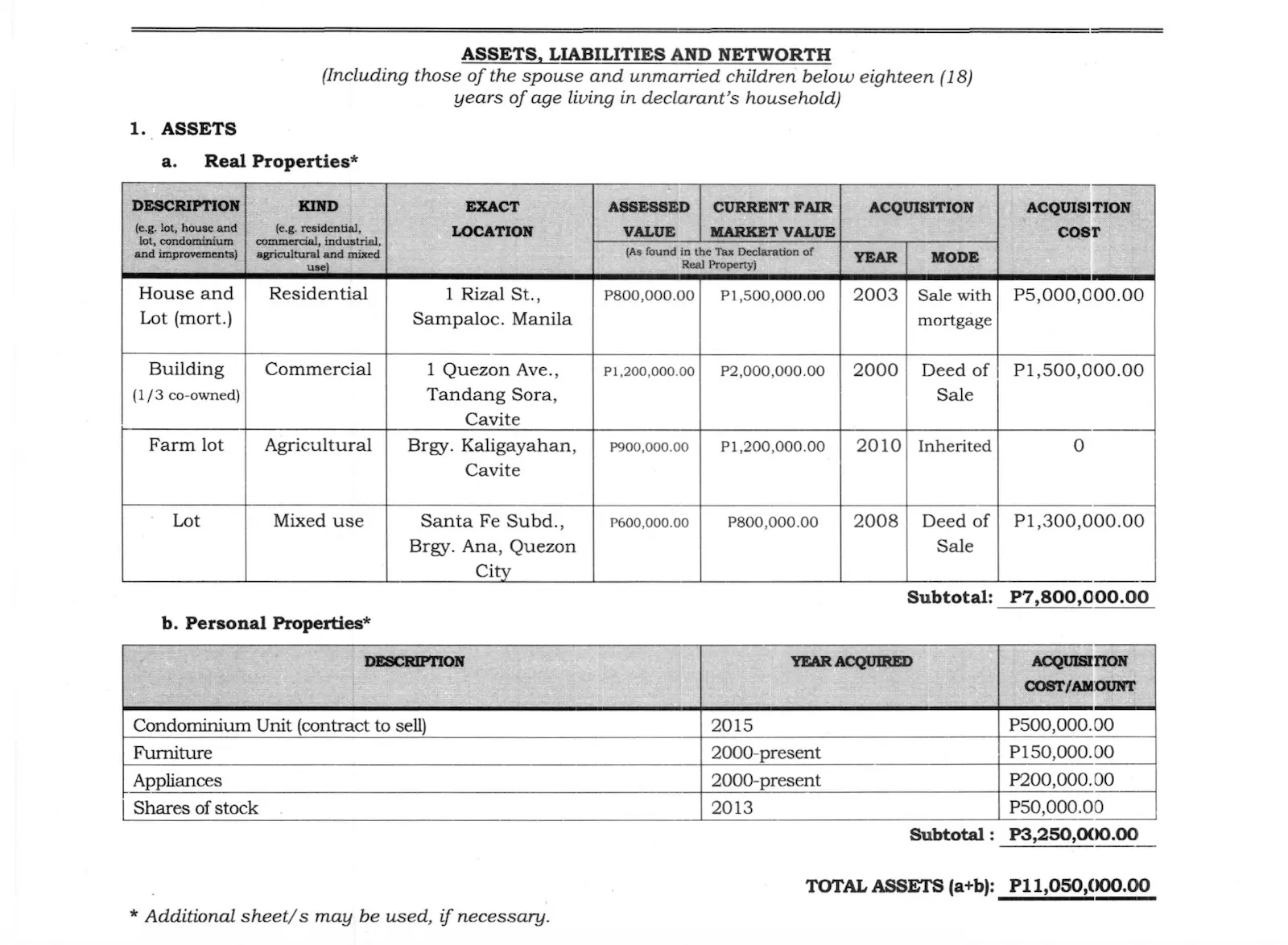
A SALN is a document declaring an official’s assets and liabilities, “including business and financial interests, of an official/employee, of his or her spouse, and of his or her unmarried children under 18 years old still living in their parents’ household,” according to the Official Gazette. All government officials and employees are required to file their SALNs within 30 days of assuming office, on or before April 30 of every year, and within 30 days after separation from service.
Under the new memorandum, sensitive details will be omitted from copies of the SALN given to the requesting party. These include:
- The complete address of the declarant
- Names, dates of birth, and ages of unmarried children below 18 years old living under the declarant’s care
- Signatures
- Government-issued identification number of the declarant and co-declarant
However, the lifting of Martires’ restrictions means that the media can now get their hands on any government official’s SALN. To do that, a request may be filed at the Ombudsman’s Public Assistance and Corruption Prevention Office (PACPO) or the Public Assistance and Corruption Prevention Bureau (PACPB) at any regional or sectoral Ombudsman office.
The requesting party must fill out a form issued by the office and present two valid IDs, and pay the reproduction or certification fee. The office will then review the request.
According to the Office of the Ombudsman, all SALN requests will be granted, except in the following conditions:
- The office is not the official repository
- The requested SALN is not on file
- The request is for an unauthorized commercial purpose
- The requesting party has a derogatory record of misuse
- The request is linked to a pending case to influence or harass
- There is evidence of extortion or safety threats
- The identity of the requesting party is fictitious
- The purpose is contrary to law, morals, or public policy
The memorandum also requires requesting parties who publish, broadcast, or otherwise publicly disseminate any information derived from the obtained SALN to submit a copy of the output or link within five days of each publication.