

The final blows to the 21-year rule of the dictator Ferdinand Marcos Sr. were delivered in just 17 days of February 1986.
The first strike was from 30 women and five men from the National Computer Center who walked out as they saw electoral fraud play out in his favor in front of their eyes.
Then, a jab from then-Defense Minister Juan Ponce Enrile and then-General Fidel Ramos, who defected from Marcos. Cardinal Jaime Sin then delivered an uppercut by calling on Filipinos to head to Camp Aguinaldo to protect the two erstwhile Marcos men.
Ultimately, it was the millions of Filipinos heeding this call who knocked Marcos and his family out of Malacañang and freed the country from the tyranny of his regime, marred by gross human rights abuses and unabashed corruption.
For a long time, it was a long-held consensus among Filipinos that the 1986 People Power Revolution was something that was positive, or at the very least, worth celebrating.
After Cory Aquino’s tumultuous coup-wracked term as president ended and gave way to the country’s first democratic transition of power in over two decades, the uprising at EDSA and in other parts of the archipelago had been observed year after year as a solemn event that was always punctuated with a flurry of yellow confetti.
Things took a turn in 2016 when Rodrigo Duterte secured the country’s top seat in a come-from-behind victory that defied the full force of the political machinery of his predecessor, Cory’s son, Noynoy Aquino.
By the time the People Power anniversary came around again in February 2017, Duterte’s brief honeymoon with the Left had ended largely over the botched peace talks with Communist rebels, compounded by increasing opposition toward his lethal war on drugs that also earned the ire of the Liberals.
So instead of Malacañang’s occupant being present at the EDSA rites that year, as it always had been before Duterte, the Left and the Liberals, notably former President Noynoy Aquino and then-sitting Vice President Leni Robredo, showed up at the People Power Monument instead.
Never did Duterte attend a formal commemoration of EDSA as president, and certainly not flanked by any “komunista” or “dilawan,” whom he spent his entire six-year term debasing, demonizing, and decimating.
“People Power means that we’re responsible for what has happened from 1986 to today, and it also means that for as long as we remain a democracy, we’re responsible for what happens from today onwards.”
And so, the snubbing of EDSA rites by the incumbent president became a new tradition that was readily and very naturally adopted by Duterte’s successor, Ferdinand Marcos Jr., son of the late dictator who bestowed upon him his name and is, frankly, the ultimate reason for the season.
To Duterte’s credit, even as families and friends were being ripped apart by polarizing political views post-2016 and 2022 elections, students and workers at least had a special non-working holiday to look forward to every February 25, something which Marcos Jr. had denied Filipinos the privilege of since 2024 to the dismay of victims of his father’s torturous martial rule, progressive groups, “dilawans,” “pinklawans,” and even Catholic educational institutions.
Besides, on the 37th anniversary of EDSA, Marcos Jr. “once again offer[ed his] hand of reconciliation,” an often-repeated plea from him and his family that suggests the country should just move on and “pursue progress and peace and a better life for all Filipinos.”
The EDSA consensus now
The old consensus on EDSA, if we were to read private polling firm WR Numero’s latest survey on the revolution, has been shattered. No longer does People Power hold a monolithic spot in our collective memory, which has been muddled by disinformation and brainrot.
Around a decade ago, it would have been easy to answer, especially in the affirmative, whether Filipinos benefited from People Power. 40 years after Marcos Sr. was ousted and fled to Hawaii with his family, most of the Filipinos in this article from different sectors and disciplines straddled somewhere in between “yes” and “no” when asked if their lives improved thanks to EDSA.
But that’s not the case for Myrna Reyes, a 56-year-old vendor whom we caught assembling sampaguita garlands behind the EDSA Shrine in Ortigas. She was beaming with certainty that she is a direct beneficiary of the blessings of People Power, at least in the most pragmatic sense.
“Nakakatulong naman din,” she said as she paused from threading the white flower buds. “Kasi kapag may rally rito, as in nandito kami. Kaya nasasabi ko paulit-ulit: Malaking tulong ‘pag may rally. Kasi kahit papaano nakakapagtinda kami.”
Around 800 meters north of EDSA Shrine, 22-year-old Gina Bertolaga was sleeping on the sidewalk under an umbrella, a short distance behind the People Power Monument. Her slumber was rudely interrupted by her sister, who asked her to answer our questions as she returned to man their stall made of scrap plywood and metal grills.
Even as Bertolaga seemed to be halfway between sleep and consciousness, EDSA’s gift to ordinary Filipinos was not lost on her.
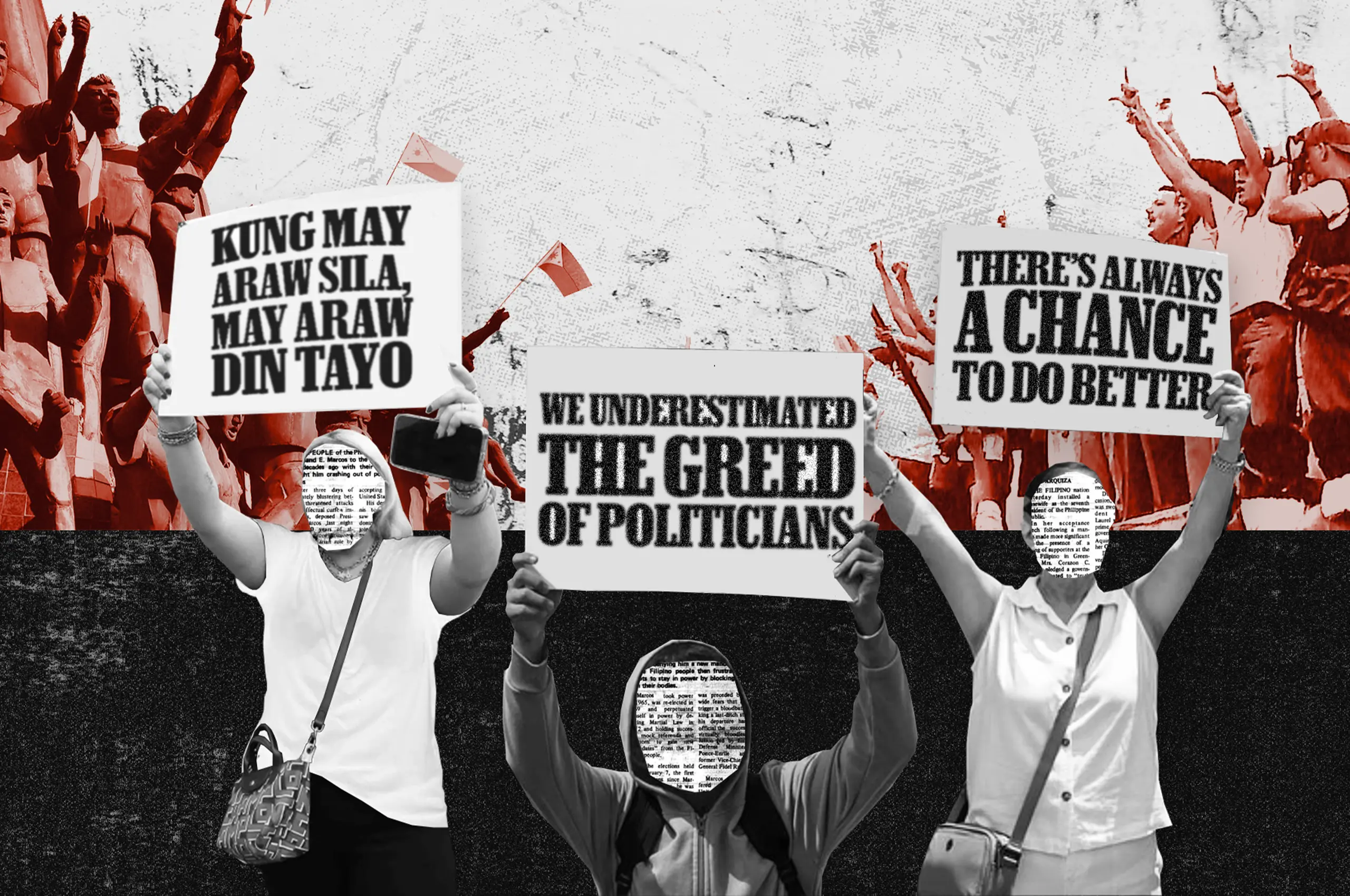
“Araw natin ‘yan para magreklamo sa gobyerno, sa mga kurakot,” she slurred slightly. “Kasi kung may araw sila, may araw din tayo.”
People Power still inspires
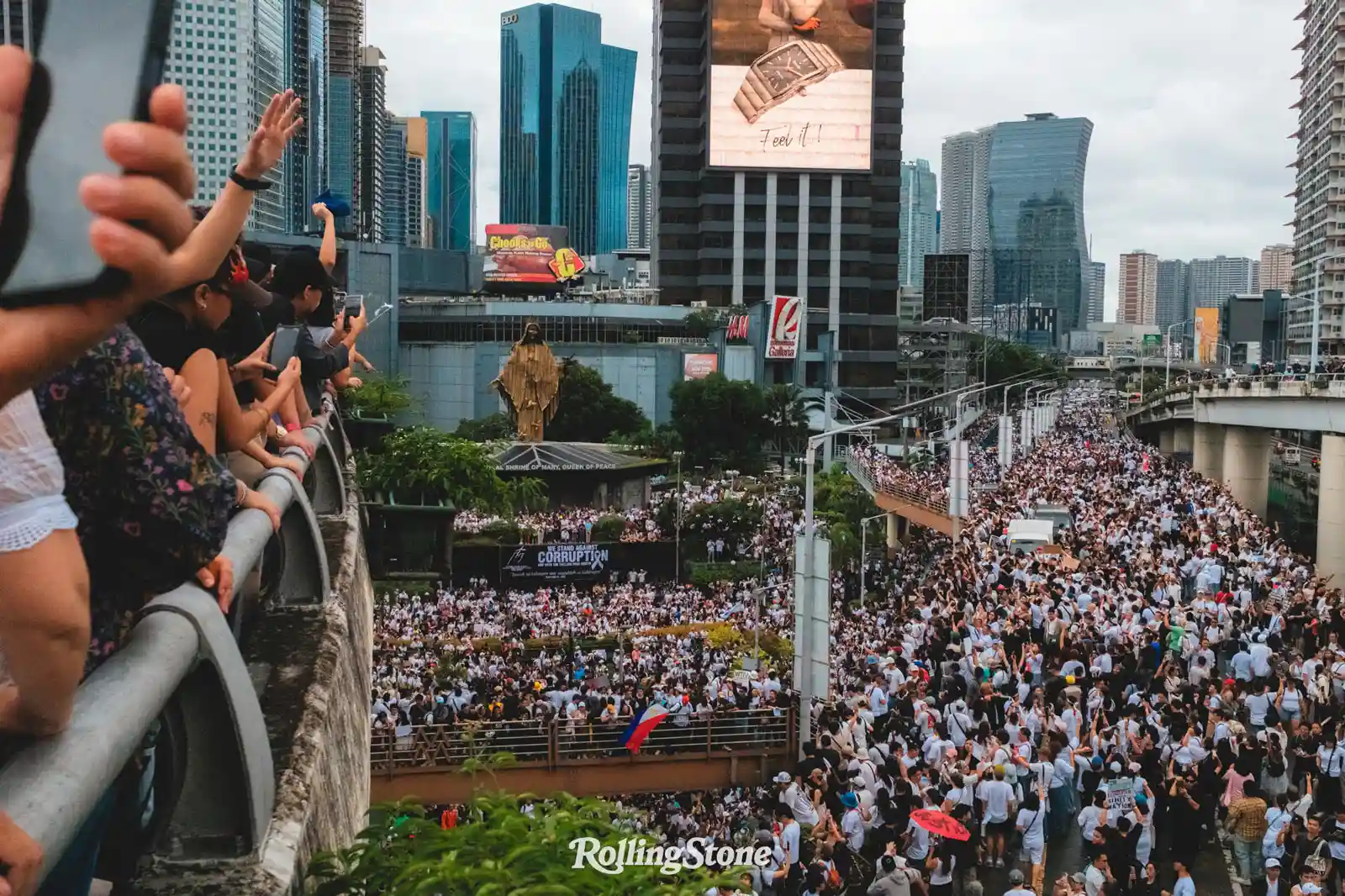
One of those days did fall upon the People Power Monument again last September 21, 2025, traditionally remembered as the anniversary of the declaration of martial law. Around 15,000 people clad in white turned up to denounce corruption related to substandard, or even nonexistent, flood control and other government infrastructure projects.
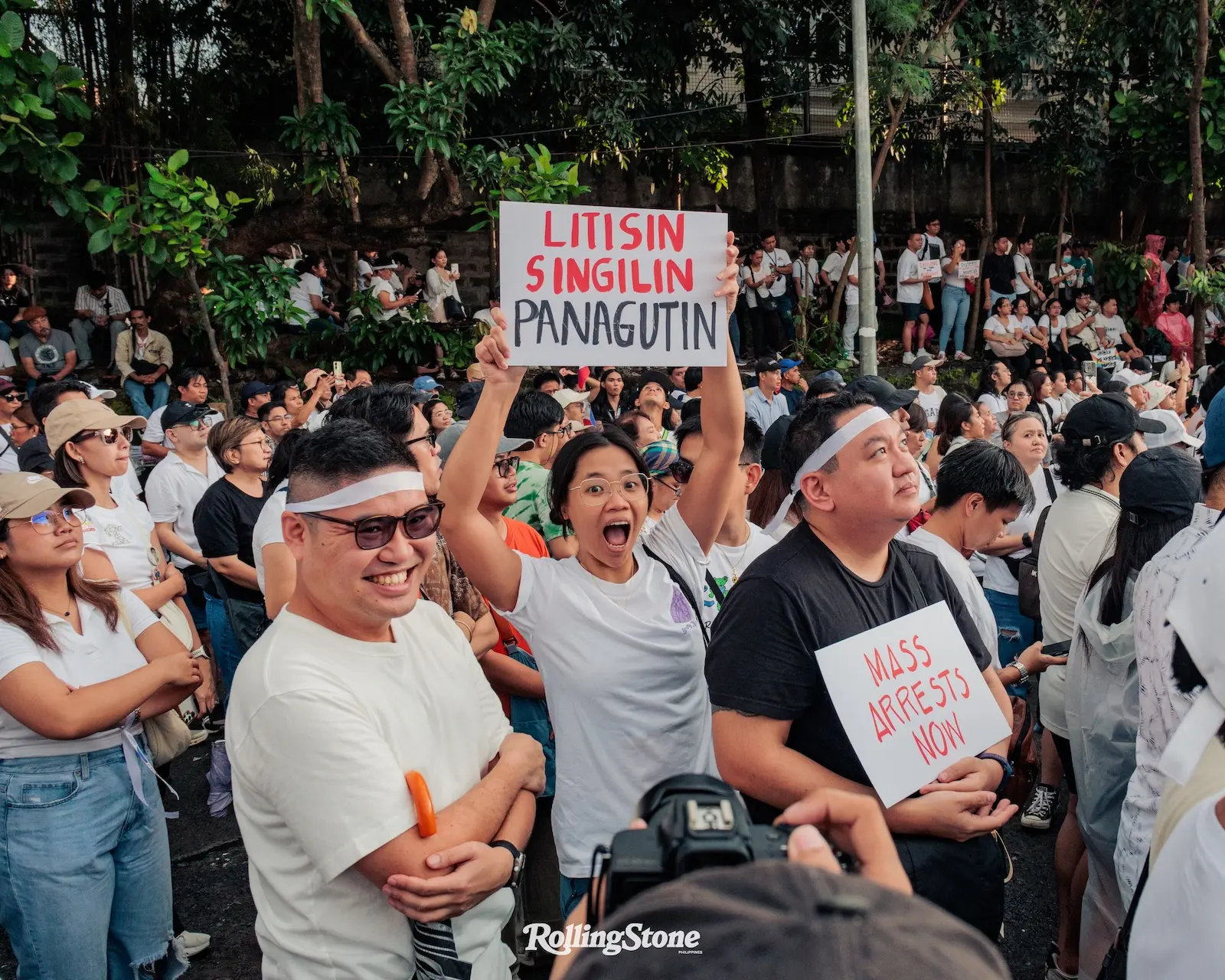
“When we chant, ‘Ikulong na ‘yang mga kurakot,’ in the streets today, we’re rightly calling out those in power right now,” said Kiko Aquino Dee, a political scientist who is a scion of the Aquino family and among the co-convenors of the Trillion Peso March. “We don’t need to wait until the election to make […] change [happen.] That can involve protest, voluntarism, policy work, or any number of other things.”
Jude, 25, who had interned with the Intramuros Administration, was among the thousands who turned up at the second Trillion Peso March last November 30, 2025, to demand accountability over rampant corruption in government.
“[The] EDSA [Revolution] made me free and made me feel valuable as a person and also as a Filipino,” he said as we hid under the shade of the People Power Monument from the bright morning sun. “Even though we’re experiencing a lot of struggles right now, we already have our voice, and we already know what to do.”
‘Electric’ post-EDSA period
Indeed, in the immediate aftermath of the revolution, Filipinos instinctively knew what to do, or at least, what to feel. “There was relief and possibility after the People Power Revolution,” said Mona Magno-Veluz, who had lived through martial law and EDSA in her teens decades before she became a popular history social media content creator known as Mighty Magulang.
She continued, “It was the kind of liberation that inspired art and music. Suddenly, newspapers were freer, conversations felt less guarded, universities became spaces of open debate again.”
This “electric” feeling post-1986 at the University of the Philippines (UP) was witnessed by high school social studies teacher Anna, 55, who had participated in the EDSA rallies as a student. She recalled, “Palma Hall was covered in posters. Tambayans were discussion hubs. Student orgs held forums [about] land reform, labor rights, U.S. bases, foreign policy. Political engagement wasn’t extracurricular; it was ambient.”
“It felt like the country could finally breathe again,” said Akbayan Rep. Chel Diokno, son of martial law detainee and former Senator Jose W. Diokno. “There was a deep sense of relief and renewed possibility.”
Pulitzer Prize-winning journalist Manny Mogato, who endured a four-day marathon coverage of the People Power Revolution as a young reporter for The Manila Times, observed that “Filipinos were selfless” right after the ouster of Marcos Sr.
“They helped each other. They shared food. They shared something. The initial effect of EDSA was good,” he told us over Zoom.
Then, in his final years of undergraduate study at the Ateneo de Manila University, constitutional law professor Dante Gatmaytan recalled that “there was an almost visible energy that animated Filipinos at that time.”
“I think we trusted too much, thinking after the EDSA Revolution may pagbabago na ang pananaw, ang attitude. Pero nagkamali po kami.”
Mea culpa
Gatmaytan continued, “There were serious efforts to write a Constitution participated in by progressive elements who participated in the ‘parliament of the streets.’”
Exactly a month after the conclusion of the People Power Revolution, the newly-installed President Cory promulgated the Freedom Constitution, a provisional charter that, for one year, granted her sole legislative power and supervision over all local governments pending the ratification of a new constitution to be drafted by a commission composed of 30 to 50 natural-born Filipinos.
This awkward interregnum that Aquino resisted calling a “revolutionary government” — even though she was sworn in as president in defiance of the prevailing Marcosian 1973 Constitution — was a crucial period to introduce the necessary repairs and reforms to the country’s institutions that were practically bulldozed during the dictatorship.
The Constitutional Commission was earnest in its effort to draft a new charter that embodied the ideals of the EDSA Revolution, but its surviving members now admit that the numerous coup attempts on the Aquino administration deprived them of enough time to finesse the Constitution’s language, leaving loose threads that were only discovered and began to unravel long after it has been ratified.
Among them was a provision banning political dynasties that was left open for Congress to define after the new Constitution took effect.
“We decided that we leave it to Congress, believing that the Congress will be patriotic and wise enough to define [what a political dynasty is] right away after the ratification of the Constitution,” said Rene Sarmiento, one of the 48 framers of the 1987 Charter, in an interview on ONE News.
Sarmiento went on to admit, “Nagkamali po kami. Nagkulang po kami.”
“I think we trusted too much, thinking after the EDSA Revolution may pagbabago na ang pananaw, ang attitude. Pero nagkamali po kami,” he said.
Repeat offender
“We underestimated the greed of politicians,” said Cardinal Pablo Virgilio David, who was a student activist during the Marcos dictatorship. “We assumed those who would lead after 1986 would act as servants of the common good. Many did not. Too many turned politics into a family enterprise, a private investment, a marketplace of favors. And over time, that corroded the credibility of democratic institutions and made people cynical about EDSA.”
On top of this, Mogato said that then-President Cory relied heavily on the same political leaders from the deposed Marcos regime, effectively recycling rotten public officials.
“Binalik ‘yung the most corrupt and the most greedy political warlords,” Mogato said. “They needed their cooperation to run the country. So binalik ‘yung mga old traditional political families.”
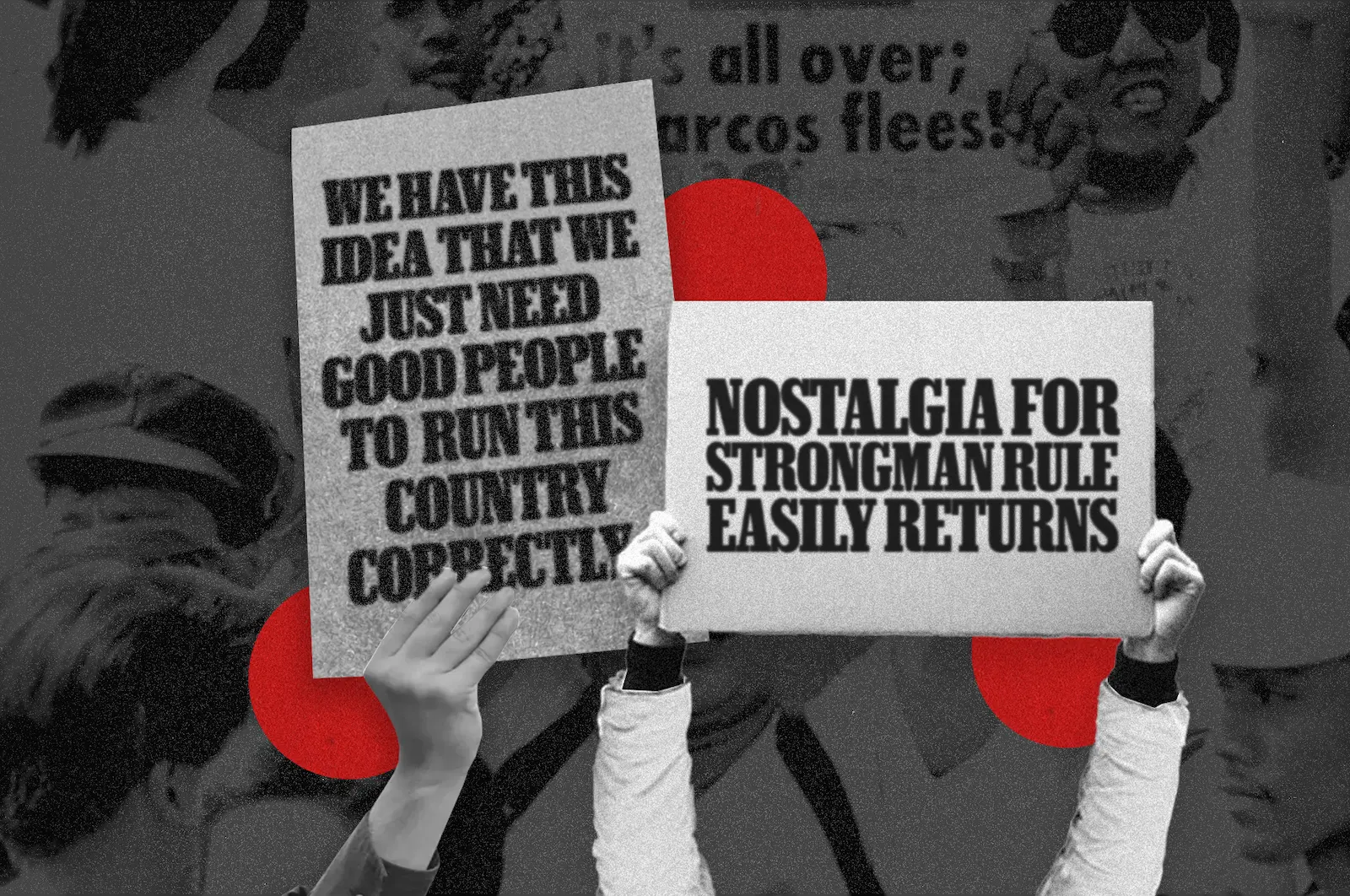
“[But] for many among the poor, daily life changed little. Where democracy does not deliver material security, nostalgia for strongman rule easily returns.”
He added that new dynasties were also birthed courtesy of President Cory. Mogato said that in Metro Manila alone, the Binays of Makati, the Cayetanos of Taguig, and the Abaloses of Mandaluyong all owe the entrenchment of their clans in their respective cities to the widow of the slain former Senator Ninoy Aquino.
Long-time feminist activist and international studies professor Tesa de Vela of Miriam College also attributed the post-EDSA decline to the country’s apparent attachment to traditional politics.
“We have this idea that we just need good people to run the country correctly, when we haven’t really asked what running it correctly really means,” she said. “We have this idea that change can happen within, and without changing the status quo.”
Unchecked authoritarian nostalgia
But EDSA was “transformative” for the middle classes, journalist and sociologist Randy David, brother of Cardinal David, said. “[But] for many among the poor, daily life changed little. Where democracy does not deliver material security, nostalgia for strongman rule easily returns.”
After all, this was how martial law came to be in the first place. David explained, “Martial law justified itself through the claim that Filipinos lacked discipline and collective purpose, traits said to be necessary for development. That narrative had some superficial plausibility: Elites abused privilege, while many among the poor saw little reason to invest in a system that benefited only the powerful.”
This legacy of and nostalgia for Marcos Sr.’s authoritarian rule, said Anthony Lawrence Borja, a political science professor from De La Salle University, “were largely ignored rather than confronted.”
“I call this the ‘natulog sa kangkungan’ moment for my generation,” Magno-Veluz said. “We did not do enough to keep the memory alive.”
“Gumagawa lang tayo ng ingay. Wala namang nagbabago e. Dapat mayroong pagbabago para sa lahat.”
The discipline that was supposedly instilled in Filipinos by martial law is what 73-year-old Joe dela Cruz remembers as he paused on his bike in front of the People Power Monument to speak to us.
“‘‘Yong panahon ng martial law, ‘yong mga tao medyo tumino nang kaunti kasi may takot sa gobyerno,” he said. “Ayan ang martial law, ‘di ba? Batas militar. Ang tao [ay] may takot noong panahon na ‘yon.”
Across the monument, 43-year-old mototaxi rider Gerald Ferrer told us that he was taught in school that martial law was a terrible time for the country, but later on learned on his own that Marcos Sr.’s regime was good for Filipinos.
“Nagkaroon ng disiplina ang mga tao,” he said. “Kasi kahit sa libro noon, talagang hindi maganda ‘yong kwento. Pero sa mga tao na nakaranas noon, may disiplina. ‘Pag sumunod ka sa batas, e ‘di okay ka. ‘Pag hindi ka sumunod, magkakaproblema ka talaga.”
Mission accomplished?
Many of the Filipinos in this story shared the same sentiment when asked what exactly was People Power’s promise: “It was to oust a dictator,” said Rappler’s Lian Buan, a journalist with Ilocano roots who closely followed Marcos Jr. on the 2022 campaign trail. “That clearly was achieved.”
“Wala na ‘yung inaayawan nilang presidente,” said dela Cruz, still on his bike in front of the People Power Monument. “E ano pa ‘yung dapat nila ikagagalit sa nakaraang administrasyon na ‘yun? Matagal na ‘yun. 40 years na.”
When we finished talking, dela Cruz set out to complete the four-kilometer bike route that he repeats every day from White Plains out onto EDSA and then into Cubao. “Gumagawa lang tayo ng ingay,” he said. “Wala namang nagbabago e. Dapat mayroong pagbabago para sa lahat.”
Now more awake and alert, the 22-year-old Bertolaga declared without any hesitation that People Power has become irrelevant.
“‘Di rin naman natitinag ‘yung mga kurakot e,” she said with a tinge of disdain and resignation. “Kahit anong rally nila, ganoon pa rin ‘yung nangyayari. Kahit may bagong umupo, ganoon pa rin ‘yung nangyayari. ‘Di sila natitinag e.”
‘Victim of its own promises’
Borja, who also hails from a pro-Marcos household, said, “EDSA was a victim of its own promises. We can’t expect the oligarchy that benefited from EDSA to push through with reforms that will make them obsolete.”
Speaking to us over Zoom while conducting academic research in her hometown of Ilocos, the bailiwick of the Marcoses, political sociologist Ash Presto said, “The Philippines has not even changed” even after People Power.
“It was not followed by a legitimate regime change in the sense that the person who took over is part of the ruling elite class,” she said. “And now political dynasties as part of the ruling elite class have totally taken over Philippine politics through other legal reforms, including the party-list law.”
Paolo Tamase, associate dean of the UP College of Law, said that EDSA relied too much on the law, which he called an “elite institution,” to sustain its momentum.
“We used courts to be the venue of social activism instead of the elected branches or the streets,” he said. “We chose the least transparent, most inaccessible forum to argue rights, removing them from the majority who needed them most.”
For Cristina Palabay, secretary general of human rights group Karapatan, those who are most in need of those rights are far worse off than they were 40 years ago.
“I think that life for ordinary Filipinos has worsened, with the more dire economic conditions of peasants, workers, and the middle class, the climate of impunity that hovers in our democratic space, and the poor quality of governance that we contend with to this day,” she said.
Audrey Cruz, owner of Onlypans Taqueria that publicly supported Robredo in the 2022 presidential race against Marcos Jr., knows this firsthand.
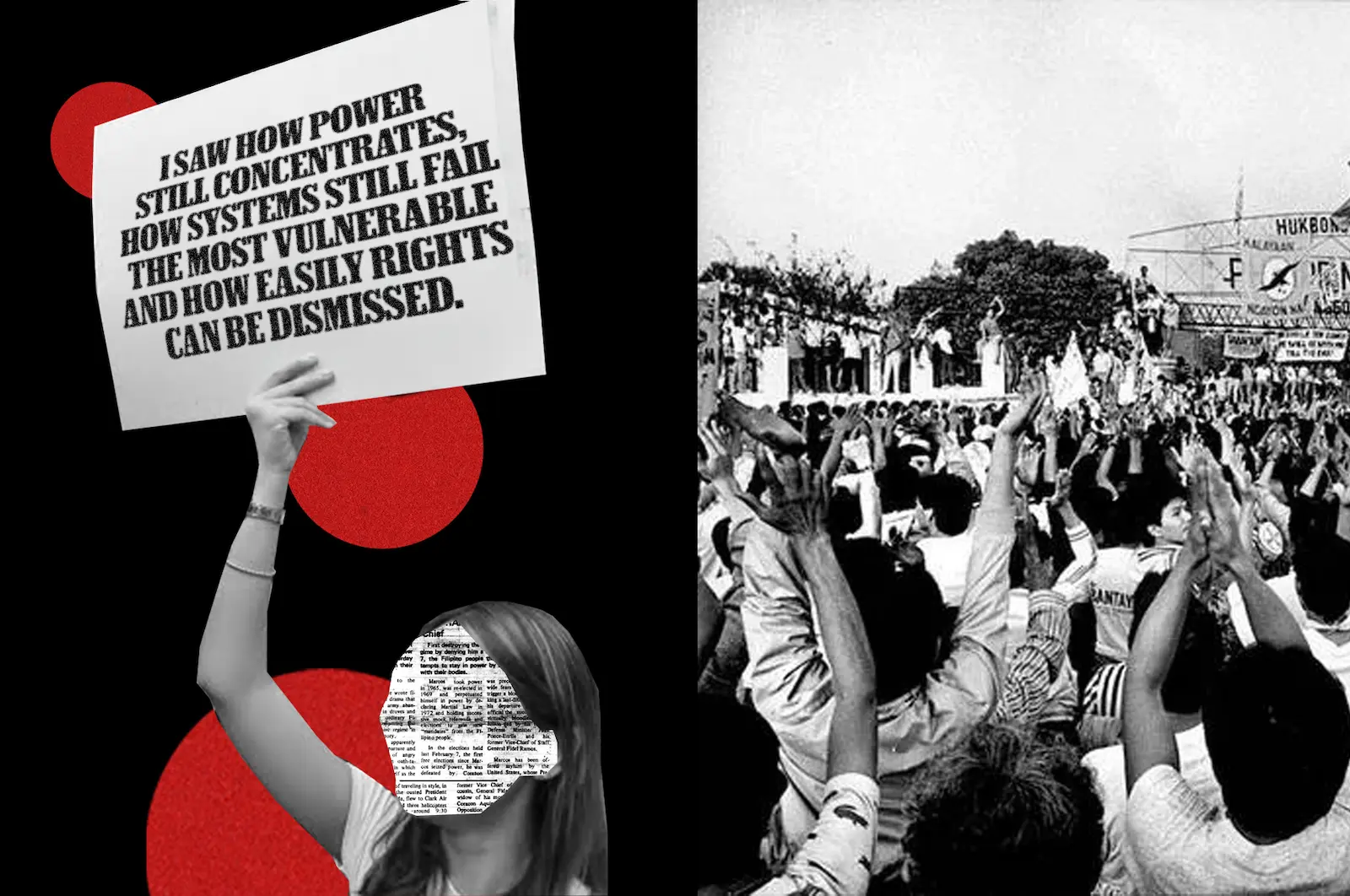
“When I began working, employing people, and navigating institutions […] I saw how power still concentrates, how systems still fail the most vulnerable, and how easily rights can be dismissed,” Cruz said. “That’s when EDSA stopped feeling like a finished chapter and started feeling like an unresolved responsibility.”
‘Work in progress’
Gibby Gorres, founder of public relations firm Gugma and former communications director at the Senate, warned that believing in the narrative that EDSA has failed is a “dangerous path to tread.”
“EDSA is not a magic pill. It’s a story we should continuously tell and a promise we continuously work towards,” he said. “If we are disgruntled about the way things are 40 years after, it’s not because EDSA failed us. Perhaps it’s because we failed EDSA.”
Buan said EDSA taught Filipinos to speak up against oppression, but even she is unsure if this lesson is still relevant today.
“We live in a world where bad people doing bad things are applauded and cheered on. How that happened is still a big question we need to collectively answer,” she said.
Dee, the political scientist hailing from the Aquino family, said that while government officials are absolutely responsible for whatever happens in our country, we — the people — also share some of that burden too.
“People Power means that we’re responsible for what has happened from 1986 to today, and it also means that for as long as we remain a democracy, we’re responsible for what happens from today onwards,” he said. “I think a beautiful thing about democracy is that there’s always a chance to do better.”
“Democracy is never a ‘one-time victory,’” Cardinal David said. “It is always a work in progress.”
Will the real opposition please stand up?
But there remains a feverish disagreement over how that work should be done. So much so that Buan largely attributes EDSA’s apparent decline to infighting between the Left and the Liberals.
The cracks have never been clearer within the traditional opposition, a phrase that has now become necessary to differentiate the Left and the Liberals from the pro-Duterte blocs that now stand in opposition to the Marcos Jr. administration, which they helped elect in 2022.
In the past week alone, in the increasingly small space on social media where the traditional opposition’s voice is (at the very least) perceivable, people who lean Left have quarreled with people with Liberal tendencies over whether the third Trillion Peso March which will be held on the anniversary of People Power should welcome calls for the resignation of Marcos Jr. and the impeachment of Vice President Sara Duterte.
Dee’s twice-edited Facebook post on the calls of the upcoming protest at the People Power Monument is ground zero of this social media war, where some from the Left have gone as far as dismissing the credibility of the organizers of the Trillion Peso March, while some Liberals have resorted to the usual red-tagging tactics popularly employed by one of the common enemies of both the Left and the Liberals: Rodrigo Duterte.
These tensions within and among factions of the traditional opposition have been brewing long before this social media brouhaha.
The Left was greatly weakened when it splintered in the 90s into “reaffirmists” and “rejectionists” due to the thorny Great Rectification Movement that resulted in the killings of some of their cadres (a historical point that merits its own article, but for now we have Supreme Court Senior Associate Justice Marvic Leonen’s acknowledgement of this split during the oral arguments on the Anti-Terrorism Act in 2021).
In the Liberal camp, infighting had been present even (and especially) during their peak from 2010 to 2016, when the party was split between the pro-Noynoy Aquino “Samar” group and the “Balay” group that favored former Senator Mar Roxas.
This same dynamic is still present in the run-up to the 2028 polls, as former Senator Antonio Trillanes IV of Magdalo has publicly supported Akbayan’s Senator Risa Hontiveros for president while lobbing criticisms against Liberal’s Robredo (for her supposed silence on national issues) and Katipunan ng Nagkakaisang Pilipino’s Senator Bam Aquino (for his “ideal” scenario where crimes against humanity — which former President Duterte is accused of before the International Criminal Court — are tried in Philippine courts).
In rare moments of what could have been showcases of unity, like the launch of the anti-corruption protests in response to the flood control scam, portions of the Liberal flank got spooked and almost abandoned the movement after the Left suddenly chanted anti-Marcos and anti-Duterte slogans at a joint press conference.
All this is happening even as the traditional opposition can take advantage of the relatively low ratings of Marcos Jr. (48 percent disapproval and 47 percent distrust, according to the Social Weather Stations (SWS) in December 2025) and extremely early 2028 presidential race entrant, Vice President Duterte (56 percent approval and 54 percent trust, also according to SWS).
‘Illegitimate’ protests
Another point of the squabbles within the traditional opposition was one that emerged in the wake of the September 21 protests, where some protesters in Mendiola turned violent — an act deemed valid by portions of the Left, but was categorically condemned by Liberals and other mainstream talking heads, including Cardinal David who, in his homily during the second Trillion Peso March, said the movement rejects “violence and disorder.”
In conversation with us, the cardinal maintained the same line: “EDSA showed the world that people could pursue political change without hatred and without bloodshed, through courage, prayer, solidarity, and moral persuasion.”
Peaceful non-violence had always been the Church’s stance when it came to resistance to the Marcos regime. When the Catholic Bishops Conference of the Philippines (CBCP) condemned electoral fraud during the 1986 snap elections that pitted Marcos Sr. and Cory Aquino against each other, it called for “active resistance of evil by peaceful means — in the manner of Christ.”
“We [do not] advocate [for] a bloody, violent means of righting this wrong. If we did, we would be sanctioning the enormous sin of fratricidal strife. Killing to achieve justice is not within the purview of our Christian vision in our present context,” the CBCP said then.
But Presto, the sociologist, said recognizing People Power, often described as “peaceful” and “bloodless”, as the only legitimate form of protest is also “dangerous for democracy.”
“Hailing that as the one and only legitimate, valid form of revolution can be dangerous because it can relegate some equally valid forms of revolutions like the angry, loud revolutions as less valid because you are putting this specific peaceful revolution on a pedestal,” she said.
Presto added that it is also undeniable that criticism of “ill-mannered” protesters have “classist” undertones, “specifically because people who tend to be tagged as ill-mannered usually tend to come from the lower socioeconomic classes and people who are doing the tagging of incivility are from the upper to middle class sectors of the society.”
Fulfilling EDSA’s promise
Rep. Diokno, of the “rejectionist” Akbayan party, is among the few to admit within his flank of the Left that has been identified with the formerly ruling Liberal Party that EDSA’s goal of preventing the concentration of power in the hands of a few families remains unmet.
“As a result, the same families continue to dominate our system, undermining equal access to public service. This is why Akbayan filed House Bill 5905, the Comprehensive Anti-Political Dynasty Law — to finally fulfill what EDSA and the Constitution promised that Congress has long failed to deliver,” Diokno said.
Akbayan’s anti-political dynasty bill is just one of 24 similar measures in the House of Representatives, which also include a version filed by Speaker Faustino Dy III of Isabela’s Dy clan and Majority Leader Sandro Marcos, son of Marcos Jr., whose administration has identified the proposal as a priority measure in the wake of the flood control scam.
While the anti-dynasty bills in the House are still pending with the Committee on Suffrage and Electoral Reforms, which is currently conducting consultations across the country, Dy vowed that the House will pass “a fair, just, and implementable anti-political dynasty law in the 20th Congress.”
“It was the kind of liberation that inspired art and music. Suddenly, newspapers were freer, conversations felt less guarded, universities became spaces of open debate again.”
At the Senate, the anti-political dynasty bill has cleared the Committee on Electoral Reforms chaired by Akbayan’s Hontiveros, who said that the upper chamber aims to pass the measure before Congress goes on a break from March 21 to May 3.
As of writing, 12 senators have backed this version of the bill, which seeks to ban relatives of incumbent politicians from running simultaneously for elective office up to the second degree of consanguinity or affinity (meaning their parents, spouses, children, and siblings). The ban, however, only applies when politicians and their kin are both running for national seats or are both seeking local positions.
This is a deviation from what Akbayan is seeking in both the House and the Senate, which is to ban relatives of politicians from elective office up to the fourth degree of consanguinity or affinity.
“Favored talaga ng [academe, private sector, at business organizations] ‘yung [ban] to the fourth degree of consanguinity and affinity. So hindi ko pwedeng indahin kung pupunahin nila ‘yung aming committee report,” Hontiveros said when asked about potential criticism that the anti-dynasty bill that would pass Congress would be watered down.
“But having said that I think kahit ‘yung puna nila ay makakatulong sa progressive legislation natin,” she continued. “Aasahan ko na mananatili silang both nagbabantay sa implementasyon nitong unang batas […] up the road pag-review ng implementasyon nitong batas at possible amendment para palakasin siya.”
Mogato is less optimistic about the passage of Akbayan’s “revolutionary” anti-dynasty bill, but expects that a “watered down” version could still pass. “Sana mag-saya na tayo dahil nabawasan, kaysa wala,” he said.
Moving forward
Beyond the halls of Congress, the work of democracy continues in organizations like the BPO Industry Employees Network, a formation of workers in the business process outsourcing sector fighting for their rights in the workplace.
The group’s secretary-general, Renso Bajala, shared that his life and advocacy were shaped by the contradictions between what EDSA promised and what he said it failed to deliver.
“If we are disgruntled about the way things are 40 years after, it’s not because EDSA failed us. Perhaps it’s because we failed EDSA.”
“That tension is what drives me to believe that the struggle for democracy was not fully realized or attained in 1986, and that it continues in the everyday battles of workers, farmers, indigenous people, women, and the youth of today and other marginalized sectors for dignity, justice, and genuine people’s power,” he said.
For Anna, the high school teacher, engaging the youth is critical to maintaining a revolutionary spirit, and that it hasn’t been completely lost. “I saw echoes of that civic awakening during the 2022 elections. Young people organizing, volunteering, fact-checking. That energy reminded me of the late ‘80s. One lesson stayed with me: Democracy survives only if the youth engage. Once apathy sets in, institutions hollow out.”
“Teaching became my form of sustained activism,” she added. “My husband and I remained politically engaged in small but consistent ways. We followed policy debates. We joined rallies when necessary. We argued over the news. We tried not to disengage.”
Mogato traced his entire career in journalism that eventually led to him winning the Pulitzer Prize for reporting on Duterte’s war on drugs back to those four days on the ground during the People Power Revolution. Post-EDSA, he said Philippine media, although with its faults, became freer and strived to become more ethical.
Randy David, the journalist and sociologist, was 40 years old when the EDSA Revolution happened, and turned 80 in January.
“At midlife, I found myself not only a witness but a participant in the ongoing struggle to define EDSA’s meaning beyond the fall of a dictator,” he said. “By accident, EDSA launched a second career for me in media, even as I continued teaching at UP. It was my response to the call to democratize public discourse […] That experience transformed me. It sharpened my ability to translate sociological ideas into everyday language and, I hope, helped broaden the public’s sociological imagination.”
“EDSA taught me that freedom is not inherited, it is maintained,” Onlypans’ Cruz said, adding that this learning is incorporated into the way she runs her business. “As a business owner, I’ve learned that there is no such thing as an apolitical workplace. Every decision is political: Who gets hired, who gets paid fairly, who is protected, who is disposable.”
In the middle of our interview, as he was parked across the People Power Monument, mototaxi rider Ferrer received a notification on his phone alerting him that his next passenger is just a two-minute ride away. We did our best to speed up the conversation.
“Sa opinion ko, relevant siya kasi doon malalaman ‘yung pagkakaisa ng mga tao,” he said. “Iba kasi ‘yung People Power. Physical talaga e. Pero ‘yung nagsasalita lang, hanggang salita lang. Sila, may action na ginawa. Kasi ‘pag ‘yung tao ‘yung gumalaw, talagang powerful siya.”
We thanked him for his time. He smiled, nodded, and put his helmet on.
Then he moved to his next destination.
Frequently Asked Questions
The People Power Revolution was a mass uprising over 17 days in February 1986 that ended the 21-year rule of dictator Ferdinand Marcos Sr., sparked by electoral fraud allegations, military defections led by Juan Ponce Enrile and Fidel Ramos, and Cardinal Jaime Sin’s call for Filipinos to protect them at Camp Aguinaldo.
According to WR Numero polling cited in the piece, the once-widespread consensus that EDSA was unambiguously positive has fractured, with Filipinos now more divided on whether their lives have concretely improved because of the revolution, 40 years after Marcos Sr.’s ouster.
Rodrigo Duterte never formally attended an EDSA anniversary as president, a practice continued by his successor, Ferdinand Marcos Jr., son of the ousted dictator, who also removed EDSA’s non-working holiday status starting in 2024.
As of the article’s reporting, an anti-political dynasty bill mandated by the 1987 Constitution remains pending, with competing House and Senate versions differing on how many degrees of family relation should be banned from simultaneously holding elective office.
Filipinos interviewed for the piece, including vendors, journalists, academics, and political figures, expressed a range of views, from continued belief in EDSA’s value as a tool for accountability to skepticism that it produced lasting change for the poor.