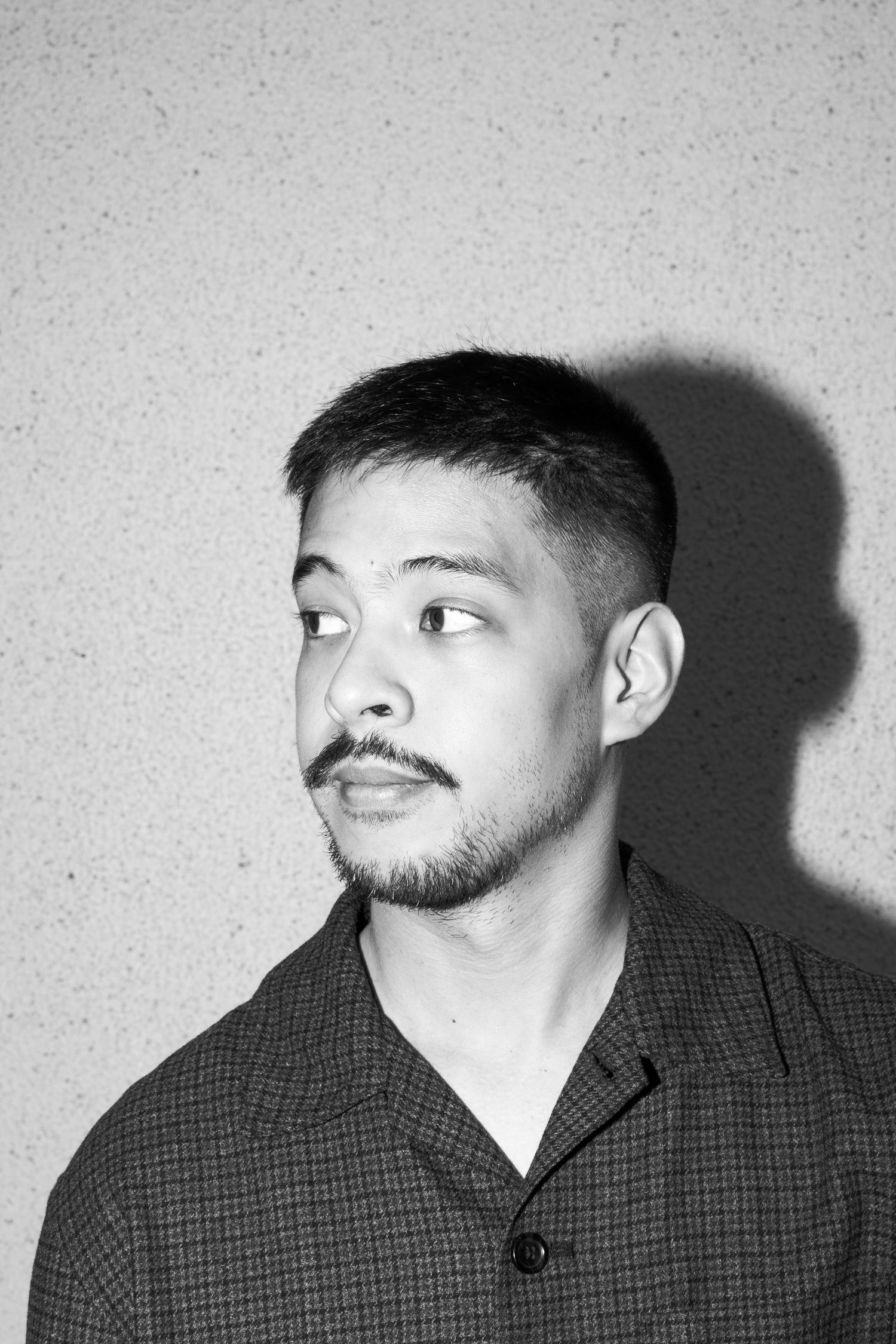


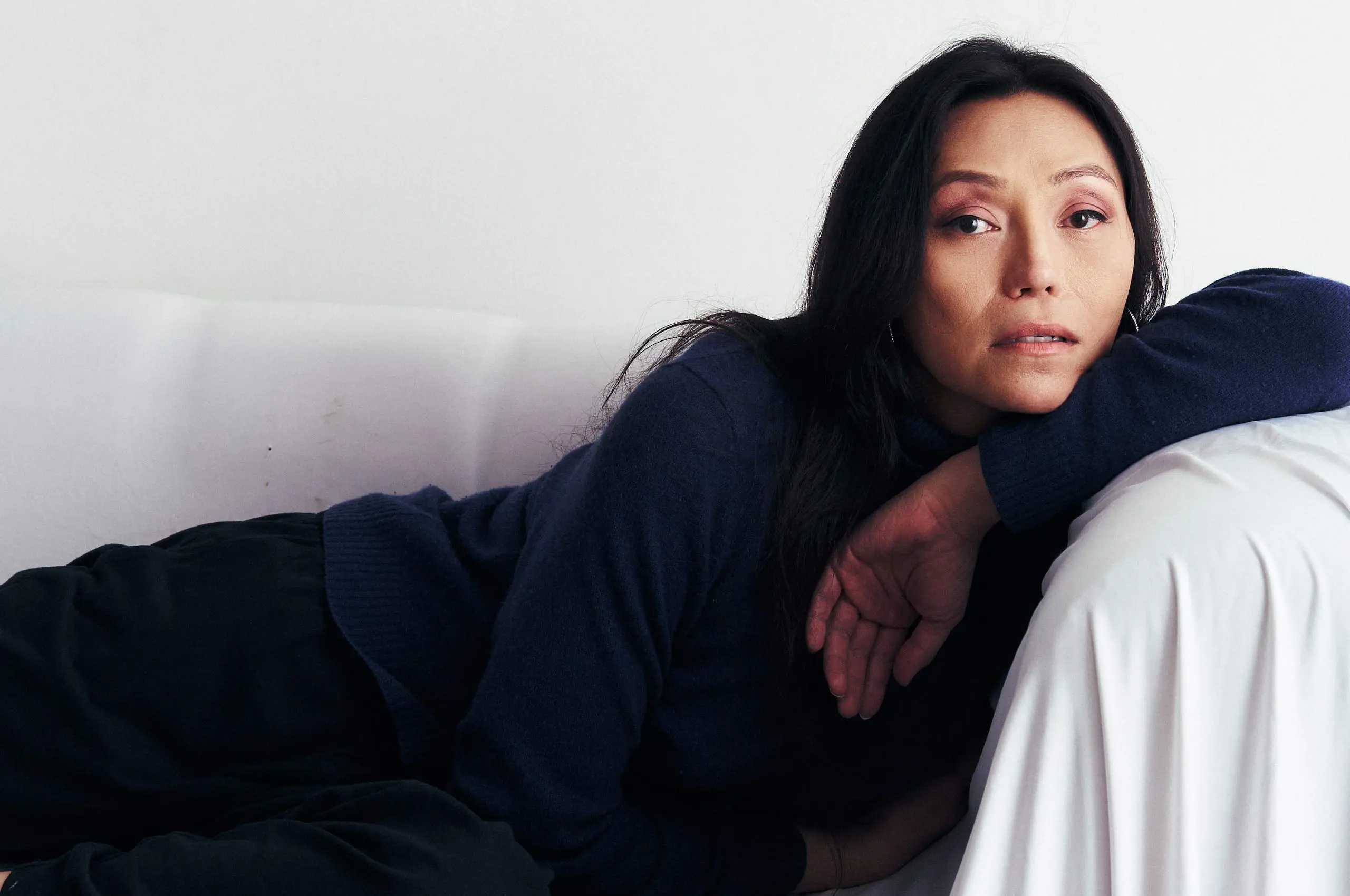
It’s 11 a.m. on a Friday, and Isabel Sandoval has barely slept since arriving in Manila and has been “living on a suitcase” since she’s also been flying back and forth between New York and Madrid while developing film projects. By afternoon, once the shoot has wrapped, she’s flying off to Cebu for a two- day trip, and then back to Manila, then off to somewhere in the Philippines for a confidential project. Any breather is momentary. But this is what keeps her going.
Last month, the actress-writer-director finally premiered her latest film, Moonglow, at the International Film Festival Rotterdam. She wears all three hats in this one, co-starring as Dahlia, a wily police officer who commits a crime to give to the poor. But then, her boss enlists her and former detective Charlie to investigate the heist. Tensions are high for Dahlia to toe the line between the perpetrator and prosecutor — all the while sidestepping the erupting emotions of being partnered again with Charlie, her former paramour. In the background, Marcos Sr.’s martial law is keeping the country in a tight grip.
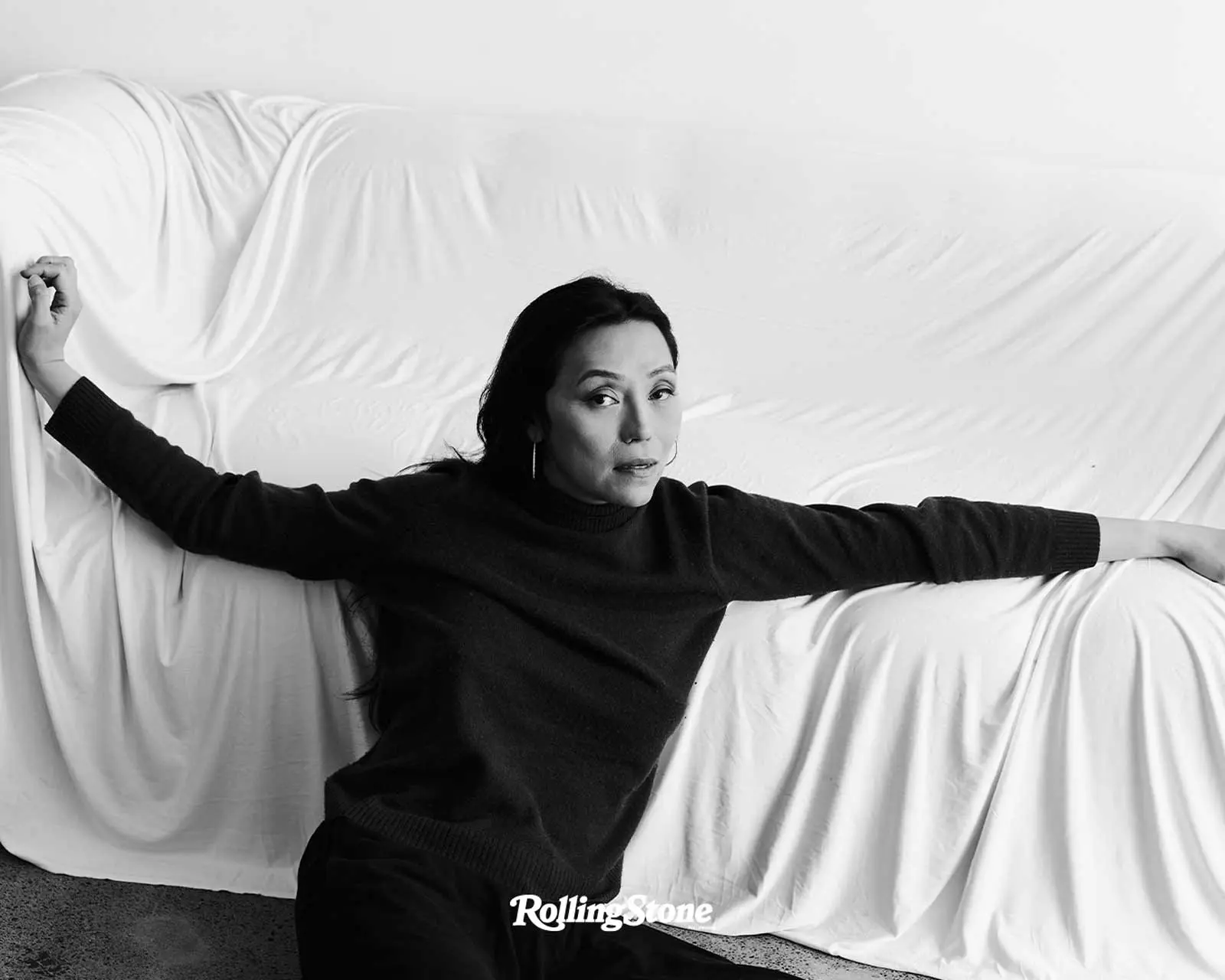
Moonglow is lush, sensuous, and highly melodramatic while playing along the lines of neo-noir. Cigarettes are consumed, colors are vivid, exchanges are frenzied. But Sandoval is a filmmaker who knows when to hold back and when to let the scene linger and submerge. At the center of Moonglow is yearning: for a new life, for a glorious past, and for the trappings of power. Dahlia is at the center of it all, feeling the push and pull between the lives she’s drawn out for herself.
The film is a huge leap from her previous films in terms of production, most especially cinematography. While films like Apparition (the Cinemalaya cloistered martial law drama starring Jodi Sta Maria and Mylene Dizon) and Lingua Franca (Sandoval’s international breakout that premiered at the Venice Days sidebar of the 2019 Venice International Film Festival) were cold and cunning distillations of lives entangled in political forces, Moonglow is audaciously colorful, bigger yet still retaining the qualities that have made her films so immersive.
Prior to completing Moonglow, Sandoval has gone through the Hollywood shuffle, directing episodes of the Andrew Garfield- starrer Under the Banner of Heaven, the Hulu drama Tell Me Lies, and the hit The Summer I Turned Pretty. She’s also done a Criterion Closet Picks (“This is the next best thing to transitioning,” she jokes in the video), where she took home the John Cassavetes and Agnes Varda box sets.
She calls Moonglow her “comeback film,” as it is the first time she’s come back to the Philippines to shoot since Lingua Franca, which was set in New York. She co-stars with Arjo Atayde, Agot Isidro, Dennis Marasigan, and Paolo O’Hara. The film both harkens to the great, smoky noirs of yore and recalls the dreamy thrillers of the past, where Manila can stand in for Hong Kong. Sandoval admits that those looking for the traditional payout expected in the genre would be better off looking elsewhere. “I’m only interested in genre tropes to subvert them, or to kind of flout them,” she says. “A few people have also considered Moonglow as a deconstruction or as a version of a heist film, similar to what Kelly Reichardt did with The Mastermind. I mean, I was not trying to make a straight-up neo-noir film. I’ve always said that it’s a melodrama, perhaps a romantic melodrama specifically filtered through noir.”
We finally sit down for a longer talk through a video chat, days after the shoot. She’s somewhere in the Philippines working on an undisclosed project. Here, she talks about jazz, being a Cinemalaya alumnus, the powers of melodrama, and questioning the intent behind cinematic imagery.
During the shoot, it was really funny that you recognized the Regine Velasquez album cover [Listen Without Prejudice], which was similar to the photo we took. Do you have any non-film influences when you write a film or whenever you shoot?
I think a lot of my influences tend to be musical. I remember Tori Amos had a song called “I Can’t See New York” from her album Scarlet’s Walk, which she wrote after 9/11. There’s an instrumental section of the song that I thought was particularly haunting and unsettling, and that inspired some images and scenes.

I think I’ve been listening to a lot of standards and jazz, songs like “Misty” by Johnny Mathis and “The Very Thought of You” by Nat King Cole have inspired, probably storylines that are just incredibly different from what the songs were about. So I guess music elicits and evokes certain feelings and moods in me, and though that usually kind of helps plant seeds of ideas that I pursue.
This is for Moonglow specifically? Or your other movies?
Different ideas for films that I have not ended up making. But for Moonglow in particular, I was listening a lot to the jazz soundtrack of Elevator to the Gallows by Miles Davis, and there was one song, “Generique,” that was also used in [the film] Burning by Lee Chang-Dong. I wanted to make a film that really embodied the mood and the atmosphere from that song.
I’m also curious, how were you brought up as a cinephile?
Because for me, since I didn’t live in Manila, there was a lot of hoping pirated DVDs of great films or even Criterion bootlegs would come to our city. But how about you? How was your cinematic upbringing? It’s funny because growing up, I would get exposed to the films of Vilma Santos, Nora Aunor, and Maricel Soriano. I was a big Maricel fan when I was a kid. Then [as I grew] older, I would get to see the films of Lino Brocka or Ishmael Bernal, and Mike De Leon — these were the three names, the holy grail of Philippine cinema. Their films would be shown in the afternoons, either in ABS-CBN or Cinema One. By that time, I was in high school, that’s when piracy really exploded. Besides the mainstream films that would be released and pirated, there were even VCDs and DVDs, since there was a burgeoning arthouse piracy market.
I was actually just back home in Cebu over the weekend, and I dug up some of the old stuff that I had bought more than 15 years ago, and I came across some of this shit. [Shows me the DVDs] I have Fellini’s 8 1/2. It Happened One Night. Modern Times by Charlie Chaplin. Rebecca. It’s crazy.
Now you have a Criterion Closet video! Crazy!
Part of me was, at first, fascinated by the covers and also by these familiar names. So that’s how I kind of started my collection at that time. And of course, they were being sold for like, what? 40, 50 bucks?
“I feel like I’m drawn to women who have secrets or a double life and are dealing with some kind of personal or existential crisis in a clearly defined socio-political context.”
In 2011, you produced and starred in your first feature film, Señorita. And you said that you didn’t have a formal filmmaking training. So, what was the journey like to make Señorita?
With Señorita, I feel like I always have this [urge] of just wanting to take the plunge and not really think too much of what I was getting myself into. I think it was only after having made that film that I realized how bad it was, how really it was a miracle that it did not fall apart completely at any point in the making of that film.
I think that’s how I approach making the films that I’ve made so far, in that I have an idea that I feel intensely passionate about, and I convince some people whose talent and skills I admire to help me make it happen, and just go for it. I think that combination of rashness and ambition and faith, I guess, in myself and the people that I’m making it with was the one that pulled us through.
Pero grabe naman, the first time you made a film, it went straight to the Locarno Film Festival!
Which was a shock, actually, because it was a pulpy noir, which was antithetical to the European film festival definition of arthouse Philippine cinema, which is very much rooted in the neo-realist slash social realism [that they usually screen].
It was a pleasant surprise, and in a way, it was an early validation to me that I wasn’t completely out of my mind for doing what I was attempting to do in Señorita.
But how much do you think you’ve grown as a director since you made your first feature?
I think it’s my relationship with words and dialogue in my films. Señorita was very verbose, at least it seemed verbose compared to my later films. Very early on, I had yet become particularly attentive to the dramatic function of cinematography. It felt like there was too much dialogue and exposition that the camera was filming a stage play, somehow. I didn’t really explore and exploit the dramatic capabilities of the camera. And that’s something that I think I rectified or compensated for in my subsequent films. Apparition, for instance, because it was set in a monastery, which is characterized by a lot of silence, it was considerably quieter.
I feel like with each film, I’m becoming more of a visually expressive filmmaker in that I am starting to harness the image or the frame as a vessel to convey my ideas and to distill certain emotions.

How did it feel when Apparition was accepted into Cinemalaya, where a lot of young filmmakers emerged at that time?
It felt very exciting to me to be among this wave of emerging Filipino filmmakers at that time. I was in the same batch as Marie Jamora [and] Gino Santos. I think the year before was Loy Arcenas, Eduardo Roy Jr. — all incredibly, incredibly talented filmmakers. And for us to kind of find our distinct sensibility and aesthetic… Even in the decades since, there has been an even more exciting generation of new filmmakers who have come out of the shadows of what is the widely accepted lens of our Philippine cinema and just gone in very unpredictable directions. I think that’s very exciting.
Do you think about Señorita when you’re writing new films? Or maybe when you’re working during Moonglow, which was your first shoot in the Philippines since you left for the U.S.?
Yeah, it’s my kind of comeback film. And it’s funny because I don’t consciously or deliberately think about Señorita when I was making Moonglow. I just try to follow my muse and see where it takes me. And for some reason, I end up returning to or gravitating to the same themes and obsessions in my work.
I remember, I think it was Jean Renoir, I think, who said that, a filmmaker only makes one film over the course of their career. And having been a Psychology major as an undergrad, I feel like, specifically in my case, a filmmaker who’s being true to my own creative impulse.
Every work that I put out can feel like a Rorschach test that allows me to project, perhaps subconsciously, unresolved dramas and crises into these plot lines or narratives that I then wrestle with on the screen. So it’s fascinating to me because I’m coming up with these plot lines and realizing that, “Oh, this is similar to what I did in this movie,” or this particular revelation is also in Apparition. I think it’s just over the course of one’s career, the style or the milieu changes. I do notice that. If I were to be a critic or someone studying my films, I feel like I’m drawn to women who have secrets or a double life and are dealing with some kind of personal or existential crisis in a clearly defined socio-political context.
“I feel like with each film, I’m becoming more of a visually expressive filmmaker in that I am starting to harness the image or the frame as a vessel to convey my ideas and to distill certain emotions.”
Moonglow is basically your film where you’re already “pedigreed.” What was the experience like compared to the last time that you made the film here? And especially now that there’s the Eddie Garcia Law.
I think it wasn’t that much of a challenge for me that now we only work no more than 12 hours every day. It’s both a combination of having been an independent filmmaker and also having worked in the Hollywood system: I’ve directed episodes of three TV shows, where, because these are union productions, we really had to adhere to a certain number of hours, certain protocols, and standards.
You learn to have a certain discipline and rigor when it comes to making sure that you complete the day with a finite number of hours and with certain resources. That’s what I brought into the making of Moonglow. I feel like I work better when I am given clear parameters, whether in terms of the number of hours, our budget, or things like that. Because it helps to clarify what is essential or what it is that I need to accomplish.
Read the rest of the story in the Anniversary Issue of Rolling Stone Philippines.
Get a copy on Sari-Sari Shopping, or read the e-magazine now here.
Frequently Asked Questions
Moonglow is a neo-noir romantic melodrama starring Isabel Sandoval as Dahlia, a police officer who orchestrates a heist. Co-starring Arjo Atayde and set against 1970s Martial Law, the film explores political tension, double lives, and emotional yearning.
Isabel Sandoval’s Moonglow made its world premiere at the International Film Festival Rotterdam (IFFR). The feature marks her return to filming in the Philippines following her 2019 Venice International Film Festival entry, Lingua Franca.
Isabel Sandoval has directed episodes for major American television series, including the FX/Hulu true-crime drama Under the Banner of Heaven starring Andrew Garfield, Hulu’s Tell Me Lies, and Prime Video’s The Summer I Turned Pretty.
Sandoval cited jazz standards and Miles Davis’s soundtrack for Elevator to the Gallows—particularly the track “Générique”—as key atmospheric influences for Moonglow. She uses music to build mood and plant narrative themes before writing scenes.
Filming Moonglow under the Eddie Garcia Law enforced strict 12-hour workday limits. Sandoval welcomed these parameters, drawing on her experience directing union television in the U.S. to maintain schedule discipline and focus on essential narrative elements.
Recommended Video