


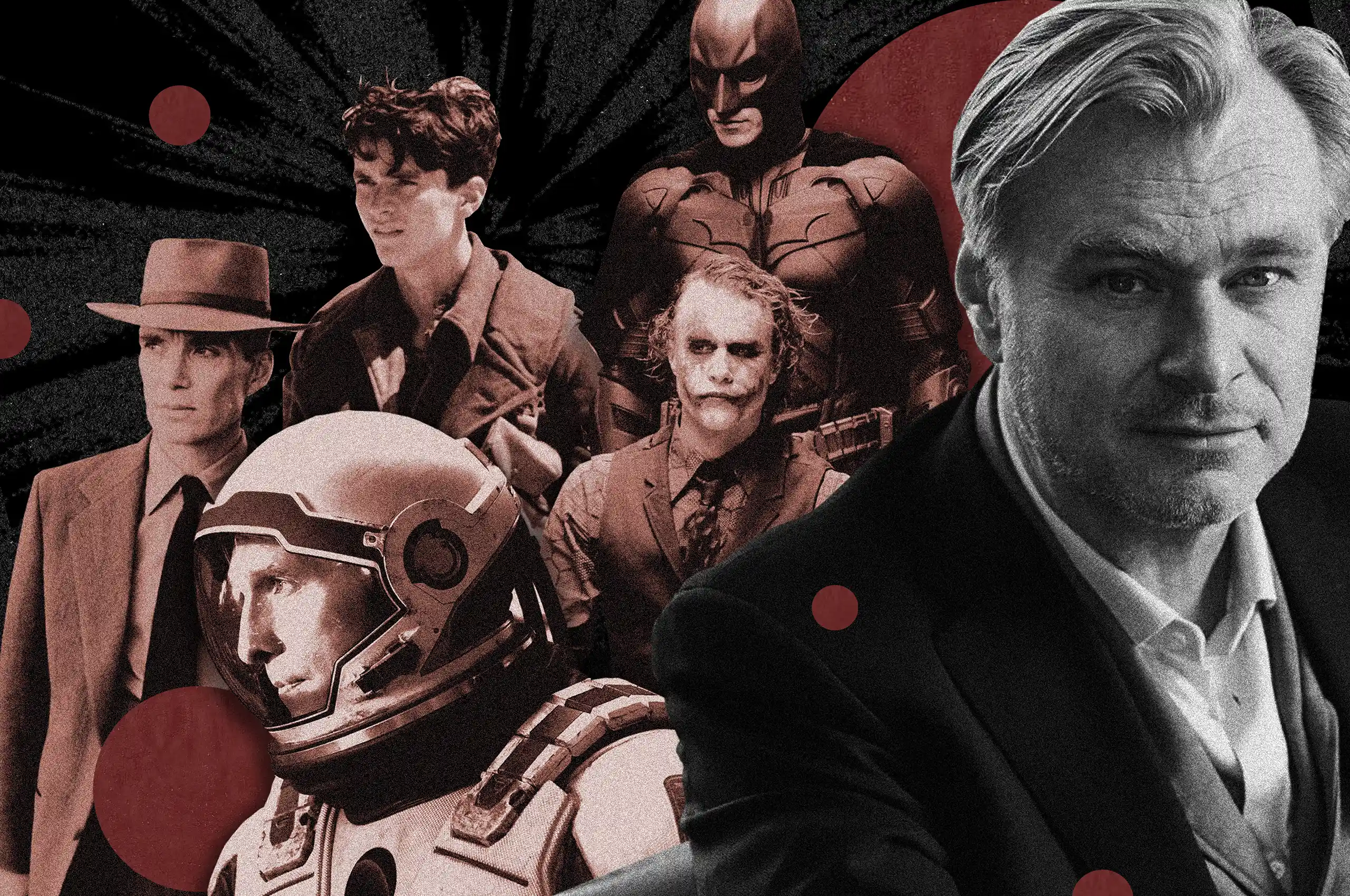
In The Odyssey, Oscar-winning filmmaker Christopher Nolan takes his audiences to a time he has never before ventured in his work. We’ve seen his take on the recent past with Oppenheimer, the far future with Interstellar, and everything else in between. But The Odyssey’s source material is far more fantastical and archaic than anything he’s done.
One thing consistent across Nolan’s filmography is his penchant for worldbuilding and visionary storytelling, but some films demonstrate his mastery of these things better than others. What one thinks is his best film is subject to taste. If you’re a geek, it might be one of the installments in his phenomenal Dark Knight trilogy. If you’re a nerd (because they are two different things), maybe it’s Interstellar. And if, for whatever reason, you liked Hugh Jackman in The Greatest Showman, then The Prestige might be your favorite.
With The Odyssey out in theaters, we rank all 13 of Nolan’s films from good to great.
A work of art doesn’t have to be easy to grasp for it to be deemed good. And Tenet is not bad, but it’s just not Nolan’s best work, either. Starring John David Washington as a CIA operative racing to stop the doomsday plot of a Russian oligarch (Kenneth Branagh), Tenet is cerebral in concept but dizzying in its execution. The film barely has any footholds for the viewer to latch onto amid all the inverted bullets and entropy talk, so much so that I find myself tapped out even in the theater. Nolan has made great mind-bending action films before, and he’ll make better ones again.
In Nolan’s independent debut feature, a young man follows thieves around London to gain inspiration for his novel and ends up in the city’s criminal underworld. With a 70-minute runtime, Following is a lot less sprawling than the blockbusters the filmmaker would come to be known for, and rendered in black and white, the film shows a director still finding his footing. But its non-linear storytelling and twists (which border on camp) make for a thrilling watch nonetheless.
With theoretical physicist Kip Thorne serving as a producer and consultant, Interstellar is probably the most scientifically grounded of Nolan’s science fiction films, even if it still takes creative liberties with concepts like tesseracts and communicating across time. Matthew McConaughey and Anne Hathaway star as astronauts searching for a new home for humanity as Earth succumbs to a global blight, and the film’s Oscar-winning visual effects remain staggering more than a decade later.
But despite all its technical achievements and emotional aspirations, I found Interstellar a little dull, and maybe even corny. Spending most of the movie explaining Einstein’s theory of relativity only to arrive at “love transcends dimensions” feels like an odd tonal swerve. It’s no wonder it’s become a favorite among social media clip farmers.
The finale to Nolan’s Dark Knight trilogy doesn’t really hold a candle to the two films that came before it. It’s visually spectacular and appropriately grand in scale, but it lacks the electricity that made Batman Begins and especially The Dark Knight so compelling.
Tom Hardy’s Bane is an imposing physical presence, but he never reaches the magnetic unpredictability of Heath Ledger’s Joker. Anne Hathaway’s Selina Kyle is easily the film’s brightest spot, injecting a bit of wit and energy into the story’s drudgery.
Inception is a cool movie. That behind-the-scenes video of Joseph Gordon-Levitt jumping around a spinning hallway continues to be a testament to how impressive practical effects are. Even the visual effects, the moments where the Paris cityscape gets warped, are impressive. Inception is a movie that is meant to make you go, “Cool!”
The “science” of the movie is riddled with rules that don’t apply to real life, and I have to hand it to Nolan for the expansive — if not tedious — worldbuilding. But like a few other Nolan movies, its characters are dull, and I hate to see Marion Cotillard’s talents relegated to the dead wife role. Having won Best Cinematography and Best Visual Effects at the 2011 Oscars, I can firmly say Inception gets a lot of style points, or as Aretha Franklin once said of Taylor Swift, “Great gowns, beautiful gowns.”
Nolan returns to the neo-noir thriller with Insomnia, which is based on a Norwegian film of the same name. Stellan Skarsgård stars in the original 1997 film, and in Nolan’s remake, Al Pacino takes on the protagonist’s role. One of Nolan’s feats with this film is that it’s his first to get big names like Pacino, Robin Williams, and Hilary Swank on board. Williams plays a villain, which is quite a departure from his previous comedy roles.
As a procedural, it’s more in the vein of David Fincher and is rather meditatively paced compared to his other work, which makes it a standout. But this can also be read as a symptom of a filmmaker still figuring out what works for him, even though it comes just two years after the release of Memento, another neo-noir thriller and easily one of his best works.
Before gritty superhero reboots became the norm, Batman Begins showed that comic book movies could take themselves seriously without sacrificing spectacle. It’s a dark but explosive introduction to Nolan’s Dark Knight trilogy, centered on Christian Bale’s conflicted Bruce Wayne. One of the film’s smartest moves is casting Liam Neeson as the villain Ra’s al Ghul, using his typecast as the protagonist or wise mentor to make the eventual bad guy reveal all the more satisfying. More than anything, Batman Begins helped set the tone for the wave of grounded superhero movies that followed.
I’m a sucker for movies about tortured artists and geniuses, and Oppenheimer was the kind of movie I thought I needed to sate the thirst that Black Swan and Whiplash left me with. Cillian Murphy plays the titular tortured genius, J. Robert Oppenheimer, and his performance earned him the Best Actor Award at the 2024 Oscars.
I didn’t have the privilege of watching the film on IMAX, but Oppenheimer still has a way of arresting the senses, even when you’re watching it in a plane with a baby crying a few rows down. The film possesses the explosiveness of Nolan’s other films, but it’s an explosiveness marked by terror rather than the usual adrenaline rush. It also does a great job of depicting guilt without sanitizing the absolute evil its protagonist commits, making it one of Nolan’s best-written films.
By the time Dunkirk was out, Nolan already had blockbusters full of big names in his arsenal, so it was refreshing to see him bet on an ensemble cast of indie actors and rookies (even Harry Styles), and have that gamble pay off. Sure, Fionn Whitehead and Tom Glynn-Carney are gorgeous, but their celebrity (or lack thereof) did not distract from the film’s realism.
Like Oppenheimer, it avoids depicting the abject brutality of war, even as its protagonists find themselves in the thick of it. In this way, the film is the reverse of the bloody Saving Private Ryan, which was similarly set in France during the Second World War. But Nolan is still good at creating a sense of dread through sound, deploying silence not as a moment of calm but as punctuation to chaos.
The Prestige has great replay value. Hugh Jackman and Christian Bale play rival magicians whose obsession with outdoing each other spirals into something sinister. As Variety aptly put it, the movie is “structured like the ultimate magic show.” It’s full of twists but has enough restraint not to feel so gimmicky. The Prestige is proof that Nolan’s films could be complex and challenging but also very fun.
I like it when Nolan does something grungy like Memento, which trippily shuttles between black-and-white and color scenes. Guy Pearce’s Leonard Shelby is by far one of the most interesting Nolan protagonists of all time: an anterograde amnesiac who copes with memory loss by taking Polaroids and getting tattoos — things that my friends like to do. The premise of a man solving the mystery of his wife’s killing through fractured memory is ambitious, but Nolan manages to keep the story tight and still leave the audience confused in the best way possible.
The Dark Knight is inarguably up there as one of Nolan’s best., an amalgamation of everything that we love about him. It’s a bit of a crime thriller, but it’s also an action-packed superhero movie. I don’t know how many times I’m allowed to say a Nolan film is explosive, but The Dark Knight is also that.
The complexity of Christian Bale’s Bruce Wayne/Batman as a character is most apparent here, with him having to deal with the consequences of his vigilantism. But it’s Heath Ledger’s Joker that makes The Dark Knight what it is. Here, he is twisted and evil for evil’s sake, and to this day serves as the blueprint for many other coo-coo villains in superhero films. Nolan’s lens trails him unblinking.
Of today’s lineup of modern auteurs, very few — if not no one — can interpret a story so grand in scale as Nolan. The film is ambitious and Homeric, even if not totally faithful to Homer’s epic, capturing key moments of Odysseus’ perilous journey home. Everything about the film’s production is striking and bombastic: the dedication to practical effects, the cast’s performance, the score, and the cinematography.
Here, Nolan proves his dedication to making something feel as real as possible, even if it’s mythical. The Odyssey makes you feel claustrophobic when Odysseus’ men try to stay upright in the cramped interior of the wooden horse, afraid when they’re in the Cyclops’ cave, sick when Circe turns them into pigs, and buzzed with adrenaline in the final fighting scene.
The Odyssey stands as Nolan’s best film — at least, for now. Nolan says that in creating The Odyssey, he’s “hit the limits” of his stamina, and his next release may have to be in 2029. We’ll see then if the auteur can outdo himself again.
Frequently Asked Questions
Christopher Nolan is a British-American Oscar-winning filmmaker behind films like Interstellar, Oppenheimer, and the upcoming The Odyssey.
One thing consistent across Nolan’s filmography is his penchant for worldbuilding and visionary storytelling, but some films demonstrate his mastery of these things better than others.
Nolan is the director of Batman Begins (2005), The Dark Knight (2008), and The Dark Knight Rises (2012).
Nolan’s first feature-length film was the neo-noir thriller Following, which came out in 1998.
The retelling of Homer’s centuries-old epic features Matt Damon’s Odysseus and his years-long journey to return to Ithaca, as well as a deeper look at the palace intrigue occurring at his home while Odysseus is away, notably the power struggle between Tom Holland’s Telemachus, son of Odysseus, and Anne Hathaway’s Penelope, and Robert Pattinson’s Antinous, who seeks to claim power over Ithaca.
Recommended Video