


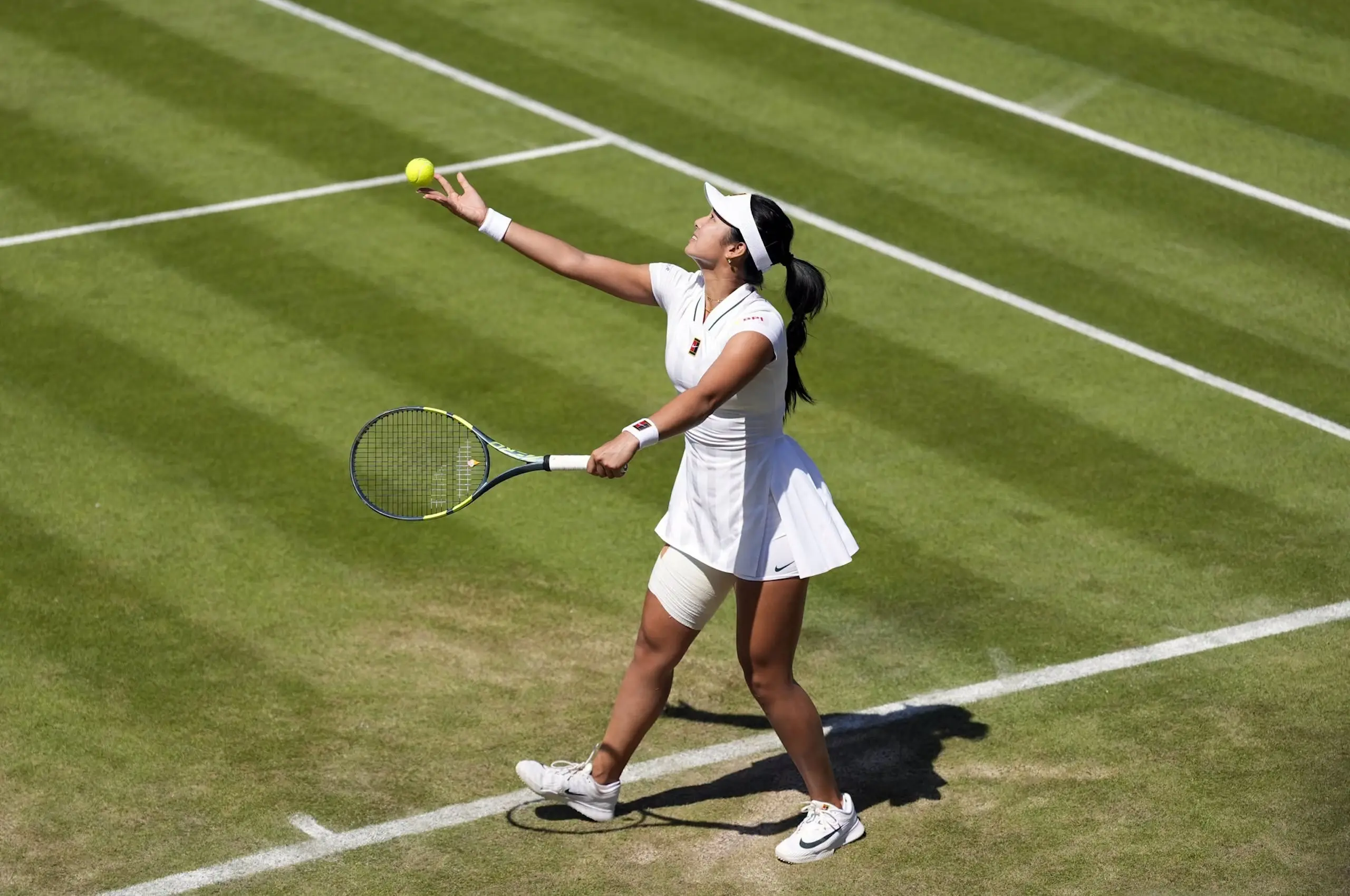
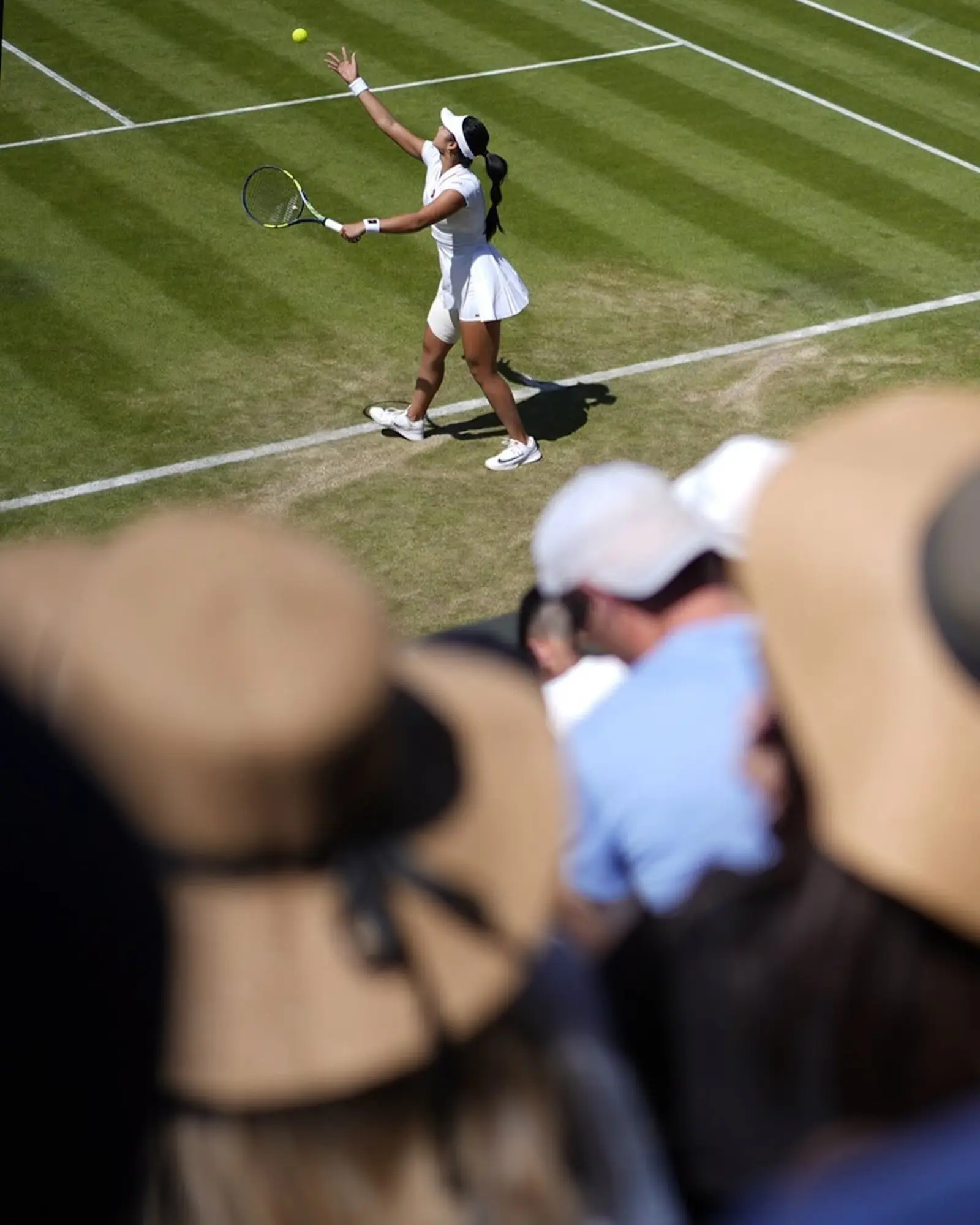
Alex Eala beating reigning Wimbledon champion Iga Swiatek in the third round in straight sets(!) isn’t really that surprising for two reasons: she’s won against her in the past (also in two sets), and the Filipina Ace has been having a great grass season so far, having won the Birmingham Classic and reaching the semifinals in Berlin.
“For someone who grew up in the Philippines…” a teary Eala trailed off in a post-match on-court interview on the Center Court. “I went to train with my brother and grandfather every day after school with ruffled socks and my light-up shoes and chubby cheeks, so to her, this is everything.”
Eala graduated from and still trains at the Rafael Nadal Academy, which developed her game on clay, a surface which, like grass, is rarely — if at all — available in the Philippines, where converted basketball hard courts and shell courts are the norm. This is partly why her outstanding performance on grass is a mystery to many. Plus, this is only the second grass season of her career.
“But obviously, just because I’m emotional doesn’t mean I’m satisfied, so yeah. Okay, next round. Let’s go.” Eala, having tallied three round wins, has so far earned P32 million. If she makes it past the fourth round, she’ll take home an additional £300,000 or P24.6 million.
This Monday, she continues her historic run at Wimbledon for a spot in the last eight, in what could be her first Grand Slam quarterfinals — if she can move past Wimbledon 2024 finalist Jasmine Paolini.
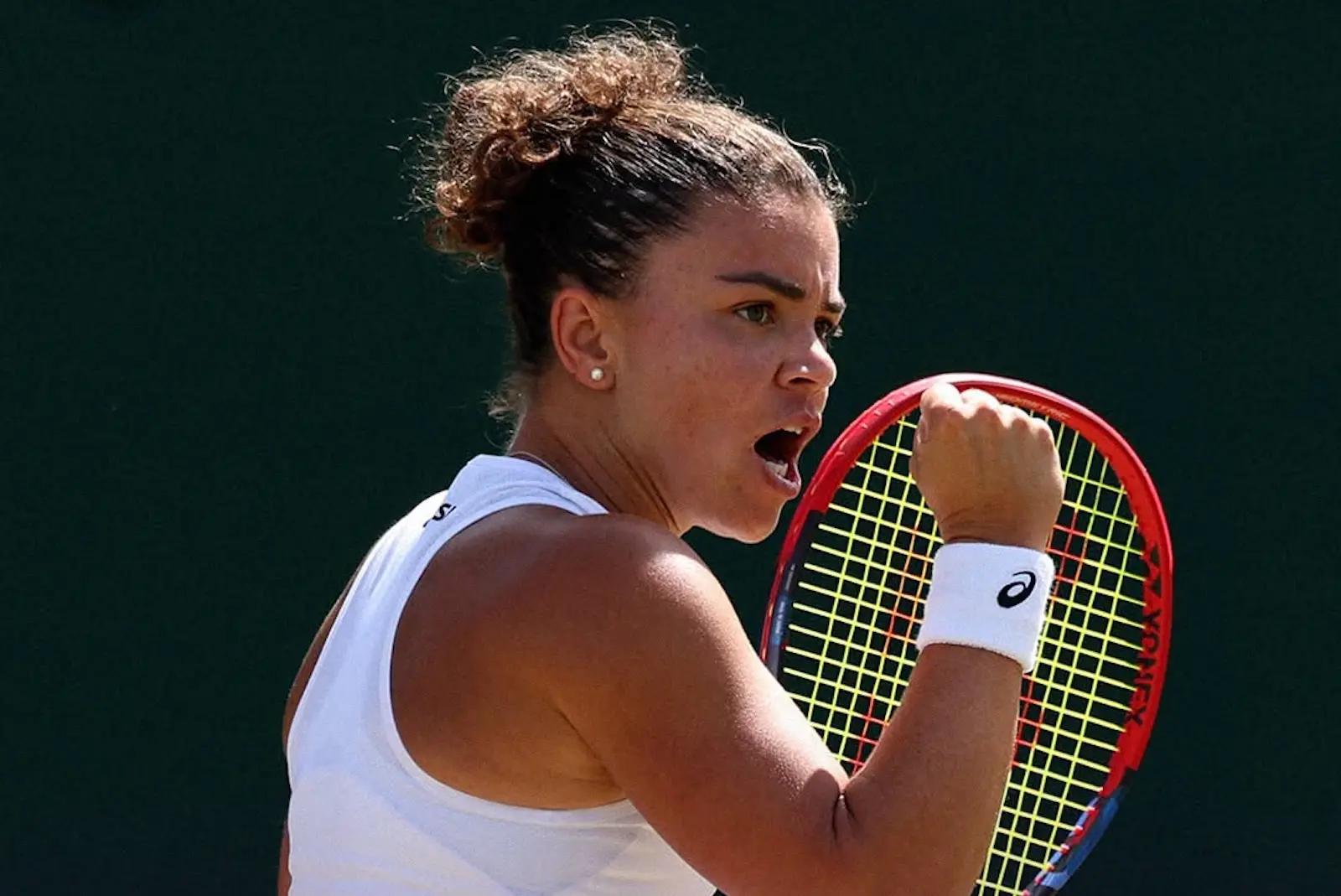
Who is Jasmine Paolini?
The 30-year-old Italian tennis player, Paolini, is currently the World No. 17 and the 13th seed at the grass Grand Slam. Though she’s fairly short at 5’4 ft., the right-handed player is known for her agility and top-spin-heavy forehand.
In 2024, she had her career-high ranking of #4 after winning the WTA 1000 tournament in Dubai and becoming a finalist in two Grand Slam tournaments in the same year: the French Open and Wimbledon, where she lost to Swiatek and Barbora Krejčíková, respectively.
She’s also famously the doubles partner of Italian doubles Grand Slam champion Sara Errani, who’s also Paolini’s coach. Together, they’ve won Gold in the 2024 Paris Olympics and 2025 Roland Garros.
Paolini has since slipped out of the Top 10 in part due to the foot injury, which worsened during this year’s clay season. Her best performance this year was a Round of 16 appearance at the WTA 1000 tournament in Indian Wells. She’s looking to return to the Top 10 this year.
Eala and Paolini’s first meeting was in Dubai earlier this year in the Round of 32, where Eala dominated in the first set (6-1) and fended off a second set return by the Italian in a tie-break (7(7)-6(5)).
Eala’s Chances of Beating Paolini
Their second encounter is proving to be a consequential match for both players. For Eala, a first-ever Grand Slam quarterfinal is on the line, although she’s already made history as the first Filipino to make it past the first round in any Grand Slam tournament. This is her best at any Grand Slam in four appearances since she made a breakout run in Miami last year.
Paolini is out to prove herself after a lackluster season so far due to injury, which will likely be a factor in their matchup. The Italian quietly withdrew from doubles with Errani at Wimbledon to focus on her singles campaign. This has so far proven to be a smart decision. After a first round scare and a shaky second round win, she pretty much dominated Maria Sakkari in the third round, winning in straight sets (6-1, 6-2) and showing no signs of her injury impairing her game.
Eala’s path to the Round of 16 has been smooth sailing in the first round, while her last two matches against Australia’s Maya Joint and Swiatek (at least in the first set tiebreak) have both been nail-biters.
Her lefty and spin-oriented serve has proven to give her opponents a hard time on grass. In her last match, she’s logged fewer double faults and higher first serve in and first serve won percentages, outdoing Swiatek’s figures. In a post-match interview, Swiatek said Eala’s serve went slower and slower, breaking her rhythm, resulting in missed returns.
Reacting to the Pole’s assessment, Eala said, “I’ve never been the biggest server in comparison to a lot of girls here, so I do my best to use my serve as an advantage… Although I do believe it’s been improving a lot.”
Her aggressive return position, especially on second serves, will also likely set her apart from Paolini, who has a mid-60 percent first serve in percentage and below 50 percent second serve win percentage, according to the WTA website.
Eala’s rise to fame in tennis has sparked national interest in the sport, resulting, among other developments, in the establishment of the Philippine Women’s Open, a WTA 125 tournament held in Manila in January. Many Filipinos have also picked up the sport, which was previously largely inaccessible owing to a limited number of publicly available courts.
In March, the 21-year-old said, “There are not many public courts, and if there are, they’re not in great shape. They’re mostly in country clubs.” She also urged “more people in power” to “make a difference.”
Frequently Asked Questions
Alex Eala is set to face Italy’s Jasmine Paolini in the Round of 16 at Wimbledon on July 6, 8:30 p.m., Philippine Time.
Jasmine Paolini, current World No. 17, was a finalist in Wimbledon 2024 and a decorated Women’s Doubles tennis player.
Alex Eala (5 ft 9 inches) is taller than Jasmine Paolini, who stands at 5 ft 4 inches. Eala’s aggressive second serve return will also likely challenge the Italian’s poor second serve win percentage.
If Alex Eala makes it to the Quarterfinals at Wimbledon, she could either face the American Ashlyn Krueger or the Ukrainian Marta Kostyuk.
If Alex Eala wins against Jasmine Paolini in the Round of 16, she takes home a prize money of £300,000 or P24.6 million. She has so far earned P32 million from her last three wins at Wimbledon.
Recommended Video