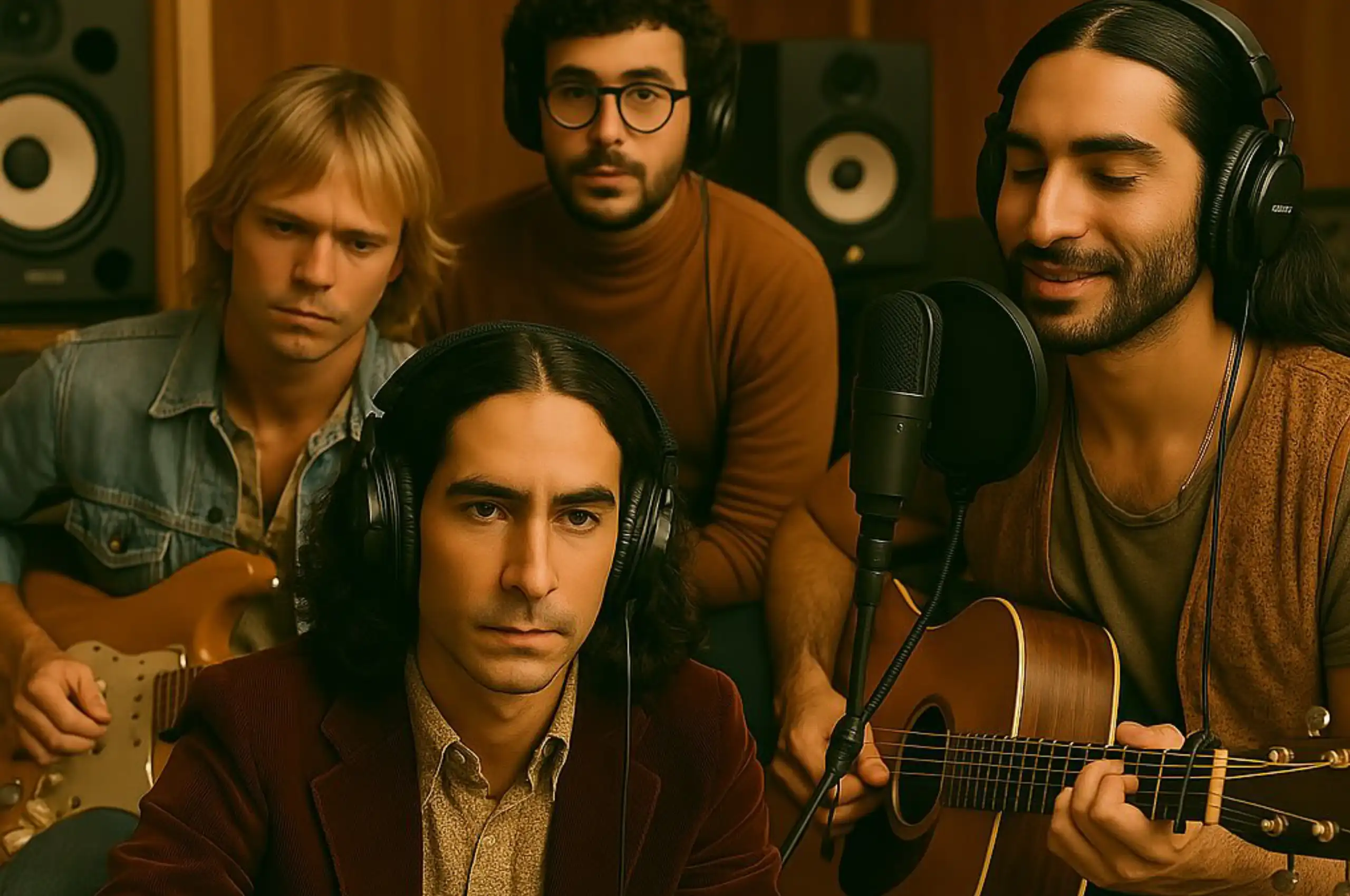
Last June, a ‘60s inspired sunshine pop quartet The Velvet Sundown appeared online with no backstory, interviews, or even a band photo — just a hazy mix of bluesy pop, soft rock, and Americana vocals on streaming platforms. Within a span of a month, the group dropped three albums, racking up nearly 1.5 million monthly listeners on Spotify. Their hit song, “Dust on the Wind,” with nearly 2 million plays, opens with melancholic guitar strings that almost echoes The Animals’ 1964 track, “House of the Rising Sun.” The rest of The Velvet Sundown’s discography carries that same vintage soul polish that, in this day and age, felt like a secret worth keeping.
Then, on July 2, everything unraveled. An X post from Andrew Frelon, listed as the band’s representative, confirmed that The Velvet Sundown had been written entirely with AI. He admitted to using Suno’s “Persona” feature to ensure consistency in songwriting — the same AI tool Timbaland has used for his controversial virtual artist TaTa, which drew backlash for its imitation of real-world style without real-world input.
The Velvet Sundown, which self-describes as a “synthetic music project guided by human creative direction,” marks a turning point in music experimentation. Unlike earlier versions of AI music that leaned toward lo-fi or electronic compositions, this band mimicked the full aesthetic of ‘60s blues rock, blurring the line between digital experiment and a believable band. That fact that it passed as “real” for long enough proves how quickly AI-generated music is mutating into something far more insidious and more convincing.
The Velvet Sundown is one of many AI-driven acts quietly infiltrating platforms — whether that’s India’s first “spiritual rock band” Trilok causing an uproar in their independent music scenes, or Filipino rapper Bugoy na Koykoy worked with YB Ghosty, an AI artist, on a collaboration single called “Landlord.” Music-generation tools like Suno, Udio, and Mubert are now easily accessible, requiring no musical background to create fully produced tracks. Spotify has already removed “tens of thousands” of AI-made songs in the past year alone, as it tries to clamp down on algorithm gaming and fake artist farms. According to Goldman Sachs, over 30% of new music could be AI-assisted by 2030, raising major questions about authorship, originality, and transparency.
As these examples have shown, AI doesn’t need to be groundbreaking; it just needs to sound real enough to slide under the radar.