The Year In Review takes a good, hard look at the triumphs and blunders that defined 2025. With one foot in the past and another in the future, Rolling Stone Philippines sheds light on the moments that changed us for better and worse.
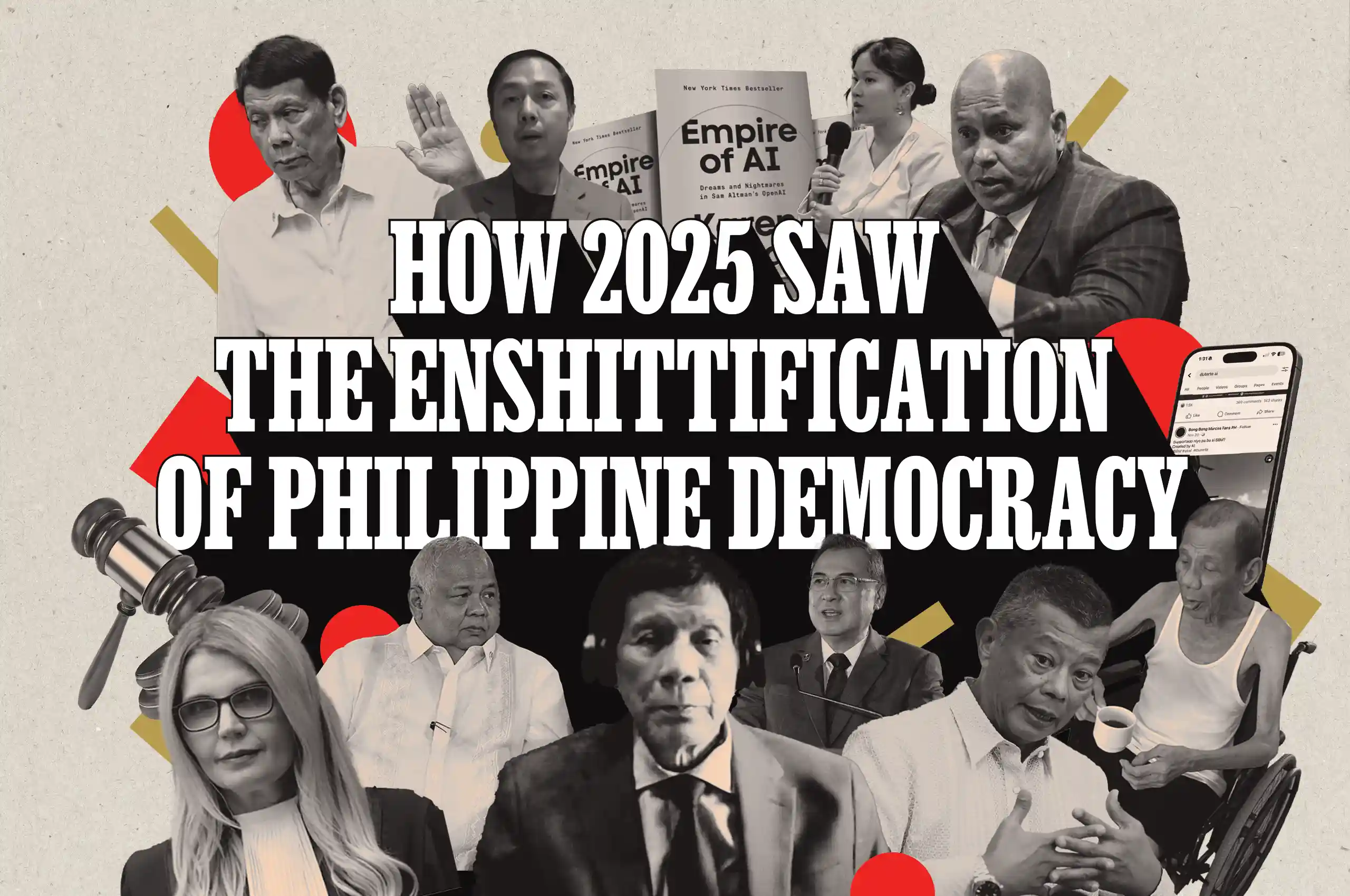
This year saw the unfolding of highly explosive moments in Philippine politics, sparking emotionally charged discussions across the country. From the dramatic arrest of former President Duterte to the public outrage from the flood control scandal, the fragile online public square further splintered along different perceptions of facts. With the exponential advancement of generative artificial intelligence (AI), it has been almost effortless to produce inflammatory content, images, and videos. All this has further driven polarization and us farther from a collective grasp of the world.
The biggest breaking news of the year was also a full-on display of the use of generative AI for political ends. On March 11, former President Rodrigo Duterte was arrested and delivered to the International Criminal Court (ICC) for crimes against humanity. In a swift series of events, the once-terrifying strongman — who promised his own people’s slaughter and taunted the ICC many times over — was whisked away to The Hague to potentially answer for the most gruesome mass atrocity policy in the post-1972 martial law era.
Duterte’s first pre-trial appearance saw his former Executive Salvador Medialdea stand as his lawyer. Medialdea’s statement during the proceedings attempted to paint for the ICC a picture of political intrigue and a nefarious kidnapping plot. To some observers in the legal profession, his statement sounded like a jarring soliloquy in an otherwise cold, clinical courtroom. To the former president’s supporters, everything was plain cruelty upon a supposedly frail old man.
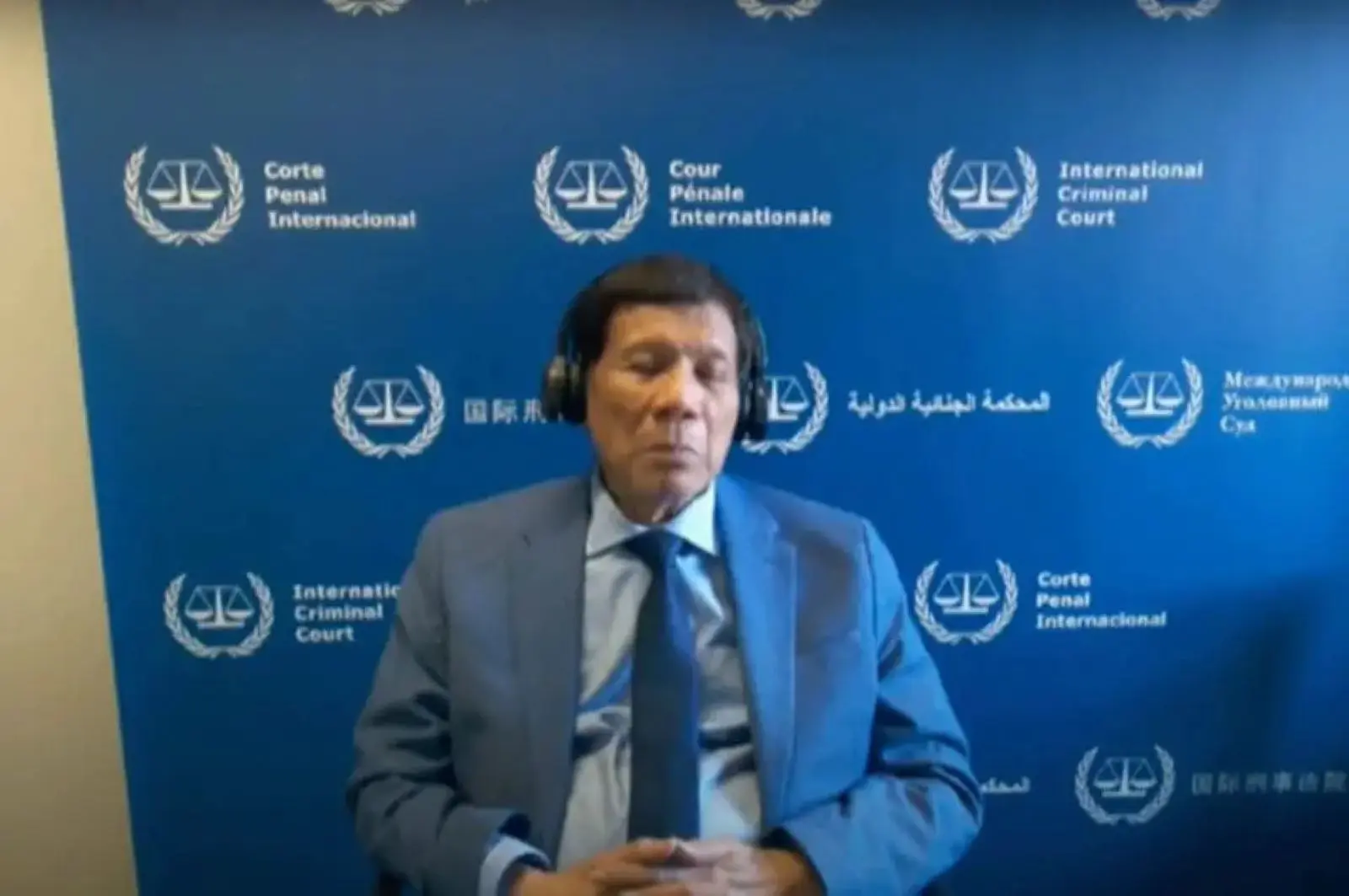
Yet something bizarre happened in the immediate aftermath of the livestreamed initial appearance: supporters of the former President tracked down Presiding Judge Iulia Motoc’s profile in the professional network site LinkedIn and bombarded her posts with spam messages. Soon after, Judge Motoc became the subject of false information campaigns. For one, Duterte supporters claimed she was incapable of understanding the proceedings as she cannot speak English. Another strange copypasta that circulated on Facebook was her alleged ties to First Lady Liza Araneta-Marcos.
To this day, the ICC’s Facebook page is still swamped with similar-sounding comments from dubious profiles with equally doubtful identities. Days after the arrest, an AI-generated photo of an emaciated, balding Duterte in a wheelchair made the rounds on social media. Whether the photo was made for humorous ends did not matter. Some supporters took it as an image that would only support their call to #BringHimHome. Not wanting to be eclipsed, former Presidential Spokesperson, former human rights lawyer, and asylum hopeful Harry Roque fanned the flames by casting doubt on the drug war’s scale and the credibility of its witnesses, as if to we had hallucinated the years of many bodies on the streets, which is not unlike AI hallucinating claims on our shared reality.
The Dark Underbelly of AI
AI hallucinations are when an AI model creates fake information that presents itself as factual, which makes for an interesting thought exercise. If human intelligence is the barometer for AI, there are many peculiarities that, in a highly technical field of practice such as international criminal law, even Philippine-based lawyers get flat out wrong, especially in the weeks after Duterte’s arrest.
Even as Ombudsman Jesus Crispin Remulla announced information on a supposed warrant against Senator Ronald “Bato” Dela Rosa, some still got the intricacies of that process wrong. Many more are deliberately spreading false information. With just a few strokes and clicks, the most basic and accessible generative AI platform can produce a mishmash of correct-sounding text that can be easily shared on social media. Anyone can be their own expert, with AI obliterating people’s capacity to not only be a healthy skeptic, but to also be uncertain. Regardless of whether Dela Rosa will soon join Duterte in The Hague, we can expect further threats to our information landscape as it continues to fracture our democratic institutions.
I straddle two writing-heavy fields, academia and the legal profession, with grim prognoses on whether they will survive the rapid development of artificial “intelligence.” Large language models can process entire swathes of case law and legal codes that could otherwise take years of study and practice to master. Some pieces published in mainstream media, including The New Yorker and The Atlantic, have pronounced the death of the college essay. Academics have engaged in similar discussions. Recently, over 400 researchers came out with a manifesto that rejected the use of generative AI for qualitative research. The overlords of these new technologies proudly proclaim that the machines will replace us, somehow suggesting it make our lives better.
“In the Philippines, whether AI could crack the fundamentals that will finally make our government process more transparent is a question that will pop up one way or another.”
Platform Decay
There is a fatal attraction to solutions presented by AI for age-old problems. In late 2025, Chief Justice Alexander Gesumond told the media that the Philippine Supreme Court was “eyeing” the use of AI on legal research as part of its efforts to “modernize” the judiciary. If these discussions progress in the coming year, the courts will have to reckon with the institutional stamp of using controversial technology. We can expect the court’s proposed use of AI in its official work will lead to more discussions on the integration of AI in the bureaucracy. Elsewhere, governments have developed official guidelines in the use of AI, such as the U.K.’s general guidance for integrating AI tools in the judiciary.
Still, the guidelines lean towards caution, emphasizing the risk of AI hallucinations to the integrity of official processes. In the U.S., lawyers have been disciplined for the use of AI-generated court documents with hallucinated sources. In the Philippines, whether AI could crack the fundamentals that will finally make our government process more transparent is a question that will pop up one way or another.
Former AI insider and journalist Karen Hao’s 2025 book, Empire of AI, does not take the use of the image of imperialism lightly. For Hao, AI is the new technology of mass extraction and exploitation, with its great costs to human labour and the environment, and the arms race it is all leading to. And much like empires of old, AI’s incursion into our political and public lives may very well make us vulnerable to unintended consequences.

In 2022, the Oxford Internet Institute studied the shift towards a “planetary-scale labour market” in the arms race of AI companies, with data workers from places like the Philippines working in “digital sweatshops” in a “race to the bottom” that further drives global inequality. For a country consistently touted as the “patient zero” of digital disinformation, the new phase of AI-generated fake news will further bear down on the Philippines.
While we can always be optimistic about new technology, tech companies have notoriously created a pattern of making technology worse in the name of shareholder profit. You’ve likely observed how our social media feeds, previously filled with posts of friends, are now mostly filled with boosted content from companies. “Enshittification,”’ a neologism coined by Canadian writer Cory Doctorow in 2022 and Macquarie Dictionary’s word of the year in 2024, describes this trend of platform decay, which has not only applied to Philippine online platforms in 2025, but, consequently, to the quality of our democracy entirely.
In the country’s past election cycles, we have seen many efforts to inoculate the public from the evolving virus of disinformation, with fact-checking and more aggressive responses to fake news peddlers. AI and its slop have only introduced new challenges to these attempts to hold together what remains of our collective sense of the world. In the wake of the flood control scandal of 2025, for example, many users have doubted the authenticity of “expose” videos of ex-Congressman Zaldy Co, noting the change in his appearance and unnatural speech pattern with each new video. As Filipinos demand answers and accountability, the facts become more elusive as technology makes it harder to verify.
If institutions and political norms at their most fundamental form require a shared understanding of society, how could we prepare for a politics of fragmented (non-)reality?
Some tech watchers have dismissed the trillion-dollar AI boom as a mere bubble ready to burst, much like the dot com crash of the late 1990s. More than the stakes for the billionaire class, AI is poised to radically change the world by altering our relationship with human knowledge, labor, and social relationships. The Philippines’ highly polarized political landscape will likely be tested even more with the advent of realistic AI slop, as our national elites drive further into factionalism and emotionally-charged public clashes. Human intelligence and discernment needs sharpening more than ever if our political spaces will stand a chance in the fracturing of a shared reality.
Ross Tugade practiced international criminal law and human rights, and taught law in the Philippines. She is currently doing her PhD in Law in Australia.