


This review contains spoilers for Christopher Nolan’s The Odyssey.
Unsurprisingly, Homer’s Odyssey is the perfect story for Christopher Nolan to adapt. Its hero spends a decade in a war and another 10 years in a treacherous homecoming, which is only fitting for a filmography where the passage of time seems to be a prevailing theme. The scale of its setting and the pedigree of its cast also demand a filmmaker with ambition, and nobody goes bigger than Nolan.
In The Odyssey, the British-American director doesn’t try to wring plot twists out of something we already know. He opts instead for non-linear storytelling, jumping between the past and present, and taking time and care with each episode or conflict, as opposed to rendering them as mere vignettes.
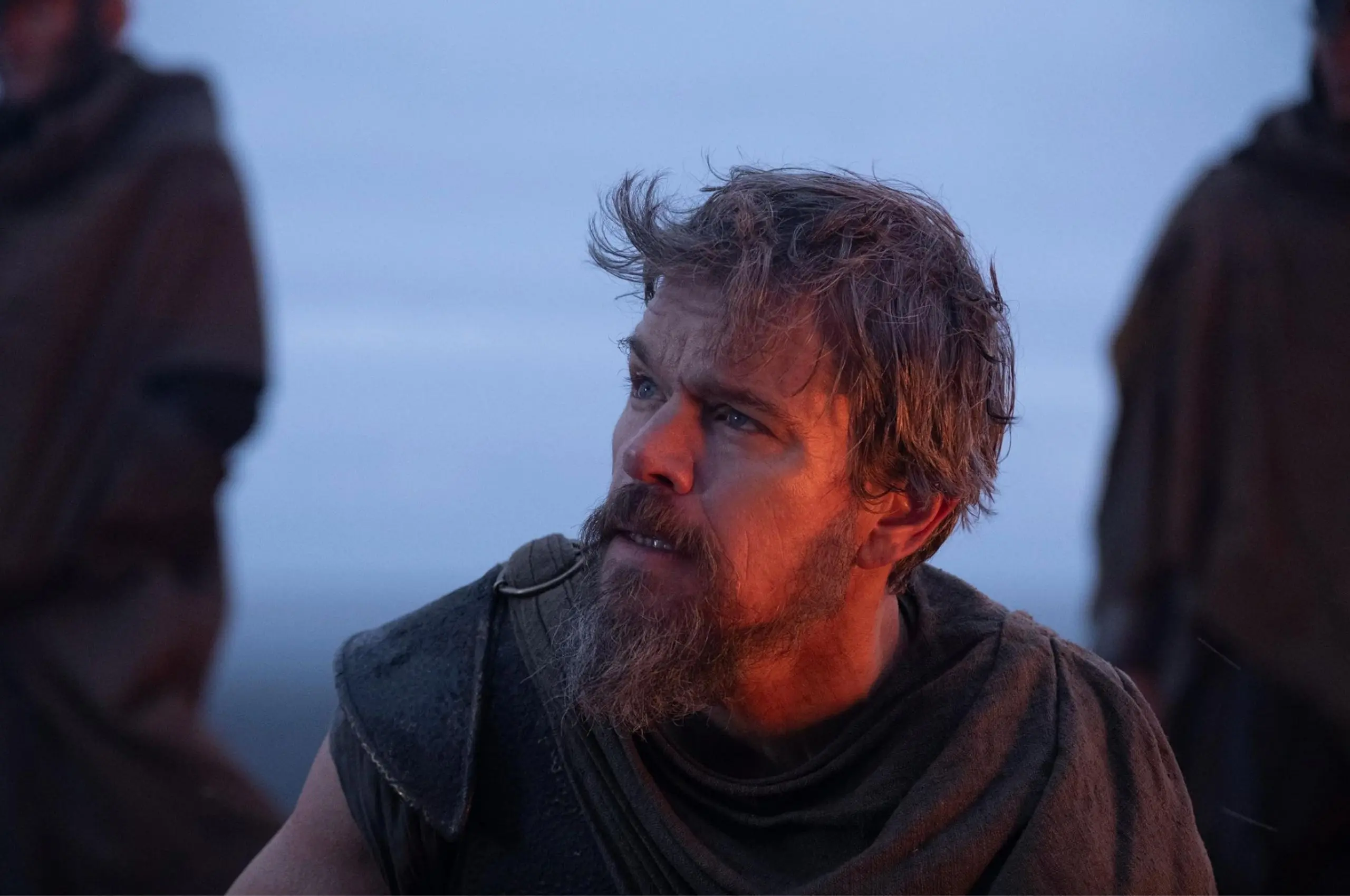
The film begins with Odysseus (Matt Damon) stranded on a desert island with the nymph Calypso (Charlize Theron). Unlike Calypso, who’s cursed with immortality and therefore still looks divine, the story’s hero looks weather-worn, fatigued by the Trojan War and his journey.
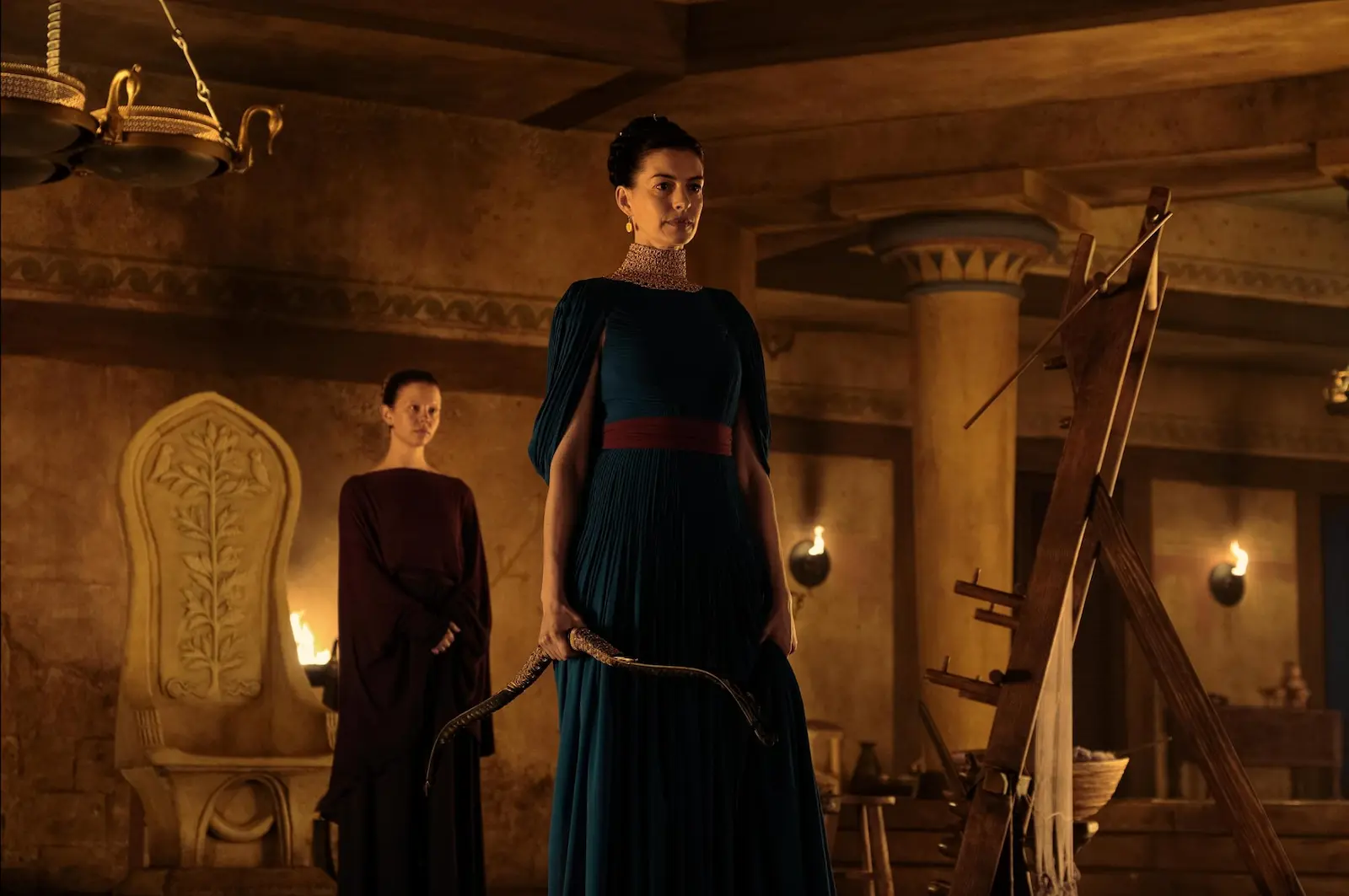
His seat of power, the island of Ithaca, has been left unoccupied for too long. Odysseus left for the war when his son Telemachus was just a toddler; we see the prince all grown up now (Tom Holland), quietly watching a bard (Travis Scott) tell the story of the Trojan War, along with the 108 suitors who camp out in the palace waiting for the queen Penelope (Anne Hathaway) to choose a new husband and king.
One of the suitors is Antinous (Robert Pattinson), a power-hungry but cowardly nobleman who had switched his lot with Sinon’s (Elliot Page) during the draft years ago so that he could be spared from war. He and the other suitors mock Penelope, Telemachus, and the servant Eumaeus (John Leguizamo) for believing that Odysseus will return.
Telemachus sets out for Sparta to meet Menelaus (Jon Bernthal), brother of the king Agamemnon (Benny Safdie) and husband of Helen (Lupita Nyong’o), seeking answers regarding his father’s whereabouts. Meanwhile, back on Calypso’s island, Odysseus’ memory starts coming back to him as Calypso stops feeding him her magical, mind-blunting lotus flowers. They retell what they know of the war and the journey home.
What Happened in Odysseus’ 10-Year Journey Home?
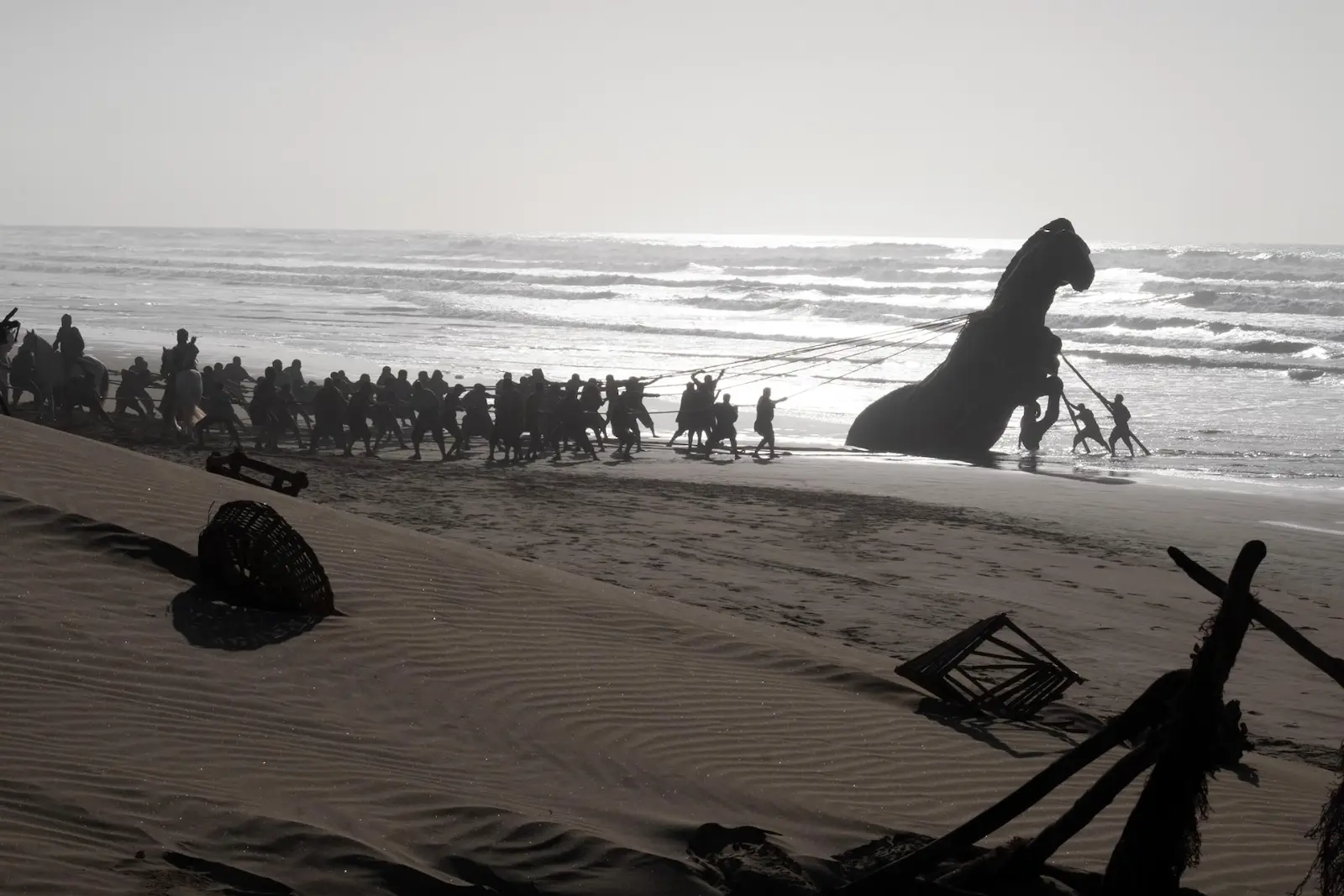
A huge part of the story should already feel familiar to those acquainted with the source material: the Spartans, guided by Odysseus’ strategy, sneak into Troy in a giant wooden horse given to the city as a peace offering, sack the city, and retrieve Helen.
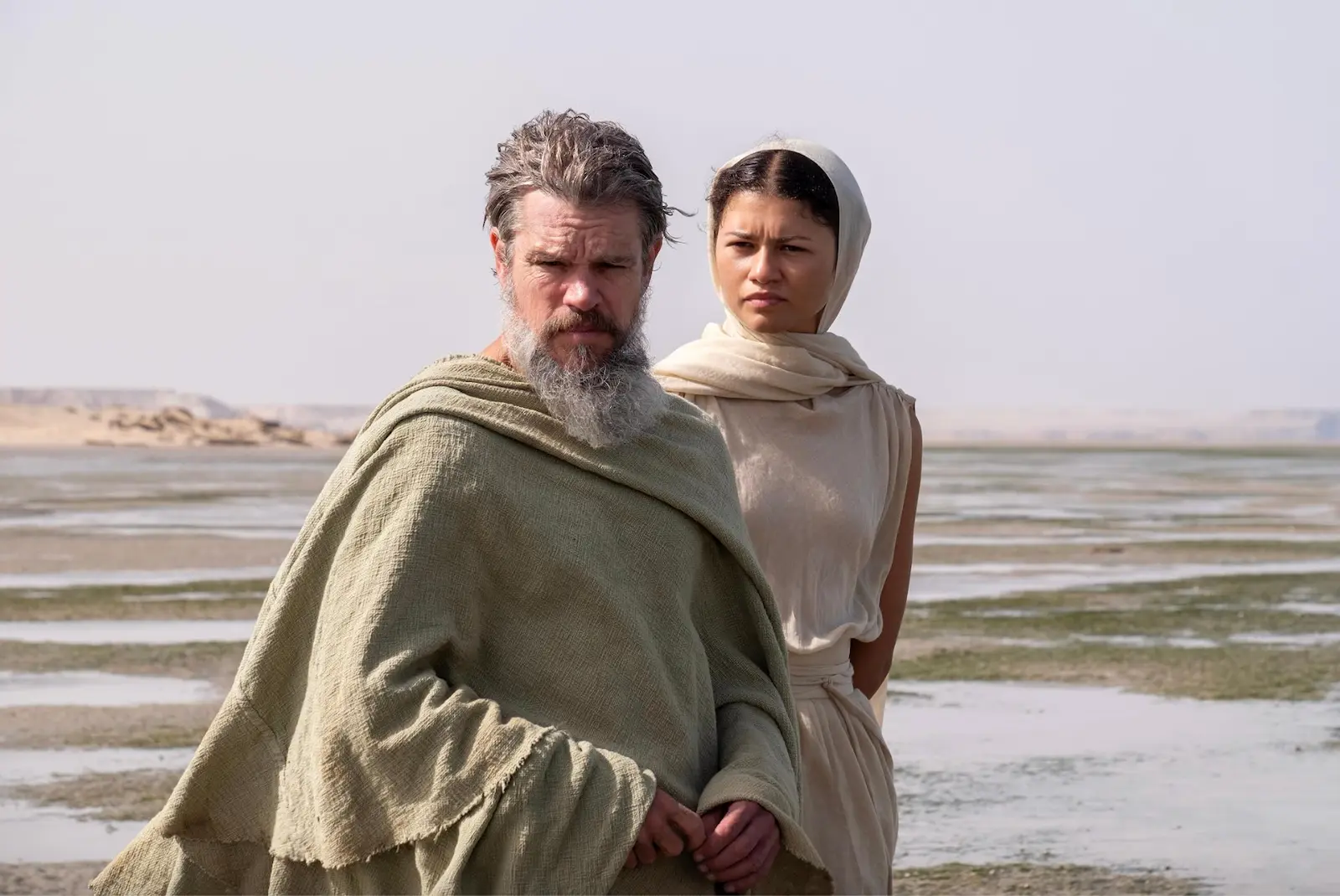
When the war is won, Odysseus, his right-hand man Eurylochus (Himesh Patel), and the other men set sail for Ithaca, guided by Athena (Zendaya). Along the way, they encounter the cyclops Polyphemus (Bill Irwin), man-eating giants called the Laestrygonians, and the witch Circe (Samantha Morton), who turns the soldiers into pigs in the movie’s most frightening, stomach-churning sequence. Odysseus manages to get her to turn them back into men, and she tells him he must head to the underworld to make it back to Ithaca.
In Hades, he meets the shade (or ghost) of the prophet Tiresias (James Remar), who tells him how to get home and what sacrifices he has to make next. He also meets the shade of Sinon, who was killed when he delivered the wooden horse to the Trojans. The young soldier hands him the lot that got him into the war in the first place, and Odysseus promises to deliver it back to Antinous when he returns to Ithaca. Finally, Agamemnon’s shade appears, and it’s revealed that his wife Clytemnestra (also played by Nyong’o) had killed him after his return to Mycenae, as revenge for his sacrificing their daughter to the gods for their favor in the war.
Back at sea, Odysseus and his men encounter the monsters Charybdis and Scylla, the Sirens, and a storm that wipes out everyone but our hero. He washes ashore on Calypso’s island, where she tends to his wounds and keeps him for seven years before finally letting him go out of pity.
He leaves the island on a makeshift raft and, after years of angering the gods to survive, finally submits to the elements, which float him all the way back to Ithaca. There, he returns Sinon’s lot to Antinous and fights off the suitors, falling into Penelope’s arms. In the end, Telemachus becomes king, while Odysseus and Penelope set sail for the west, where he had promised to honor all the men he’d lost.
Is ‘The Odyssey’ Nolan’s Best Film Yet?
Homer’s epic has a lot going on, and in the hands of a lesser filmmaker, the adaptation may collapse under its own weight. But with The Odyssey, Nolan thankfully keeps the story intact and still manages to surprise the viewer in other ways.
For one, the scenes in Troy play out like scenes in Dunkirk. We’re introduced to the Trojan horse plot with a shot of Sinon on the beach, the wooden horse slowly sinking in the water. The camera also follows Odysseus as he makes his way to the gate to open it for the rest of Agamemnon’s soldiers. But just as the sequence is about to get too familiar for Nolan fans, the director goes all out on the violence — something he’s held back on in past works.
Another high point in the film is how it leans into the abject horror of Odysseus’ journey. The scene with the cyclops came straight out of a well-made monster flick. Polyphemus is not supposed to be a scary guy: when the men try to blind him in his sleep, instead of attacking them right away, he turns his back on them to weep and pray to his father, Poseidon. But he’s scary anyway because he’s a giant, ugly cyclops, and Nolan writes Odysseus as a flawed man who is afraid of and threatened by the unfamiliar.
Another part that also reads like a horror film is the scene at Circe’s cottage, with the men slurping down tendrils of mystery meat, choking and continuing to eat while Circe heavy-handedly molds and warps their features into those of a pig. When it comes to human-animal transformation sequences in media, we’re used to Cinderella’s “bippity-boppity-boo” spell, but this one is visceral. It works as a testament to how far the director is willing to go to drive home the point that Odysseus’ journey really is horrific. It’s not gory — Nolan’s films never are — but it’s still very grotesque.
As expected, I spent half my time in the movie theater on the edge of my seat, thanks in large part to Swedish composer Ludwig Göransson’s score. The film’s soundtrackSoundtrackThe music that accompanies a film, series, or game, including original scores and licensed songs. A good soundtrack sets the mood and can become a hit on its own, turningGo to Soundtrack Glossary is embellished with Greek instruments that ground the story and, at times, droning synths that heighten the feeling of dread.
Nolan is a master in creating tension and paying it off with excitement, and he demonstrates it again here, with each line and scene perfectly paced. I can feel the claustrophobia and unease of being stuck in a wooden horse with twenty men, and the exhilaration of the fight scene in the final act.
There were worries from purists that the diverse casting, or Hathaway’s alleged Botox freezing her forehead, would break the immersion in The Odyssey, but I think they add a realism that makes the film all the more tangible. Hathaway’s forehead was actually very expressive, by the way, and she delivers a standout performance as a more commanding, less docile Penelope.
Nolan has been criticized for skirting away from the brutality of war in past films like Dunkirk and Oppenheimer. With a hero like Odysseus, he has no choice but to face it in all its ugliness, and he does so with unflinching storytelling and the film’s arresting cinematography and sound design. The result is a sprawling, fantastical, in-your-face spectacle that is unlike anything the filmmaker has done. It would not be a reach to call The Odyssey a career best.
Frequently Asked Questions
Matt Damon stars as Odysseus in Christopher Nolan’s adaptation of Homer’s epic, opposite Charlize Theron’s Calypso, Tom Holland’s Telemachus, Anne Hathaway’s Penelope, and Zendaya’s Athena.
The film keeps core events from Homer’s Odyssey, such as the Trojan horse, the cyclops, Circe, the underworld, and Calypso’s island, but they unfold in Nolan’s The Odyssey through non-linear storytelling.
The Odyssey pushes further into violence and grotesque horror than Nolan’s earlier films. The cyclops and Circe sequences are staged with unflinching, visceral intensity. The film also features more fantastical elements, as it is an adaptation of a Greek epic, while his past works lean toward science fiction and action.
Swedish composer Ludwig Göransson scored The Odyssey, blending Greek instrumentation with droning synths to heighten tension throughout Odysseus’ journey home.
In The Odyssey, Odysseus returns to Ithaca, fights off Penelope’s suitors, and reunites with her. Telemachus is crowned king, and the couple then sets sail to the unexplored west.
Recommended Video