


Tracking down the names is one thing, but breaking the cycle is another matter, especially for something as long-ingrained in the Philippines as political dynasties. Now, Filipinos have taken it into their hands to allow change through a digital, citizen-led platform.
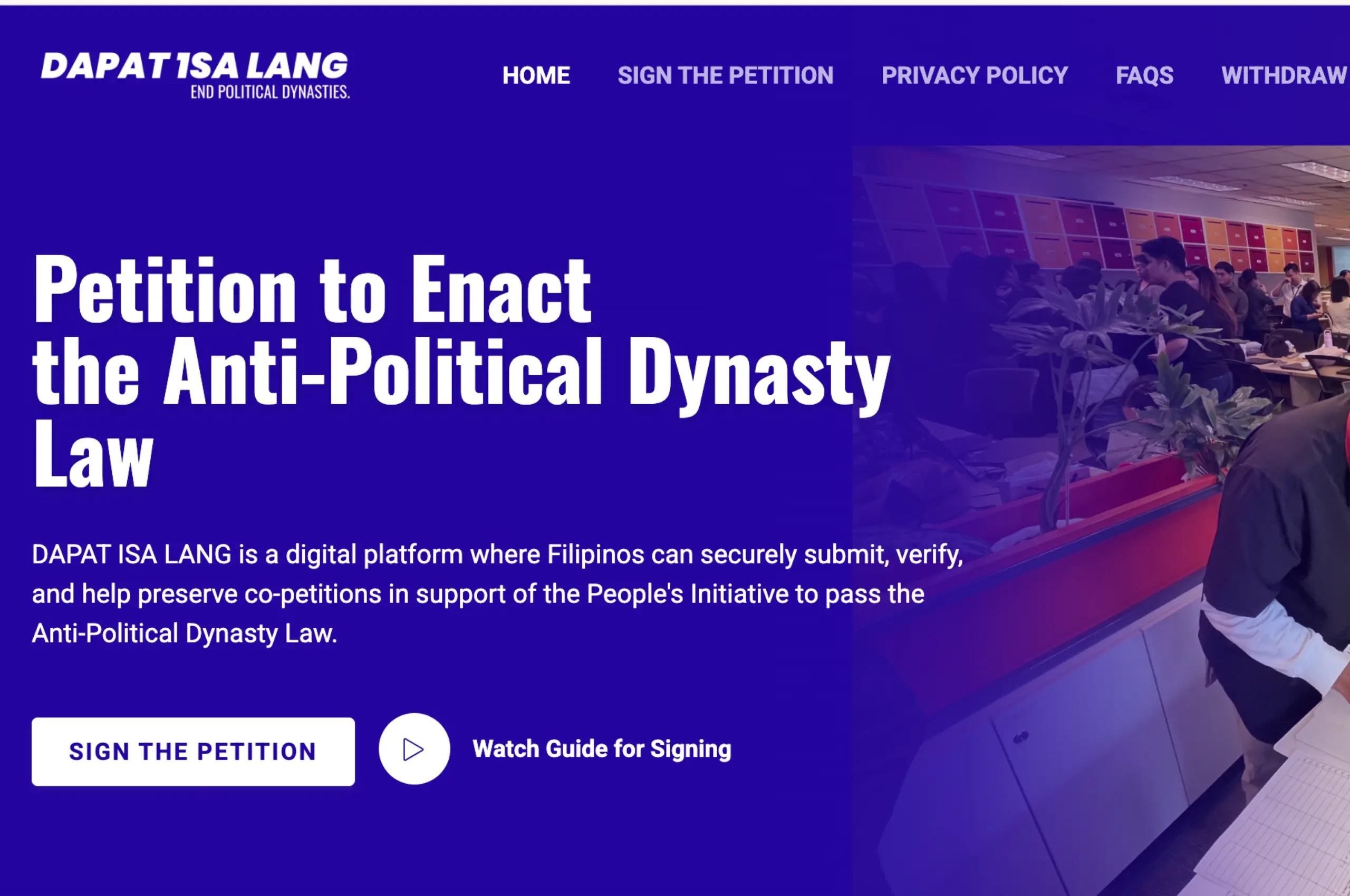
The People’s Initiative Coalition Against Dynasty (PICAD) officially launched its Dapat Isa Lang (D1L) website on September 30, a nationwide, co-petition platform to pass the Anti-Political Dynasty Bill. The initiative, first rolled out early in the year, had previously relied on physical, on-site signature collection before moving to a digital platform to make participation more accessible.
The platform walks you through the whole process. It invites potential co-petitioners to first read the full text of the proposed Anti-Political Dynasty Act before signing, with language options available in Filipino, English, Bisaya, and Ilocano.
If you don’t have the privilege of time, the site also provides a video summarizing the entire bill. It ensures that you have thoroughly understood what the petition means before you can access the digital petition form. And even before going through the forms, the site asks you to prepare the requirements needed: your signature, a selfie, and your registered voter location.
The site also lets co-petitioners withdraw their support upon verification.
Now, the newly launched digital platform may make signing easier and more efficient, but a signature alone can not make a law. For Dapat Isa Lang to move its proposal forward, it has to meet the constitutional requirements for a People’s Initiative.
What Is The People’s Initiative?
Under Article VI, Section 32 of the 1987 Philippine Constitution, the Filipino masses are given the power to propose, enact, or reject any act or law passed by Congress or a local legislative body after the registration of a petition signed by at least 10 percent of the total number of registered voters, including three percent coming from every legislative district.
As of July 2026, the Commission on Elections (Comelec) recorded 68,877,876 registered voters in the Philippines, making its ten percent threshold equivalent to roughly 6.9 million signatures. But according to PICAD Convenor Eirene Aguila during the platform’s launch, they aim to collect 7.5 million signatures nationwide to further advance the proposed Anti-Political Dynasty Bill.

The movement is backed by various sectors, including the Catholic Bishops’ Conference of the Philippines (CBCP), which encouraged its dioceses, parishes, Catholic schools and universities, religious communities, lay organizations, and all people of goodwill to support the initiative.
Efforts On the Anti-Political Dynasty Bill
The digital petition platform is not the first one to put an anti-political dynasty law into the books. In the Supreme Court’s 2026 briefing regarding the delays in the bill’s enactment, the SC said it took “judicial notice” of at least a hundred anti-political dynasty bills filed but left unacted since the ratification of the 1987 Constitution. The highest court also noted that this implies either “a lack of interest, avoidance for convenience, or service of self-interest.”
The Philippine Daily Inquirer previously reported that the closest an earlier measure came was Senate Bill No. 82, filed by then-Senator Teofisto Guingona Jr. in 1987, which was approved on third reading but did not make it through the House of Representatives. Guingona later shared that someone from the House told him there were “so many inter-relatives among the congressmen,” making the bill difficult to pass.
The 21st Congress’ Anti-Political Dynasty Bill was approved in the House but remains pending in the Senate as of this writing.
FREQUENTLY ASKED QUESTIONS
Dapat Isa Lang (D1L) is a digital, citizen-led co-petition platform launched by the People’s Initiative Coalition Against Dynasty (PICAD) under the Dapat Isa Lang Movement on September 30. It lets Filipinos sign a People’s Initiative to pass an Anti-Political Dynasty Law.
A People’s Initiative requires signatures from at least 10 percent of total registered voters, including three percent from every legislative district, as mandated by Article VI, Section 32 of the 1987 Constitution. PICAD Convenor Eirene Aguila said they aim to collect 7.5 million signatures nationwide.
Co-petitioners need to first read the full text of the proposed Anti-Political Dynasty Act or watch its video summary. They then prepare three requirements: a signature, a selfie, and their registered voter location, before accessing the digital petition form. Signatories can also withdraw their support upon verification.
A 2026 Supreme Court briefing noted at least a hundred anti-political dynasty bills left unacted since 1987, pointing to a lack of interest, convenience, or self-interest.
The 21st Congress’ Anti-Political Dynasty Bill was approved in the House but remains pending in the Senate as of this writing. The Dapat Isa Lang People’s Initiative offers a parallel citizen route to enact the law directly.
Recommended Video