The Oscars never shies away from a few political moments, and this time around, the 98th Academy Awards didn’t disappoint, from the winners of the Best Documentary categories to jabs at the Trump administration and Javier Bardem’s call to free Palestine.
“I should warn you, tonight could get political, okay? And if that makes you uncomfortable, there’s an alternate Oscars being hosted by Kid Rock at the Dave & Busters down the street,” said host Conan O’Brien in his monologue, calling back to the Make America Great Again movement holding its own Super Bowl halftime show in protest of Bad Bunny’s show in February.
After a break, the comedian said, “We’re coming to you live from the Has A Small Penis Theater,” referencing the time U.S. President Donald Trump renamed Washington, D.C.’s John F. Kennedy Center for the Performing Arts to the “Trump Kennedy Center.”
Political Documentaries
Aside from O’Brien’s jokes, this year’s selection of Best Documentary nominees and winners, as in previous years, were also politically relevant. For Best Documentary Feature Film, David Borenstein and Pavel Talankin’s Mr. Nobody Against Putin won against The Alabama Solution, Come See Me in the Good Light, The Perfect Neighbor, and the Iranian documentary Cutting Through Rocks.
Mr. Nobody Against Putin follows Talankin, a primary school teacher in the rural mining town of Kalabash, Russia, as he records and documents the Putin administration’s indoctrination of students to support and join the Russian military in its invasion of Ukraine.
For Best Documentary Short Film, Joshua Seftel and Conall Jones’ All the Empty Rooms won over nominees Armed Only with a Camera: The Life and Death of Brent Renaud, Children No More: “Were and Gone,” The Devil is Busy, and Perfectly a Strangeness.
In All the Empty Rooms, broadcast journalist Steve Hartman and photographer Lou Bopp visit and memorialize the bedrooms of children killed in school shootings across the U.S. Gloria Cazares, the mother of one of these children, joined the filmmakers onstage to accept the award.
“Gun violence is the number one cause of death in kids and teens,” said Cazares in her speech. “We believe that if the world could see their empty bedrooms, we’d be a different America.”
Presenting these awards, comedian and fellow late-night talk show host Jimmy Kimmel said, “We hear a lot about courage at shows like this, but telling a story that could get you killed for telling it is real courage. As you know, there are some countries whose leaders don’t support free speech. I’m not at liberty to say which. Let’s just leave it at North Korea and CBS.” This is in reference to the July 2025, CBS cancellation of The Late Show with Stephen Colbert, which is set to end in May this year. Though CBS said that the show would not be renewed purely for “financial reasons,” many called the decision an act of censorship, as host Stephen Colbert is known to criticize the Trump administration through humor.
Calls for Peace
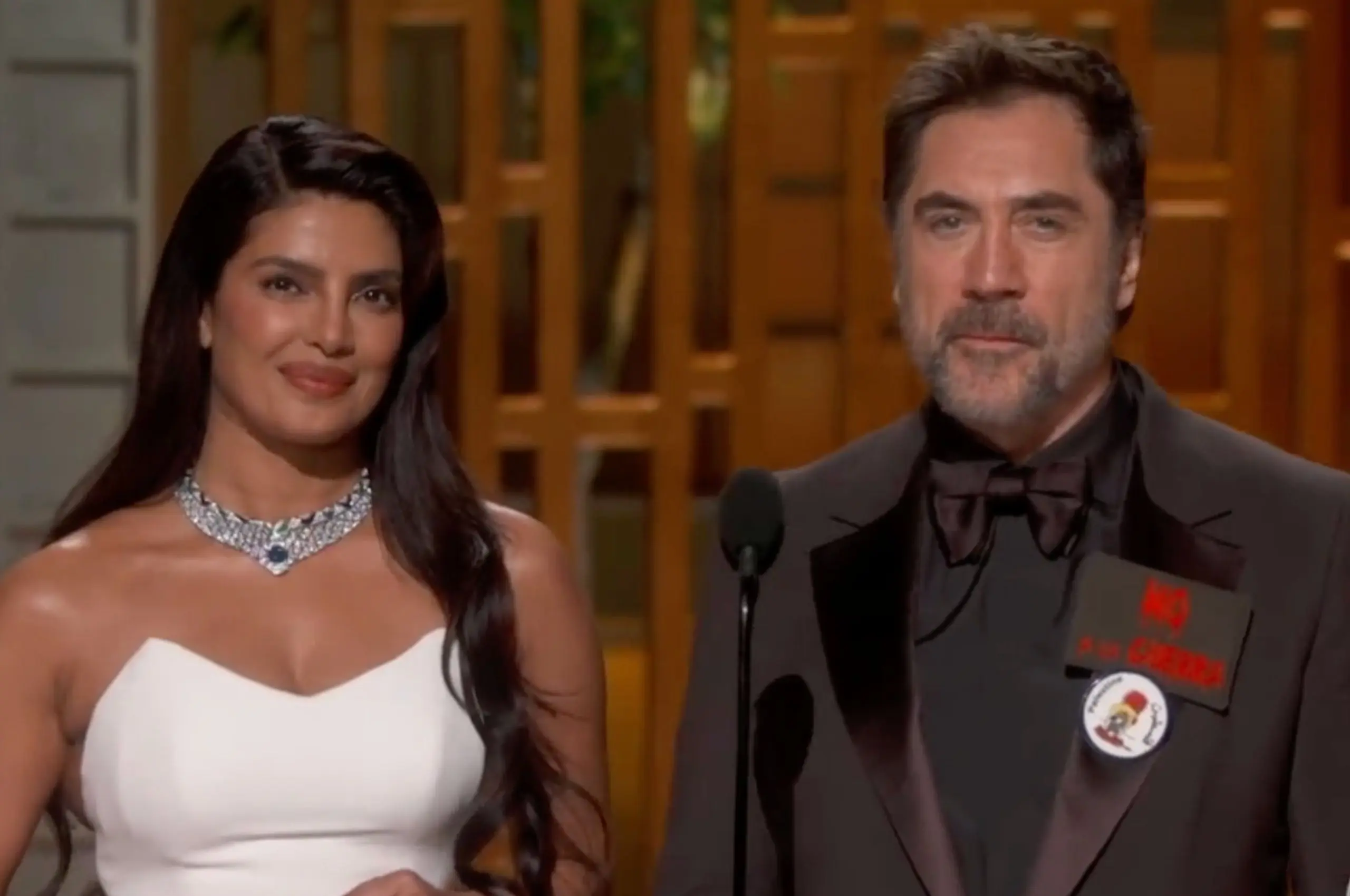
Actor Javier Bardem also did not shy away from discussing conflicts in the Middle East at the Oscars. On the red carpet, he wore a large patch that read “No a la Guerra” (“No to war” in Spanish) and a large pin featuring a drawing of Handala, a Palestinian cartoon character often depicted as a personification of the Palestinian people in their struggle.
Bardem also began his time onstage presenting the award for Best International Feature Film to declare, “No to war, and free Palestine,” earning him applause. The Spanish actor has been vocal about the genocide in Gaza, showing up to the 2025 Emmys red carpet in a Palestinian keffiyeh and calling for sanctions on Israel.
The Voice of Hind Rajab director Kaouther Ben Hania, one of many filmmakers wearing a pin in support of Palestinians at the ceremony, told Al Jazeera, “This red carpet is not detached from the rest of the world.”
Mohammadreza Eyni, one of the filmmakers behind Best Documentary Short Film nominee Cutting Through Rocks, also spoke on the situation in Iran, saying, “We really wanted to celebrate this moment with our people. But even we don’t have internet access to talk with them, and we don’t know how they get the news.” He added that Iranians could not celebrate the nomination of Eyni’s short film because it “isn’t a priority” amid the U.S.-Israel-Iran conflict. “We hope for a better future and peace for our country,” he said.
Frequently Asked Questions
O’Brien referenced the MAGA movement’s Super Bowl protest against Bad Bunny and joked about Trump renaming the Kennedy Center, calling the venue the “Has A Small Penis Theater.”
“Mr. Nobody Against Putin,” about Russian military indoctrination in schools, won Best Documentary Feature. “All the Empty Rooms,” about children killed in U.S. school shootings, won Best Documentary Short.
Presenting Best International Feature Film, Bardem said, “No to war, and free Palestine,” while wearing a “No a la Guerra” patch and a pin depicting Handala, a Palestinian cartoon symbol.
Cazares, whose child was killed in a school shooting, said onstage while accepting the award for “All the Empty Rooms,” “Gun violence is the number one cause of death in kids and teens.”
Mohammadreza Eyni, a filmmaker behind “Cutting Through Rocks,” said his team in Iran lacked internet access to follow the film’s nomination due to the ongoing U.S.-Israel-Iran conflict.
Recommended Video