

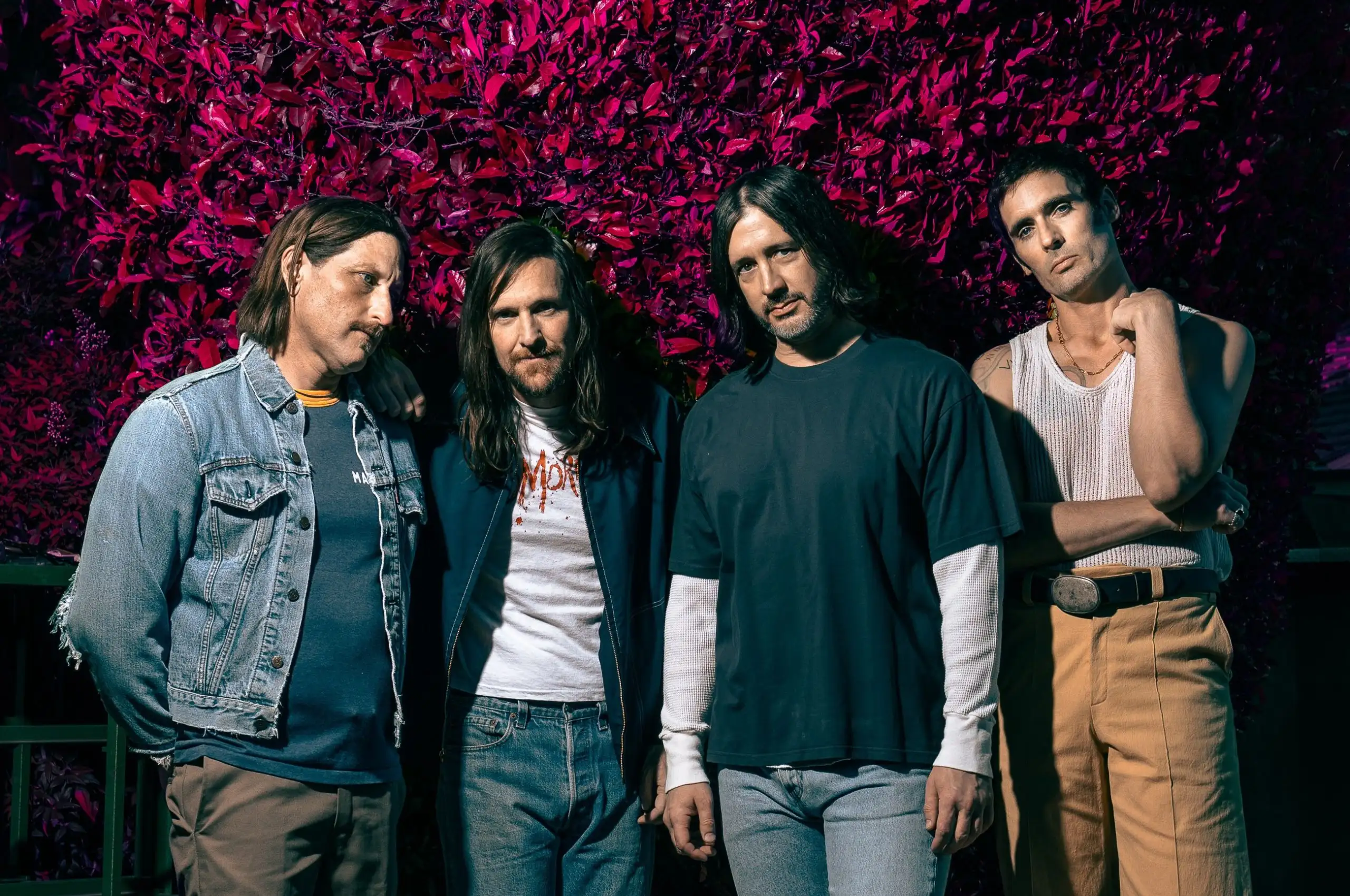
The past year has been revitalizing for The All-American Rejects, a band that’s been around since 1999 but whose members have only found their way back to each other recently.
Much has happened since the emo rock band’s last full-length record under a major label, 2012’s Kids in the Street. Between then and now, the band released a few singles, left its label in 2018, and almost stopped making music altogether when, in November 2020, frontman Tyson Ritter suggested that the four-piece may not be putting out a new record anymore.
“People always ask, ‘When’s the new Rejects record?’” he said on the radio show Emo Nite. “And Joni Mitchell said [that] as an artist, or as a songwriter, you need to know when to stop. It’s not gonna be very likely that we’re gonna do another record any time soon.”
Things would change when the band reunited in 2022 for the When We Were Young Festival, with that year’s edition headlined by Paramore and My Chemical Romance. In 2024, the Rejects also headlined the Dearborn Homecoming Festival with fellow rock band The Verve Pipe.
“It wasn’t until 2023, when we decided to do our first headlining tour in 11 years as an experiment, that we would find a new lust for this band,” Ritter tells Rolling Stone Philippines. “The next logical step was to get into the studio and see if there was magic there too.”
And magic, there was. In April 2025, The All-American Rejects released “Sandbox,” the lead single and title track for what would become their first full-length record in 14 years.
But what really generated hype for the band’s new era was the House Party Tour, a series of concerts and DIY shows set up in unlikely but intimate venues like bowling alleys, skating rinks, barns, college campuses, and even a random backyard. In a May 2025 interview with Rolling Stone, Ritter called them “the best shows we’ve ever played in our lives.” The following year, they released Sandbox.
Ritter tells us the new album isn’t “overthought,” and that many of the final recordings came from the writing and demo process. “There’s an urgency to something that’s being performed as it’s being created, and we wanted to capture that as much as possible,” he says.
In this quick Q&A, Ritter tells Rolling Stone Philippines more about leaving a major label, the making of Sandbox, and how the House Party Tour has given The All-American Rejects and fans “a whole new life.”
It took 14 years between your full-length releases, and you were off Interscope Records since 2018. What happened in those years between leaving the label and deciding to make Sandbox? What got you back in the studio?
During the first decade of our career, we would write an album, record an album, tour an album, and then repeat that three more times. After 10 years of that cycle on a major label, we were tired and didn’t really have a lot to say. Rather than go through the motions and make an album that wasn’t authentic, we decided to take some time off. And that lasted a while. Another 10 years, actually. It wasn’t until 2023, when we decided to do our first headlining tour in 11 years as an experiment, that we would find a new lust for this band. The next logical step was to get into the studio and see if there was magic there too. The ideas started flowing, and before long we had a handful of singles that turned into an entire body of work.
You’ve said the label paid Top 40 stations to get your songs played, and that’s not what music is about to you, but some might argue that that system exists because it works. What do you win and what do you lose by refusing that system?
We had some conversations with major labels that were interested in the band last year, but they just wanted to get us in rooms with their writers and producers. That would have slowed down the momentum we were starting to have creatively. We felt like we were onto something, and we wanted to prove that we could produce, release, and promote this one ourselves. Granted, we didn’t have the bottomless production or marketing budget of a major label, but we’re proud of what we were able to accomplish with Sandbox.
In terms of sonic and creative directions, do you feel like you’ve done with Sandbox what you thought you couldn’t do when you were working under a label? Or is there more?
We just wanted to make music that we loved without going through the committee approval process that was our experience of making records on a major label. We had the experience, and I had the studio, so there was no reason we couldn’t attack this one on our own and create something that we were excited about. A lot of the tracks on the final recordings are from the writing and demoing process, so they weren’t overthought. There’s an urgency to something that’s being performed as it’s being created, and we wanted to capture that as much as possible.
You’ve called your shows on the House Party Tour the best you’ve ever played. What do DIY shows at unconventional venues give you that label-funded arena shows can’t?
Well, the label never funded our tours. It was more of a “we’ll scratch your back if you’ll scratch ours” kind of thing. Basically, if we were on the road doing our part to promote the music, they would do theirs. But the constant touring, promotion, and morning radio station visits caused a lot of burnout, and we would carry that burnout and resentment into the next album cycle until we were just done. I think creating Sandbox and launching the House Party Tour was our way of getting back to doing things on our terms and focusing on the stuff that made us want to get into this business in the first place. Personally, I never cared about the videos or the press or the attention. I just loved making the music and putting on the shows, and that’s what we got to focus on this past year. And it’s given this band a whole new life for us and for our fans.
Frequently Asked Questions
Tyson Ritter is the frontman of The All-American Rejects, an American emo rock band formed in 1999, known for hits like “Dirty Little Secret,” “Gives You Hell,” and “Move Along.”
Sandbox is The All-American Rejects’ first full-length album since 2012’s Kids in the Street. Self-produced and independently released, it grew out of demo sessions the band described as not “overthought,” preserving the urgency of songs as they were written.
The band left Interscope in 2018 after a decade of the write-record-tour cycle left them creatively burned out. Rather than make an album that felt inauthentic, Tyson Ritter said the band chose to step away.
The House Party Tour is a 2025 to 2026 run of DIY concerts The All-American Rejects staged in unconventional venues, including bowling alleys, skating rinks, barns, college campuses, and backyards. Tyson Ritter has called them the best shows the band has ever played.
Tyson Ritter says many of Sandbox‘s final recordings came directly from the band’s writing and demo process rather than later re-recordings. He describes an “urgency” to perform something as it’s being created that the band wanted the album to capture.
Recommended Video