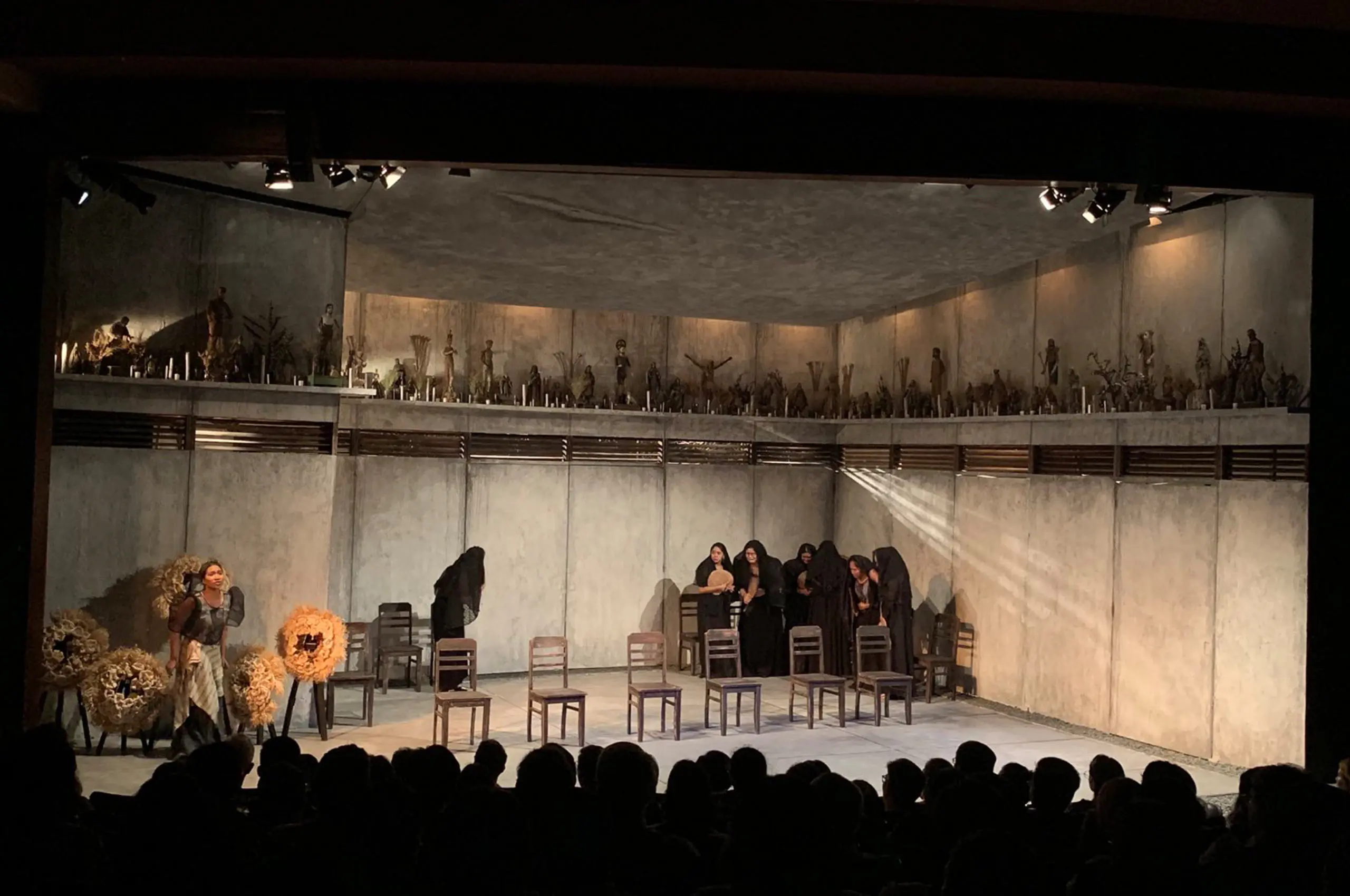
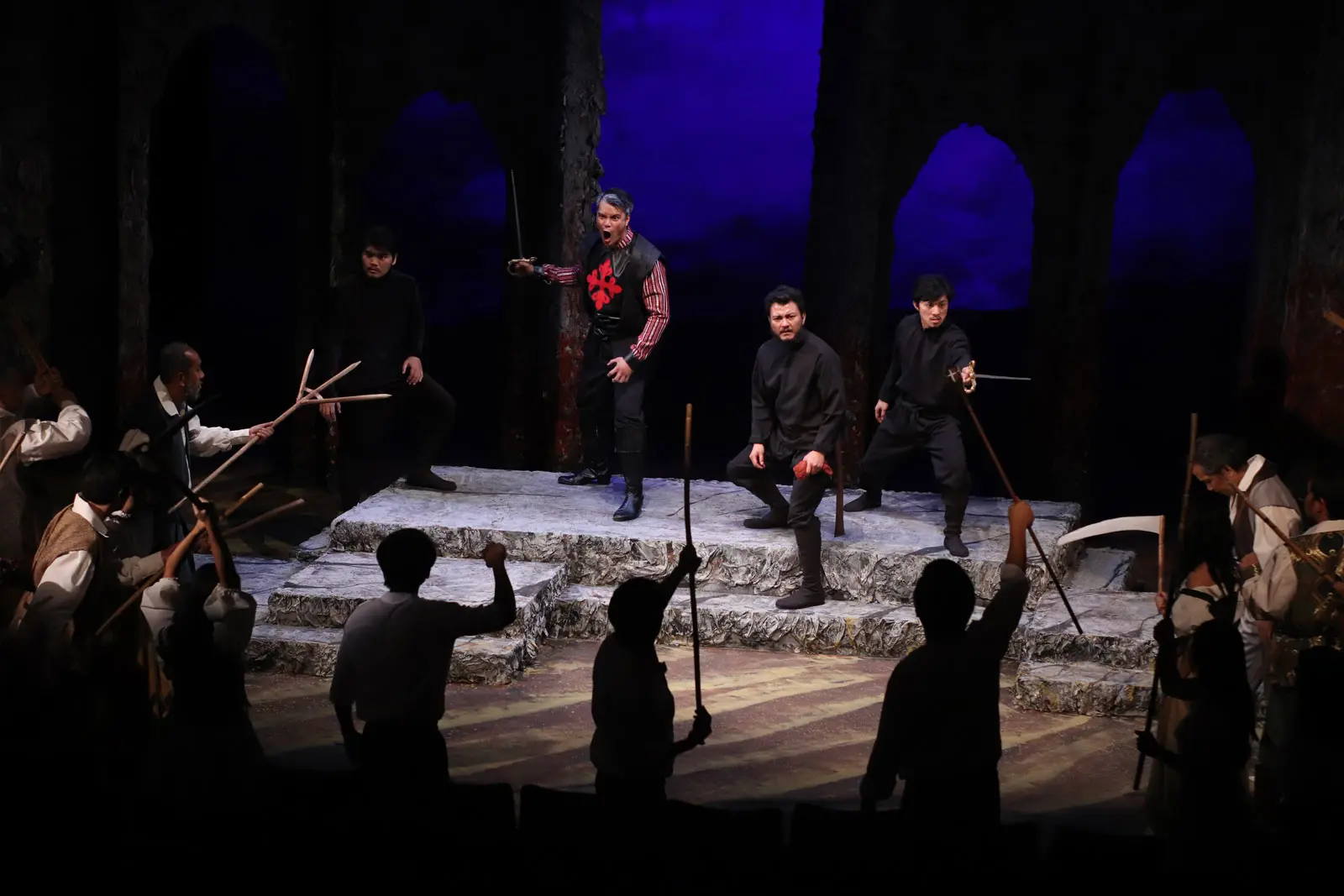
The king lifts his hands in victorious song. Surrounding him, his queen and the villagers of Fuente Ovejuna raise their voices to the dim, rust-colored sky. The village is celebrating both their killing of a tyrannical commander who had been terrorizing them, and King Ferdinand’s mercy in pardoning them for their uprising. Until a new commander can be appointed, the king says, Fuente Ovejuna will remain under direct supervision of the crown. The music reaches its crescendo — a happy ending for the king’s vassals for exercising prudence and banding together to dispense their own justice. But as the theater darkens, the red and black that linger on stage can’t help but appear sinister; for a moment, the future of the village feels uncertain, back in the same position where they started.
This was the final image directed by Antonio “Tony” Ocampo Mabesa, National Artist for Theater. The production was Spanish playwright Lope de Vega’s early 17th-century work Fuente Ovejuna. In keeping with the classic style of Dulaang Unibersidad ng Pilipinas — established in 1976 by Mabesa, who served as its founding artistic director until 2001 — the play was performed both in English and in a Filipino translation by Nicolas Pichay by the same cast. Mabesa never got to see his final directorial credit open to the public. He passed away on October 4, 2019, about a month before the opening performance, at the age of 84.
The tributes that followed and continue to be made in his honor only solidify his legacy as the “Lion of the Theater,” in the words of the late writer and cultural critic Amadis Ma. Guerrero. And in 2022, Mabesa was finally posthumously conferred the title of National Artist, recognizing his prolific career as educator, director, and actor, and his commitment to the craft.
But in the wake of his passing, Dulaang UP (or DUP, for short) — Mabesa’s bastion of classical theater, and proving ground for generations of budding theater practitioners at the University of the Philippines (UP) Diliman — finds its traditions not so set in stone. The company has gone through constant, gradual change over the decades, especially with its approach to its student collaborators, and as it arrives at its 50th anniversary, the juncture where DUP finds itself appears all the more crucial. There is cause for much celebration, of course, but also a call for reckoning with the qualities it hopes to change, introduce, and sustain stepping forward into the darkened stage ahead.
“Mediocrity has no place in the theater.”
DUP was established as the production arm of UP Diliman’s Department of Speech Communication and Theatre Arts (DSCTA), with a focus on staging classical texts and their Filipino translations. Complementing DUP are the UP Playwrights’ Theatre (also founded by Mabesa in 1986; now renamed DUP Playwrights) and UP Dulaang Laboratoryo, which produce original Filipino works and student thesis productions, respectively. But even from its very first production — William Shakespeare’s Much Ado About Nothing, also translated into Filipino by Lilia F. Antonio as Pagkahaba-haba man ng Prusisyon — DUP has distinguished itself as a directors’platform.
“If you look at the history of DUP, Sir Tony wasn’t dictating what the other directors were going to do. Kasi in other companies, if you’re an artistic director, you choose the lineup of plays that’s going to be staged in a season,” says Issa Manalo Lopez, who served as artistic director from 2022 to 2025. “Parang nakita mo kung paano na-develop ‘yung director’s practice. Lalo siyang napapatalas dahil allowed ‘yung mga directors to choose whatever ways of making ‘yung gusto nilang i-pursue or i-develop.”
The list of artists across Filipino film, television, and theater who received their formation through DUP’s semi-professional environment is a long one: Irma Adlawan, Shamaine Centenera-Buencamino, Dolly de Leon, Eugene Domingo, Cedrick Juan, Chito Roño, and JC Santos are just a fraction of the pool of talent that the company has produced. And even more recognizable names in Philippine art and entertainment have collaborated with DUP in its decades of theater-making. Among dozens of others, Jackie Lou Blanco, Laurice Guillen, Mario O’Hara, Joel Lamangan, Cesar Montano, Leo Rialp, and Romnick Sarmenta all have DUP credits to their names — additional proof of the company’s legitimacy as a theater company, and not merely a student club.
And DUP did bloom early on as a showcase for strong directorial voices, including those of Anton Juan, Jr., Ogie Juliano, Amiel Leonardia, and José Estrella (who directly succeeded Mabesa as artistic director from 2001 to 2007) — highly influential theater directors whom Lopez affectionately refers to as “mga lola.” Under them and many others, DUP’s repertoire of classical works has expanded to a dizzying variety, covering Greek and Roman texts as well as playwrights from across the Western canon: Bertolt Brecht, Anton Chekhov, Henrik Ibsen, Arthur Miller, August Strindberg, Tennessee Williams, and many others.
“Ang ganda-ganda ng suggestion ni Professor Amiel Leonardia: dapat sana in the four years of a UP student’s life, ‘yung malawak na representation ng world theater ma-experience ng bata,” recalls Jina Umali, who served as DUP’s managing director for one year until 2002. “So it cannot be all German plays in one season, it cannot be all English plays. Maybe one from the West, one Asian, one Filipino. I thought it was a very good idea.” Umali, who completed her doctorate in Japanese Literature at Doshisha University in Kyoto, went on to co-direct Kanjinchō with Mabesa in 2003 — the first all-Filipino production of a Japanese kabuki play, presented in both Filipino and the original Nihongo. It took six months of rehearsals, with the performers — both student and professional actors — spending the first three months learning the traditional form by replicating a Kanjinchō video before Japanese masters came in to help.
Still more plays across DUP’s 50 years are remembered fondly by the company’s former stewards. Lopez cites Orosman at Zafira, directed by Dexter M. Santos (artistic director from 2015 to 2018); and Estrella’s productions of Divina Palabras, Ang Dalagita’y ‘Sang Bagay na Di-Buo, and the children’s play Umaaraw, Umuulan, Kinakasal ang Tikbalang. Banaue Miclat (artistic director from 2018 to 2021) also recalls starring in another DUP children’s play, Ang Damit ng Emperador, when she was a high schooler, before becoming a regular performer for the company in college. In particular, Miclat became a part of DUP’s Philippine Centennial plays, which included Elias at Salome and The Trial of Andres Bonifacio (Ang Paglilitis) — directed by Alexander Cortez (artistic director from 2009 to 2015), and which toured the country for two years with over 200 performances.
In her career with DUP, Miclat also found herself in an especially unique if unwanted position: finishing work on Mabesa’s final project. “He blocked the whole play in one week. I took over finishing the production of Fuente Ovejuna, but I told the Dulaang UP office, just put my name in the program, don’t put it in the poster because it’s his last play,” she says. “It was a difficult production. Everyone was mourning in their own way, so that was a dark time.”
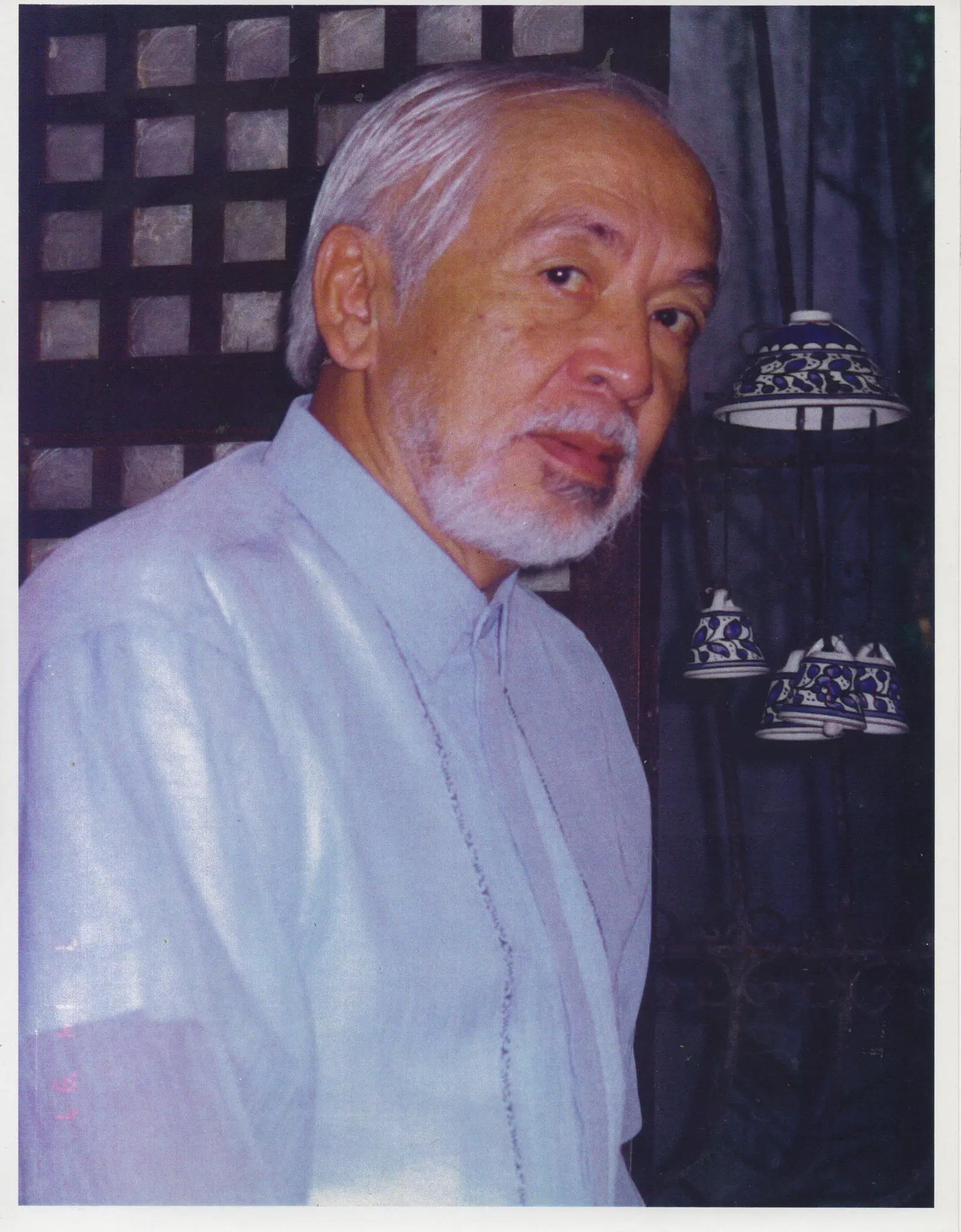
To mourn Mabesa’s passing is, in a way, to also mourn the loss of the pure, direct manner with which he approached classical theater. Fuente Ovejuna provides just a small window into his imposing body of work, but the fundamentals can all already be seen here: no unnecessary flourishes, a fierce devotion to delivering the text, and — as Nicodemus Varona (managing director from 2022 to 2023) says in Mabesa’s own words — precise, “sacrosanct” blocking. Given that DUP is an extension of a university department meant to provide a high standard of education, it only follows that Mabesa would demand absolute rigor from his students. Staging these plays should require the necessary effort to preserve their reputation as classics.
Varona had the privilege of being directed by Mabesa in the 2018 production of Luigi Pirandello’s Six Characters in Search of an Author, where he remembers the late National Artist telling the cast, “‘Mediocrity has no place in the theater.’ Nasabi talaga niya ‘yun kasi may time na na-fru-frustrate na siya with our rehearsals.” Mabesa had stressed that they couldn’t afford to do things half-heartedly — that excellence was demanded of them because they weren’t just doing theater for themselves but for their audience.
But for others, Mabesa’s passing also emphasized a shift in how DUP had changed since the beginning, especially in how the strictness of the methods employed by Mabesa and other directors has since been reassessed as excessive. “He expected a lot out of people. He was very, very intelligent, and he expected intelligence from people in his own way,” Miclat says. “So when he wouldn’t see that, it would drive him into different levels of showing anger. It filtered those who were passionate enough about theater that we would want to push through that kind of exposure, and then there were those who were not meant for those kinds of ways.”
“DUP is also known for horror stories about pinagmumura ‘yung mga actors, ‘yung mga estudyante, binabato ng mga silya, mesa,” Lopez adds, recognizing that the older directors who behaved this way were products of how they were raised in their generation. In later years, Mabesa would “only” throw shoes or mugs at people, in addition to the shouting and swearing. However, Miclat clarifies that, unlike other directors of that generation who would remain actively aloof throughout rehearsals, Mabesa is still patient and amicable. And when all was said and done, Varona says, Mabesa would keep his compliments and congratulations to a minimum, save for a rare utterance of “good job” and a pat on the back.
For those closer to Mabesa’s generation, among whom this sort of rigorous training wasn’t as frequently openly challenged — if not seen as a kind of “tough love” — the camaraderie and discipline earned through these heated moments were still worth it. “Hindi kami nalibre sa mga pagalit at sigaw,” Umali says. “But after rehearsals, minsan sama-sama kaming kumakain sa labas kasama si Sir Tony. Nagbibiruan kami, and we would even joke with him about the times he got mad at us. Walang gaping wound — we considered it part of the learning process.” Despite some heated moments, camaraderie was still forged among those involved.
“It always confronts things. You’re at a precipice. And it’s always a negotiation.”
Still, in recent times, with a growing awareness of workplace abuse worldwide and a sustained call for safer spaces in the creative industries, those who assume leadership at DUP are also called to examine the company’s established culture, even if that means speaking more frankly about the contradictions of its heroes. It isn’t an easy conversation to have, especially amid the profound sense of loss that the community is still working through today. For Umali, the changes that DUP has been undergoing have been more challenging to reconcile with. “It’s very sad na ‘yung last years ni Sir Tony, the kind of discipline na in-instill niya, hindi na-translate properly sa next generation,” she says.
Umali describes a sort of “schism” within the company, and a need to bridge the divide between the DUP of the past and the DUP being developed today. At a certain point during our video interview, Umali takes off her glasses to wipe away her tears. “Miss ko si Sir Tony,” she says. “I still owe him a publication of the Kanjinchō book.” Traditions and technique don’t seem to be the only things at stake; there are still unpaid debts and unfulfilled ideas attached to these memories of the old DUP, at risk of being lost if too much changes.
But change had to come one way or another for such an established institution. DUP’s succeeding artistic directors after Mabesa have gone through cycles of implementing more student-friendly practices — ending rehearsals at earlier times, drafting guidelines that ensure DUP remains a productive learning environment in line with the Safe Spaces Act, and providing opportunities for greater student involvement in the productions through more devised work. This comes in contrast to DUP’s original style, often led by the professional artists, with students commonly only acting as assistants or, as Lopez jokingly says, “aliping sagigilid.” She refers to Estrella’s “revolutionary” 2002 production of Divinas Palabras as the first time she felt that DUP’s student artists were regarded as equals to the professionals involved.
Lopez began to observe how great an influence the older directors had on her, as she started adopting the same kinds of images and language from DUP productions in her own Dulaang Laboratoryo works. “And later on, when we went out [of DUP], na-realize namin even the way that we were working in the theater was shaped by how the mentors taught us. And they were not all right,” she recalls. “Andun ‘yung violence, andun ‘yung paninigaw, pagmumura. And then we realized paglabas namin na hindi ‘yun ‘yung tamang paraan ng paggawa. We retained the discipline, we retained striving for excellence, pero ‘yung empathy at tsaka ‘yung softness and caring for people you work with, ‘yun ‘yung kind of natutunan na namin outside.”
No matter how one feels about the right balance of strictness and softness when staging a play or running a theater company, Lopez acknowledges, however, that the practice of theater itself is “not safe” — especially in DUP, whose works often seek to respond to the current social and political climate. “It always confronts things. You’re at a precipice. And it’s always a negotiation,” she says.
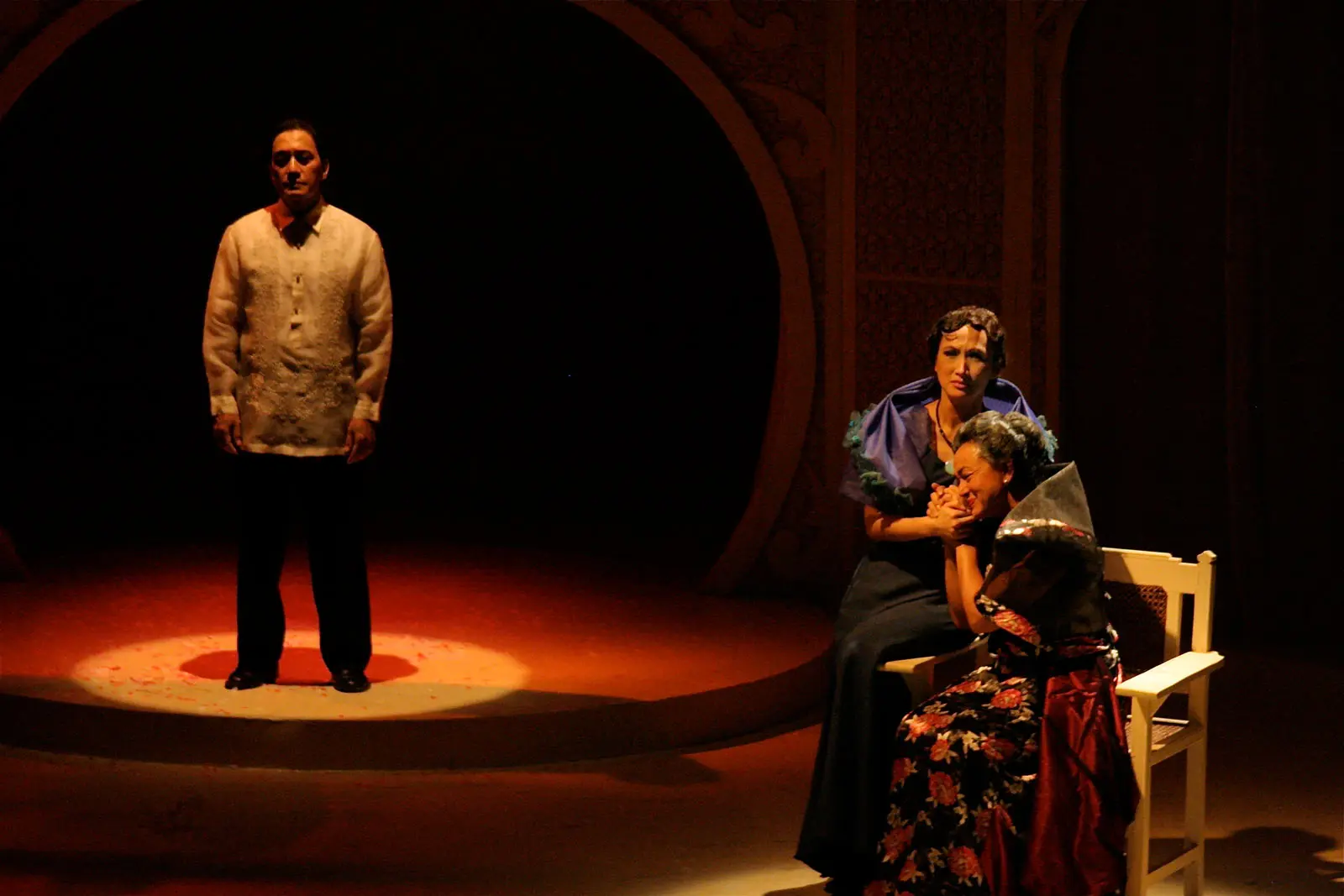
Whether they stage classics as a way to echo contemporary concerns, or original works that can more immediately address ongoing issues, political plays from UP are always thoroughly developed — with productions going through the approval of an advisory council, then being staged in association with relevant partner organizations, at times with talkback sessions after performances to help process the ideas being discussed.
In recent years, the DUP Ensemble performed in the UP Playwrights’ Theatre 2019 production of Nana Rosa, written by Rody Vera and directed by Estrella — following the first Filipino comfort woman to publicly come forward with her experiences of sexual slavery in World War II. Then in 2024, Vera adapted Brecht’s Mother Courage and Her Children into the Herbie Go-directed Nanay Bangis, which moves the play’s context to the conflict between the Philippine military and the Moro National Liberation Front. And in one of their especially popular offerings, in late 2022, DUP returned to the stage following the COVID-19 pandemic with The Reconciliation Dinner, written by the late Floy Quintos and directed by Dexter Santos. The one-act play explores how the results of the presidential elections have fractured the bond between one family supporting Leni Robredo and another supporting Bongbong Marcos.
However, while DUP has been able to clearly and confidently express these stances in support of the oppressed and marginalized and against totalitarianism and dictatorships, the company has also faced controversy. In 2019, in particular, Irene Marcos-Araneta attended the opening performance of DUP’s The House of Bernarda Alba, directed by Alexander Cortez, prompting a flash protest during the production’s intermission and after the show. Criticism from the extended UP community — accusing DUP of taking the presence of a Marcos too lightly in the historically anti-authoritarian state university — prompted the company to issue an apology.
With this incident still lingering in the memory, with unexpected layoffs at the DSCTA just last year, and with a 50-year legacy of harshness and excellence still in the process of being reassessed, this intersection is where DUP’s current leaders find themselves today. But for artistic director Arlo Deguzman and managing director Roger Federico — who assumed their positions in 2025 — their relative distance from the company may be the thing that gives them the perspective they need to carve a path forward.
“In theater, it’s not a race, it’s actually a marathon; you need stamina.”
An alumnus of the Theater Arts program, Deguzman considers himself “a newcomer but an old joiner,” having watched DUP plays since he was in the fifth grade but having spent considerable time abroad — teaching at New York University Abu Dhabi and completing his master’s degree at University of the Arts London. Meanwhile, Federico has his roots in the University of Baguio, and his theater experience is informed by devised and non-professional community theater work in the Cordillera Region. And to them, Mabesa is not a person they’ve necessarily had close personal interactions with, but he remains someone whom they consider a fearsome figure, an invaluable educational source on theater techniques, and the very genesis of the company they serve.
Assuming these positions within DUP doesn’t necessarily mean being given the opportunity to do anything they want with the company; it also means inheriting all the limitations and challenges that need to be addressed. Deguzman is much more student-centered in his management, having already given them opportunities to direct DUP productions in the regular season, but he also acknowledges the need to return to a stronger internal theater culture. “‘Yung challenge ngayon ay disiplina actually e,” he says.
“In theater, it’s not a race, it’s actually a marathon; you need stamina.”
On the other hand, Federico is focused on the potential for an even stronger community within DUP, then expanding that community beyond Manila’s borders, positioning the company at the forefront of addressing issues in the regions as well. The projects that he and Deguzman aspire toward (budget and timetables willing) range from a regional theater festival and the staging of indigenous classics right alongside DUP’s revivals of Western plays — to the introduction of smaller rituals among the students, such as “anido” bonfires and the construction of a “dap-ay,” or a stone-paved communal space, in the vicinity of the Ignacio B. Gimenez (IBG)–KAL Theater. “Para there is a traditional space where storytelling happens, and of course a contemporary space where theater happens,” Federico says.
There is a long way to go yet before these ambitions take tangible shape and before the right balance is struck between a culture of care and discipline within DUP. And if their recently concluded 48th season is any indication, Deguzman and Federico are certainly still in the middle of making sense of their personal histories and the hand they’ve been dealt. Their latest production, Ang Kaliitan ng Kasalukuyan, is written and directed by Deguzman himself, and draws heavily from his experiences working as an OFW while struggling to determine his own responsibility towards the Philippines.
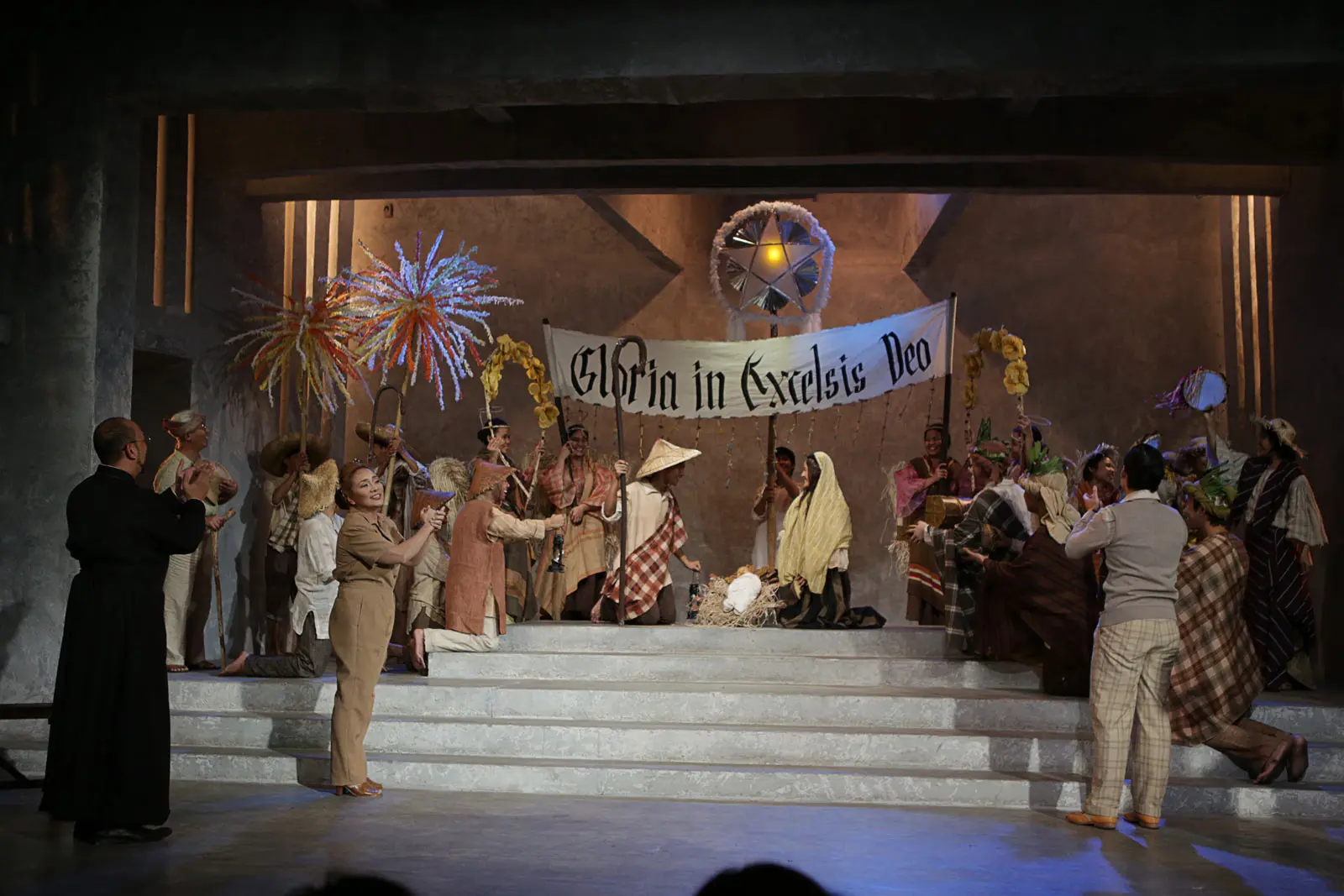
Their first production for the 48th season was entitled Para Kay Tony: Tungo sa Ginintuang Alaala, a twin bill consisting of Kalahating Oras sa Isang Kumbento and May Katwiran ang Katwiran, two Filipino classics directed with surprising assurance by students Lloyd Sarmiento Uy and MJ Briones, respectively. Both deal with the oppression of the vulnerable at the hands of harsh authority figures. In the shadows of the cavernous IBG-KAL Theater, these stories play out with the lowly losing their lives and the powerful either watching on in horror or getting away with their crimes. From an outsider’s perspective, having plays of this nature packaged as a tribute risks coming off as odd, backhanded. But for those who’ve come to know DUP, all its rough edges, contradictions, and vast potential, it can’t help but make sense. The truth is in the uncertainty.
ERRATUM
An earlier version of this piece had a quote attributed to Prof. Jina Umali that did not portray a full representation of the context. It has since been removed for this digital version.
This story first appeared in the Rolling Stone Philippines Voices Issue, now available on Sari-sari Shopping and in major newsstands soon.