

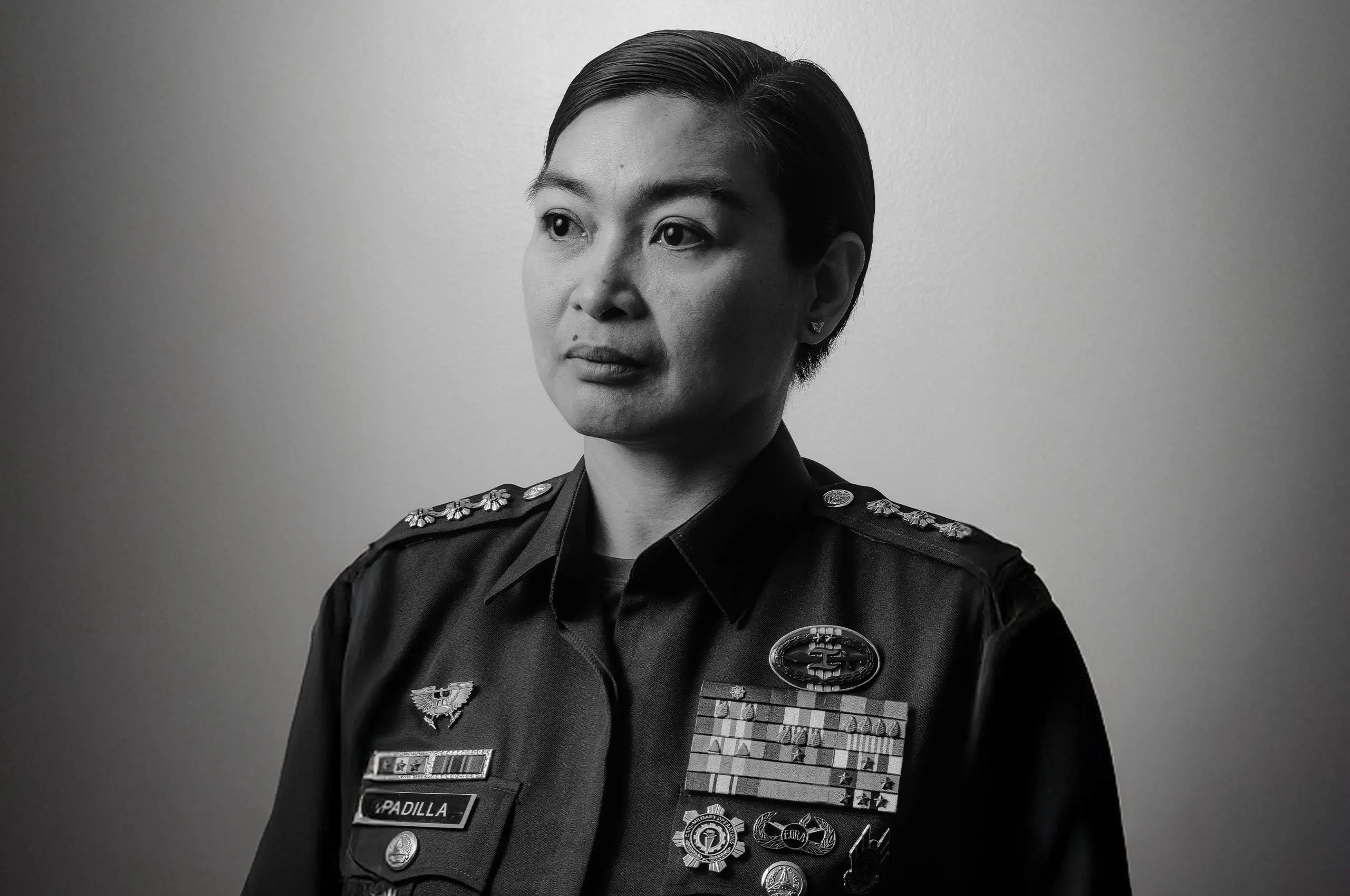
Colonel Francel Padilla spent the better part of her military career making sure no data got out. She was a signal officer, a programmer, a certified ethical hacker, someone whose professional instinct, honed over decades, was to guard information.
“In cybersecurity,” she tells Rolling Stone Philippines, “the paranoia is something good.” You assume the attack is coming. You build the controls. You protect the system.
And now, Padilla is the one the country calls when it needs to know what the Armed Forces of the Philippines (AFP) is doing in the West Philippine Sea. The contradiction is not lost on her.
“Ang paranoia namin is ang pag-leak ng data sa cybersecurity,” she says with a laugh. “So ngayon, biglang iba na ‘yong role mo. So parang kailangan mag-loosen up ka from that culture.”
And Padilla has been loosening up, carefully, for two years now — long enough to have become one of the most watched military voices in the country, at one of the most consequential moments in its modern history.
She did not plan any of it. Padilla was two years into her engineering degree at the University of Santo Tomas when her brother, who graduated from the Philippine Military Academy (PMA) in 1997, convinced her to take the entrance exams on a dare. Your name will be in the newspaper if you pass, he told her. She passed. Nobody thought she would.
“Kami noon, 10 lang,” she says of the women in PMA “Sanghaya” Class of 2000. Ten women out of 400 incoming cadets, under a quota that has since been expanded. Today, about 70 to 80 women graduate per batch.
Padilla was among the first to complete all four years at the academy alongside female classmates. It is a fact she notes not with pride exactly, but with the quiet satisfaction of someone who simply showed up and finished what she started.
Her career after PMA took her through tactical communications, cybersecurity, and the Presidential Security Group, where she helped build the digital infrastructure that now protects the country’s highest-ranking officials, including the president.
Along the way, the accolades came, among them the Ten Outstanding Women in the Nation’s Service award in 2025, one of the highest honors given to Filipino women who have made an exceptional mark in their fields. Padilla wears her laurels lightly.
Through all of it, she raised two sons largely on her own after her husband, Lieutenant Colonel Felicisimo Taborlupa Jr., her PMA classmate and mistah, died in a helicopter crash in Batangas in 2015. She does not linger on it, but it is there in the way she talks about her troops as family, about the bonds that outlast any posting or promotion.
The spokesperson job found her the same way everything else did: someone at the top decided she was the right person, and she said yes because you don’t say no to AFP Chief of Staff General Romeo Brawner Jr.
It was her former boss Major General Ramon Zagala, then-commander of the Civil Relations Service of the AFP, who first identified Padilla for the role and recommended her, calling her for months while she was still battalion commander, asking about her future plans. She had already lined up her next potential assignment at the National Security Council, something cybersecurity-related and national in scope.
Then came the call. “It happened really fast,” she says.
Her first weeks on the job as spokesperson were brutal. She was new to public affairs, navigating issues about the West Philippine Sea alongside AFP Public Affairs Office Chief Colonel Xerxes Trinidad, both of them Army officers suddenly responsible for explaining maritime operations to a country hungry for answers.
At one point, overwhelmed by a communication blunder, she went to Trinidad and told him she couldn’t do it. He reminded her she had survived four years at PMA and gone through rigorous military training. Her boss and colleagues trust her to this day, even if she stumbled along the way.
“He’s a rock star boss,” she says of Brawner. “He has your back.”
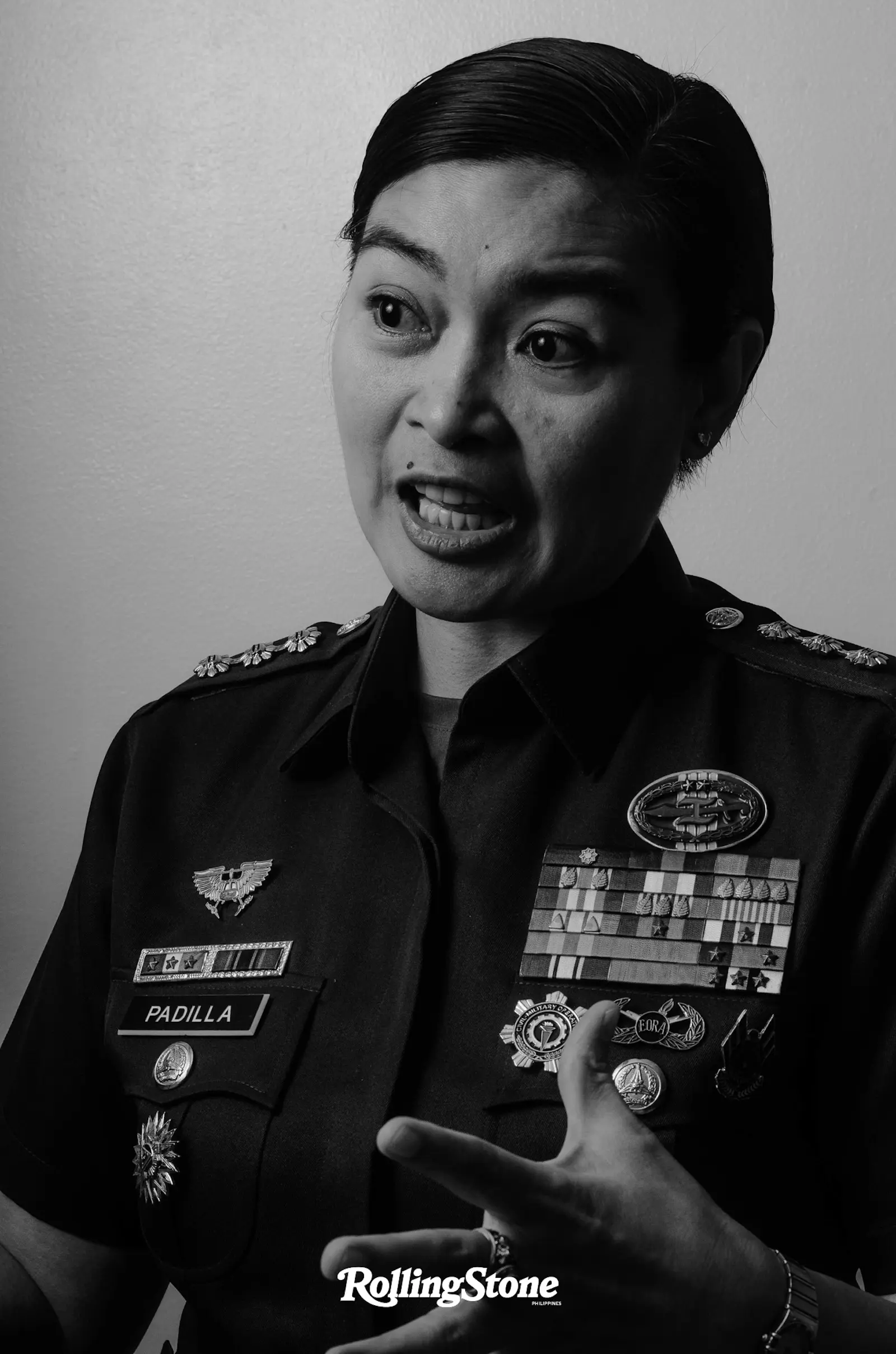
One thing that has made the job easier, she says, is something most people would never think about: the other service spokespersons — from the Army, Navy, and Air Force — are all her PMA upperclassmen. In press briefings, a single keyword passed between them is enough to signal who takes the question, who defers, who expands. It is, she says, like having a cadet corps again.
“Mayroon kaming synergy, so to speak,” she says. “‘Yong rapport with one another. Kahit na kumbaga lilingon lang, [we know what we’re talking about].”
What makes her role unlike almost any other spokesperson position in government is the specific weight of the institution she speaks for.
She is acutely aware that her audience is never just the Filipino public or the reporters in the room. Every time she opens her mouth about the West Philippine Sea, Beijing is listening. Every statement she makes about AFP operations at the contested features, the resupply missions, the encounters at sea, China’s analysts are parsing for anything that could be used, misrepresented, or escalated.
“You look at the seas,” she says. “The Coast Guard can speak because they are white hull ships, ‘di ba? We are gray hull; we are warships. So when we speak, really… we can start a war. So ganoon ka mas kaingat.”
She has been doing this for two years. She still wakes up every morning not knowing if it is her last day on the job.
“Your tenure as a spokesperson ends with your last statement,” she says. “Kasi puwedeng, ngayon may sinabi ako, mali. And then, I get removed from the job. So hindi mo alam na this is my last day in office. So every day you wake up, you don’t know what’s gonna happen.”
Every press statement is calibrated against that possibility. She knows where her lane ends. Anything policy-level goes to the Department of National Defence. Anything diplomatic goes to the Department of Foreign Affairs.
Padilla’s cybersecurity training, it turns out, mapped surprisingly well onto this. She thinks about communication the way she thinks about data security: in terms of confidentiality, integrity, non-repudiation, availability. Who is the audience? What is their clearance level? What can be released at this stage of the operation?
But the data is only half the battle. Context, she says, is where the real work happens, and most people never see it.
“Ang nakikita ng tao is ‘yong pagsalita mo lang,” she says. “‘Yong humarap ka lang, nagsalita ka. But that’s actually the smallest part of the job. The biggest part… it’s like you also, reporters, ‘di ba? The research that you do. ‘Yong talagang you try to reach out to kung sino talaga ‘yong involved. And then you get a sense of what really occurred, and then it will resonate when you speak.”
As a spokesperson, she says, you are the bridge between operational security and the public’s right to know. “Kailangan mo siyang i-balance.”
She pushes back, gently but firmly, on the framing that her presence is primarily symbolic. The awards, her career milestones, the many “firsts” as a female in the AFP — she receives them with gratitude but is careful not to claim them entirely as her own.
“I don’t think of it na it’s just me,” she says. “A lot of females ahead of me have paved the way for other females to shine in different fields.” What she wants, more than recognition, is for merit to become the only measure that matters.
“I would like to believe that you were placed there because they conducted due diligence. They looked at your background, your achievements, how you handled things, how you commanded your units. More based on merits and not on gender,” says Padilla.
The goal, she says, is the day when none of this needs to be said at all.
“We want to see the day that being a female at the helm of command is no longer a monumental feat but a normal occurrence,” says Padilla. “Dapat lang.”
“We are gray hull; we are warships. So when we speak, really… we can start a war. So ganoon ka mas kaingat.”
Outside the office, she has no deputy, no one to cover for her. She has gone to studio interviews on Christmas Day, her sons in tow, so they can see what her days look like. She does not mix the two lives more than she has to.
“I would not be in this position forever,” she says. What she wants to keep, long after the title is gone, is something harder to take away: the trust, the voice, the credibility built one careful statement at a time.
“Kahit hindi na ikaw ‘yong spokesman, you still ignite patriotism and nationalism. You still have that voice that they trust and listen to, regardless of the position that you hold,” Padilla says.
It started with a dare and a name in the newspaper. It has since become a career that has taken her from server rooms to the front lines of the country’s most consequential geopolitical standoff, from a battalion commander’s post in Northern Luzon to the most-watched podium in the AFP.
Colonel Francel Padilla is still at that podium now — steady, precise, carrying the weight of the country’s peace and security on her shoulders, and calling it, simply, the job.
This story first appeared in Rolling Stone Philippines’ Voices Issue, now available on Sari-sari Shopping and in major newsstands.
Get digital access to the latest issue here.