

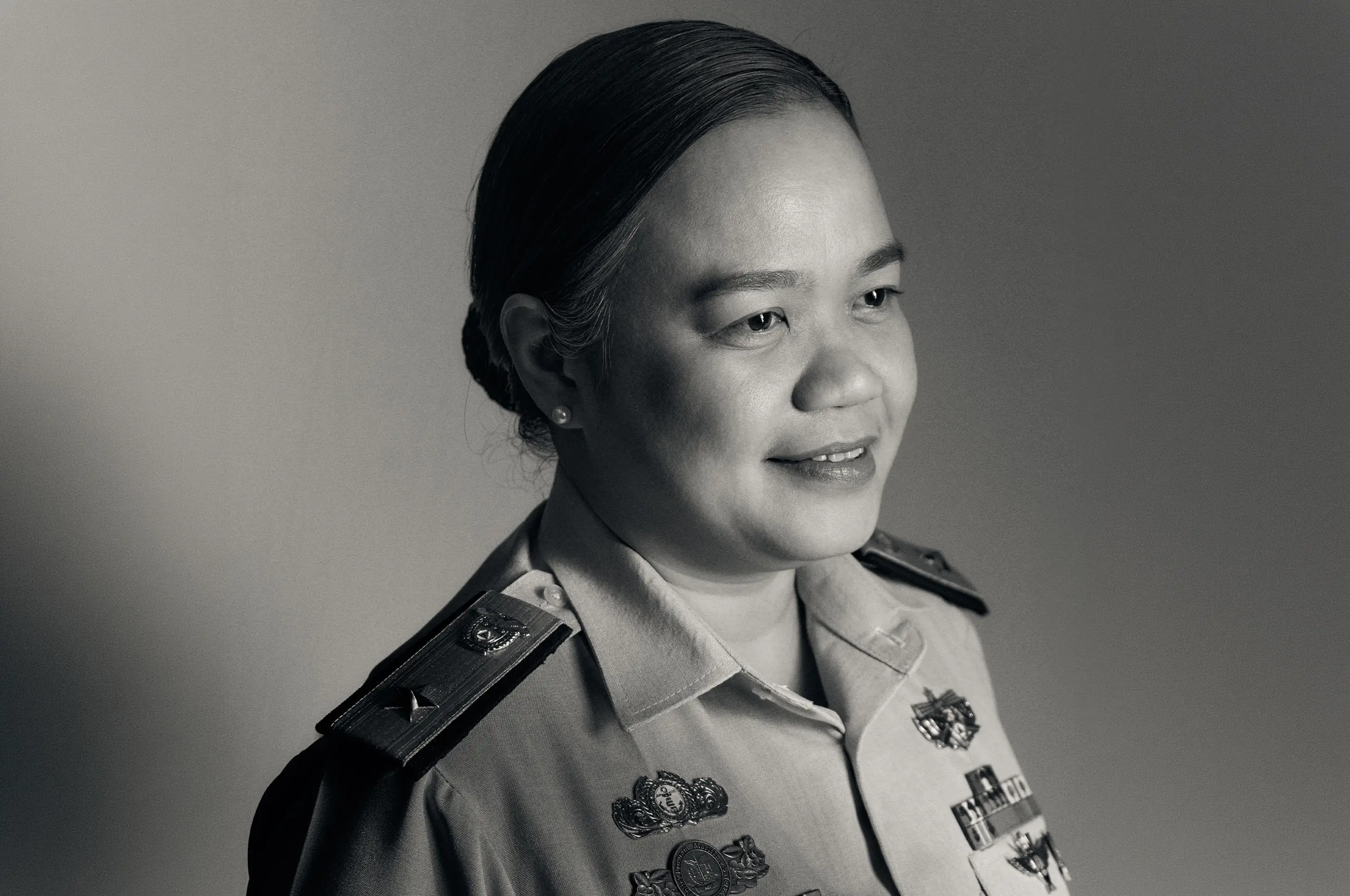
The chief of the Philippine Coast Guard (PCG) asked Commodore Noemie Cayabyab seven times before she said yes.
Commandant Ronnie Gil Gavan had been calling her since he assumed his post in 2023, convinced Cayabyab, who was just captain at the time, was the right person to become the PCG’s first female spokesperson in its 123-year-history.
Each time, she said no. She was an introvert, she told him. “Mahiyain sa camera,” Cayabyab described herself to Rolling Stone Philippines.
But on the seventh time, Gavan did not call. He stepped out of his vehicle as she was walking out of her office at the Port of Manila. Gavan called out to her.
“Takbo ako!” she says, laughing. “[He told me,] Kunin mo na ‘yong spokesperson [job]. Sabi ko, ‘Okay na po, final na ‘to.’ Nag-yes ako sa kanya.”
It is worth pausing on this image, that of the woman now trusted to be the calm, steady voice of the PCG in its most harrowing moments, running toward the commandant, finally saying yes to a job she had spent almost two years avoiding.
Cayabyab is outgoing, funny, and warm in a way that fills the room. She will tell you, with complete sincerity, that she is an introvert. Both things are true.
The PCG was always there for her. She grew up in Romblon, a few meters from the sea, the granddaughter of a lighthouse keeper who was a civilian employee of the very institution she now speaks for.
“Every day, I always visit my lolo sa kanyang office. Minsan dinadala niya ‘tong mga lantern sa bahay, nagkukumpuni,” says Cayabyab. The sea, the ships, the men in uniform — they were simply the landscape of her childhood, unremarkable and constant.
It was her grandmother who made it deliberate. Every time Cayabyab came home to Romblon from Manila — where she had moved to pursue her mass communication degree at Adamson University, and later worked the graveyard shift at a call centre to help her mother with expenses — the same instruction was waiting for her.
“Walang ibang permanente at stable na trabaho kundi sa government,” her lola would say. “You work in the Coast Guard.”
So Cayabyab applied. In the mornings, between shifts, barely sleeping, changing clothes in between.“Halos walang tulog,” she says.
In 2002, Cayabyab was accepted as an apprentice seawoman, the lowest possible rank in the PCG. Three years later, she passed the screening process for commissioned officers and became a Coast Guard Ensign, an entry-level rank.
She has been climbing ever since, through assignments in education and training, through postings across the country, through a male-dominated institution that she navigated with a combination of discipline and unflinching directness.
When a superior once made an inappropriate comment, she called him out on the spot. “Handa ako ma-relieve kung hindi nya nagustuhan ‘tong statement ko,” she says. “Pero hindi ko hahayaan, ‘wag mong haha- yaan na minsan mabastos ka.”
“‘Pag hindi tayo marunong mag-handle ng media, it’s another crisis after crisis.”
Cayabyab is now the first enlisted woman in PCG history to reach a flag rank, a fact she mentions not as a personal triumph but as proof that the door, once opened, stays open.
The spokesperson role, when it finally came, was not entirely without precedent. She had studied communications. She had reported for a local radio station as a side assignment years earlier, calling in from a payphone outside her graduate school during breaks because the PCG had a segment there.
But public affairs had never been her career path, and she learned the job the way she learned everything else: by identifying the gap and addressing it herself.
She watched interviews online. She reviewed her own performances. The gap she kept coming back to was the introversion, the camera shyness, the instinct to go inward precisely when the job demanded the opposite. What the commandant had seen in her, it turns out, was something Cayabyab had not fully seen in herself. The PCG runs an initiative called Angels of the Sea, female personnel deployed as radio operators on vessels during tense situations at the West Philippine Sea.
“‘Yong commandant believes na if the situation is intense, ‘yong voice ng woman ang nakakapagpakalma,” she says. “Parang daw boses ng nanay mo. Kahit gaanong kagulo ang isang sitwasyon, ‘pag nagsalita, napapakalma ng nanay.”
That quality, the calm in the middle of the chaos, is what he wanted at the podium. And Cayabyab is tested constantly. Her job is not to deal with geopolitics; that’s Rear Admiral Jay Tarriela’s job. But everything else falls under her purview: shipwrecks, oil spills, missing fishermen. The numbers she announces are not mere statistics, but people’s fathers, mothers, and children. And she has to say them out loud, calmly, every time.
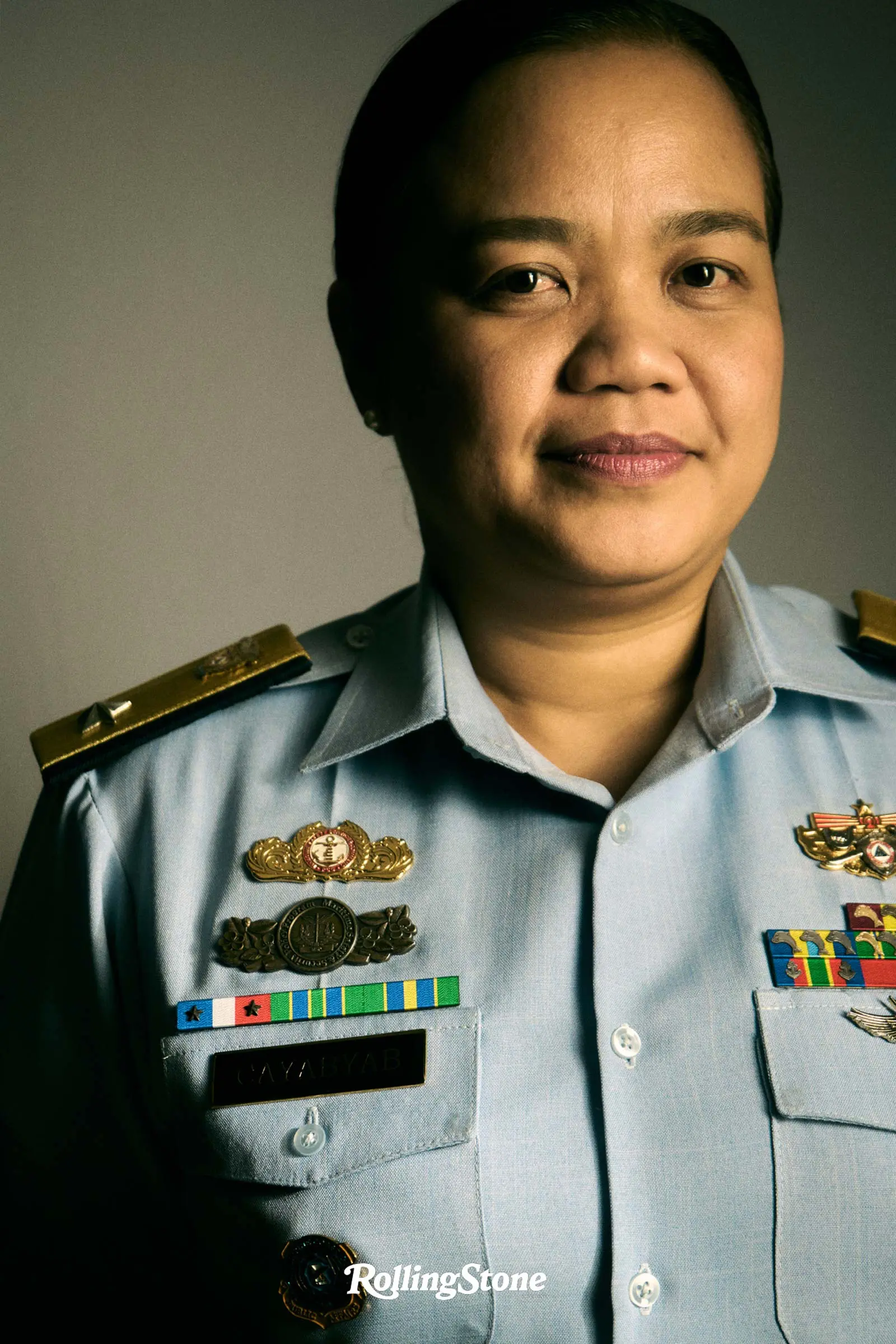
“May times na ako mismo, ayokong banggitin ‘yong casualty,” she says quietly. “Nalulungkot ako para sa mga pamilya, lalo na kung ongo- ing [ang] investigation at may mga missing pa.”
But she pushes through it, every time, by asking herself one question: “Imagine na ikaw ay mayroon ka ring hinahanap. Ano ba ang gusto mong marinig na sasabihin ng agency na iyon?”
She is also acutely aware that the space between what she knows and what she can say is where misinformation grows.
“‘Pag hindi tayo marunong mag-handle ng media, it’s another crisis after crisis,” she says. “Nakakatakot na ika-counter mo ‘yong mga mali o mga misinformation.” So she takes every interview she can, from 5 a.m. to 10 p.m. on bad days, every 15 minutes when things are at their worst. Because if the information does not come from her, it will come from somewhere else.
Outside the office, she and her husband — a fellow PCG officer she met through office banter and gentle teasing from colleagues — have built a marriage around the reality of the service. He had to board a vessel the day after their wedding. In a given year, they might see each other just for 30 days total. They compensate with scheduled check-ins every two to three hours, every day they are apart. They still celebrate their monthsary.
“Hindi dapat mawala ‘yong spark,” Cayabyab says with a smile.
She has no regrets, not about the odd hours, the spokesperson role, nor the seven times she said no before the yes that changed everything. “I love this job,” she says simply. “Kahit may mga ganoong challenges sa buhay naming mag-asawa.”
And when asked if she sees herself doing this for a few more years, Commodore Noemie Cayabyab doesn’t hesitate.
“Isang pribilehiyo para sa akin. Hindi lahat nabibigyan ng oportunidad,” she says. “Siguro ito na ‘yong para sa akin talaga.”
This story first appeared in the Rolling Stone Philippines’ Voices Issue, now available on Sari-sari Shopping and in major newsstands.
Get digital access to the latest issue here.